The verification-markup penalty in CBAM default-value filings
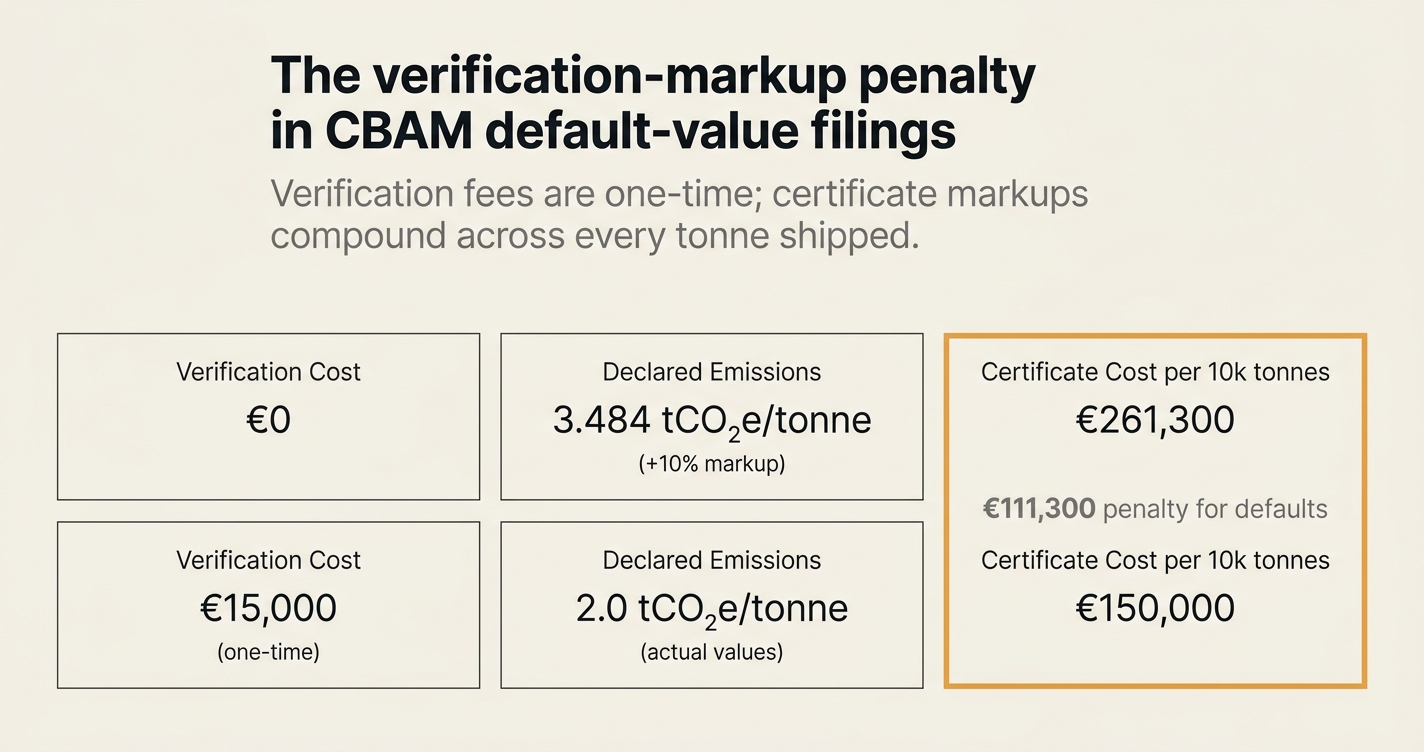
The verification-markup penalty in CBAM default-value filings
Here's the issue: non-EU exporters shipping steel, aluminum, cement, or fertilizers to the EU in 2026 face a choice between two compliance paths. The first path—providing actual installation-level emissions data—requires commissioning an accredited verifier, implementing a monitoring plan, and undergoing an on-site inspection. The second path—using default values published by the EU Commission—requires none of that. At first glance, the default path looks cheaper. No verifier fees, no site visits, no documentation burden. For a mid-sized steel exporter shipping 10,000 tonnes per year, the decision seems obvious: skip the €15,000 verification engagement and use the defaults.
However, a CBAM filing consists of two things: the declared emissions value per tonne, and the certificate cost that value generates when multiplied by the EU ETS price.
The declared emissions value has no direct cost to the exporter. The certificate cost—paid by the EU importer, then pushed back to the exporter through price negotiation or supplier substitution—is what determines market access. A filing with a lower declared value generates a lower certificate cost, and a lower certificate cost makes the exporter's goods cheaper at the EU border than competitors using higher values. The verification fee is a one-time cost. The certificate markup compounds across every tonne shipped.
While verification costs have remained stable at €5,000 to €25,000 per installation per year, default values now carry a punitive markup: 10% in 2026, 20% in 2027, 30% from 2028 onward, per Implementing Regulation 2025/2621. For Chinese blast-furnace basic-oxygen-furnace steel, the Commission default value is 3.167 tCO₂e per tonne. With the 2026 markup, the declared value becomes 3.484 tCO₂e per tonne. Modern installations typically produce actual emissions of 2.0 tCO₂e per tonne. At the current EU ETS price of approximately €75 per tCO₂, an exporter filing on defaults for 10,000 tonnes pays certificates on 34,840 tCO₂ rather than 20,000 tCO₂. The delta is €1,113,000 in additional certificate cost versus an estimated verification cost of €15,000. The markup, not the audit fee, is now the dominant cost.
How do you solve this? I think the framing needs to flip: verification is not an added compliance cost, it is a cost-reduction mechanism that unlocks a 40% discount on the certificate bill. The operators we work with treat verification as a pricing lever, not a regulatory formality. For now, the exporters who clear verification in 2027 for their 2026 data will hold a material pricing advantage over competitors still filing on defaults. The gap widens each year the markup escalates.
The shape of the argument, visualized below.
Myth 1: Default values are the low-cost compliance path
Reality: Default values eliminate verification fees but generate certificate costs 40–75% higher than actual values for efficient installations. Under IR 2025/2621, default values are calculated as the average emissions of the worst-performing 10% of EU producers, plus a markup of 10% in 2026, escalating to 30% by 2028. For Chinese BF-BOF steel, the 2026 default is 3.484 tCO₂e per tonne versus typical actual values of 2.0 tCO₂e per tonne. At €75 per tCO₂, a 10,000-tonne shipment using defaults incurs €261,300 in certificate costs, compared to €150,000 for actual values—a penalty of €111,300, or 7.4 times the median verification fee of €15,000.[1] The European Commission published these defaults on 31 December 2025 explicitly to create a financial incentive for producers to invest in monitoring and verification infrastructure.
Myth 2: EU importers will absorb the certificate cost
Reality: EU importers pass the certificate cost back to exporters through price renegotiation or supplier substitution. CBAM certificates are purchased by the importer but priced into the supply contract. Where an exporter provides only default-level data, the importer calculates the certificate cost delta between the exporter's declared value and competing suppliers' actual values, then demands a price reduction equal to that delta or shifts procurement to the lower-cost supplier. For a 10,000-tonne steel contract, the default-value penalty of €111,300 translates to €11.13 per tonne—a 0.6% margin hit on steel priced at €1,800 per tonne. EU importers are already incorporating CBAM cost into RFQ scorecards; exporters who cannot provide verified actual emissions are losing contracts they would have won on price alone in 2025.[2]
Myth 3: Verification can be deferred until the certificate purchase deadline
Reality: Verification audits the calendar year that already happened. The first CBAM certificates must be purchased by 31 May 2027, covering imports from 1 January to 31 December 2026. Verification reports for 2026 cannot be issued until 2026 is complete, and accredited verifiers require the monitoring plan, activity data, emission factors, and calculation methodology to have been in place throughout the reporting period. A producer who begins assembling documentation in 2027 is attempting to verify a year that was never instrumented. The verification body will issue a qualified opinion or reject the engagement entirely, forcing the importer onto default values retroactively. DNV and other accreditation bodies have stated that first-year verifications will include mandatory on-site inspections, with lead times of 8–12 weeks from engagement to report issuance.[3] Exporters who have not implemented monitoring plans by January 2026 cannot achieve verified actual values for their 2026 shipments.
Myth 4: National or industry-average emissions are acceptable substitutes for installation data
Reality: CBAM requires embedded carbon data at the installation level, not country-level or sector-level averages. An exporter who submits "Indian steel industry average" or "national grid emission factor" instead of installation-specific production and energy data will default to the EU's conservative default values. The monitoring methodology under IR 2025/2547 specifies that emissions must be calculated using a top-down approach: total installation emissions are measured, then attributed to production processes, then allocated to specific goods. Activity data must come from calibrated meters, fuel delivery invoices, and production logs traceable to the installation's own systems. Self-reported averages or third-party databases (such as ecoinvent or GREET) are not acceptable primary data sources for CBAM purposes.[1] Installations must generate their own data and have it verified by an accredited third party.
Myth 5: Verification is only required if the exporter wants to use actual values
Reality: Verification is required if the exporter wants to remain commercially competitive. The default-value path is legally compliant but economically unsustainable at any meaningful export volume. An installation producing 50,000 tonnes of steel per year and filing on defaults will generate €555,000 in excess certificate costs annually at current ETS prices, compounding to €1.67 million over three years as the markup escalates. A single verification engagement costs €15,000–€25,000 per installation per year, recovering its cost in the first 1,500 tonnes shipped. The payback period is measured in weeks, not years. EU importers are already requiring verified actual emissions as a condition of contract renewal; exporters who do not achieve verification by mid-2027 will find themselves priced out of the EU market regardless of their underlying production efficiency.[2]
Myth 6: Verification is a one-time event
Reality: Verification is an annual engagement covering each calendar year's production. The first verification report covers 2026 and must be issued in 2027. The second report covers 2027 and must be issued in 2028. Each engagement requires the verifier to re-examine the monitoring plan, re-audit the activity data, and re-issue findings for the new reporting period. However, installations that achieve a clean opinion in the first cycle typically see verification costs decline in subsequent cycles, as the monitoring infrastructure is already in place and the verifier's scope narrows to change management and sample testing. The up-front cost is the documentation build-out; the recurring cost is the annual audit, which stabilizes at €8,000–€12,000 per installation once the system is mature.[3] The alternative—remaining on default values—incurs escalating costs as the markup increases from 10% to 20% to 30% over the same period.
Myth 7: Verification is the exporter's responsibility
Reality: Verification is commissioned by the exporter but relied upon by the EU importer. The importer cannot surrender CBAM certificates based on unverified data; the verification report is the instrument that converts installation data into a legally acceptable declared value. However, the verifier must be independent of the producer and must have no financial interest in the compliance outcome, per Delegated Regulation 2025/2551. An exporter cannot self-verify, and an importer cannot rely on a verification report commissioned by a party with a commercial interest in the outcome. In practice, exporters commission the verification and provide the report to importers via the CBAM Registry or direct transmission. Importers review the report for completeness and accreditation status before accepting the declared value. The cost is borne by the exporter, the benefit accrues to both parties, and the importer has veto power over whether the declared value is acceptable.[4]
| Filing Path | Declared Emissions (tCO₂e/tonne) | Certificate Cost per 10,000 Tonnes (€75/tCO₂) | Verification Cost | Net Cost per 10,000 Tonnes | Payback Volume (tonnes) |
|---|---|---|---|---|---|
| Default values (2026) | 3.484 | €261,300 | €0 | €261,300 | N/A |
| Actual values (verified) | 2.0 | €150,000 | €15,000 | €165,000 | 1,500 |
| Default values (2028) | 4.117 | €308,775 | €0 | €308,775 | N/A |
"What that means is that unless a company has an actual site visit from an auditor in 2026 to verify that they are collecting and calculating [emissions correctly], they will be stuck with default values and the markup for the foreseeable future." — S&P Global Energy Transition, November 2025[5]
How Emission3 fits
Emission3 positions verification as a cost-reduction mechanism, not a compliance burden. We map which installations in your supply chain will use actual values, identify the monitoring gaps that would trigger verifier findings, and generate the documentation package (monitoring plan, calculation lineage, activity data logs, emission factor sources) that converts a 12-week verification engagement into a 3-week desk review. Our document-first ingestion platform connects your utility bills, fuel delivery invoices, production logs, and BoMs into a single audit trail, so every declared emission has a line-item evidence path from source document to filing. The verification body sees the same data structure your internal team uses, eliminating the reconciliation layer that typically doubles the audit cycle. For non-EU exporters shipping CBAM-covered goods in 2026, we treat the first verification as the design constraint: if the monitoring plan and data flow are built to pass audit on the first attempt, the recurring cost drops by 60% in subsequent years and the certificate savings compound indefinitely.
The decision point is now
The 2026 reporting year begins in three weeks. Verification audits what you did in 2026, and you cannot retrofit a monitoring plan after the year is over. Exporters who implement CBAM-compliant monitoring now will clear verification in 2027 and access actual-value pricing for their full 2026 shipment volume. Exporters who defer monitoring will file on defaults for 2026, pay the 10% markup, and face the same decision again in 2027 with a 20% markup. The markup escalates faster than most installations can build verification-ready systems from scratch. The cost curve has already crossed over: verification is now cheaper than defaults at any meaningful export volume, and the gap widens every year.
Book a CBAM readiness call to map your installation's monitoring gaps, quantify your certificate cost exposure under defaults versus actual values, and get a verification-readiness timeline before the 2026 reporting year closes.[6]
[1] https://co2-iq.com/en/eu-cbam-emissions [2] https://www.spglobal.com/energy/en/news-research/latest-news/energy-transition/111225-brussels-looks-to-tighten-cbam-verification-rules-mandates-site-visits-in-2026-draft-text [3] https://www.dnv.com/services/environmental-and-energy-certification/cbam-verification-carbon-border-adjustment-mechanism [4] https://normecverifavia.com/services/sustainability/carbon-border-adjustment-mechanism [5] https://www.spglobal.com/energy/en/news-research/latest-news/energy-transition/111225-brussels-looks-to-tighten-cbam-verification-rules-mandates-site-visits-in-2026-draft-text [6] /book-demo [7] /solutions/cbam [8] /product/ingestion
References & Sources
External Sources
- [1]EU CBAM Emissions Data: Monitoring, Reporting & Verification
Detailed methodology requirements for CBAM monitoring plans, including the top-down calculation approach and installation-level data requirements under IR 2025/2547.
- [2]EU CBAM for Steel Exports: Track Embedded Carbon & Ensure Compliance
Analysis of default value penalties for steel exporters, including the 15–25% cost disadvantage and commercial impact on procurement decisions.
- [3]CBAM Verification: Carbon Border Adjustment Mechanism | DNV
Overview of verification requirements from an accredited verifier, including on-site inspection mandates and timeline expectations for 2026 reporting.
- [4]CBAM Verification & Compliance | Normec Verifavia
Explanation of verifier independence requirements, accreditation standards, and the importer-exporter verification dynamic under DR 2025/2551.
- [5]Brussels looks to tighten CBAM verification rules
S&P Global reporting on mandatory site visit requirements for 2026 verification and the consequences of missing the first verification cycle.
Related Content
- [6]Book a CBAM readiness call
All customers start with a readiness call: we map suppliers, gaps, and implementation, no anonymous self-serve onboarding.
- [7]How Emission3 handles CBAM
Specific to CBAM exporters, shows the installation-data flow from utility bills and production logs to verification-ready documentation.
- [8]Document-first ingestion
How raw documents become audit-grade evidence with full calculation lineage and line-item traceability.