The verification cost penalty in CBAM default-value filings
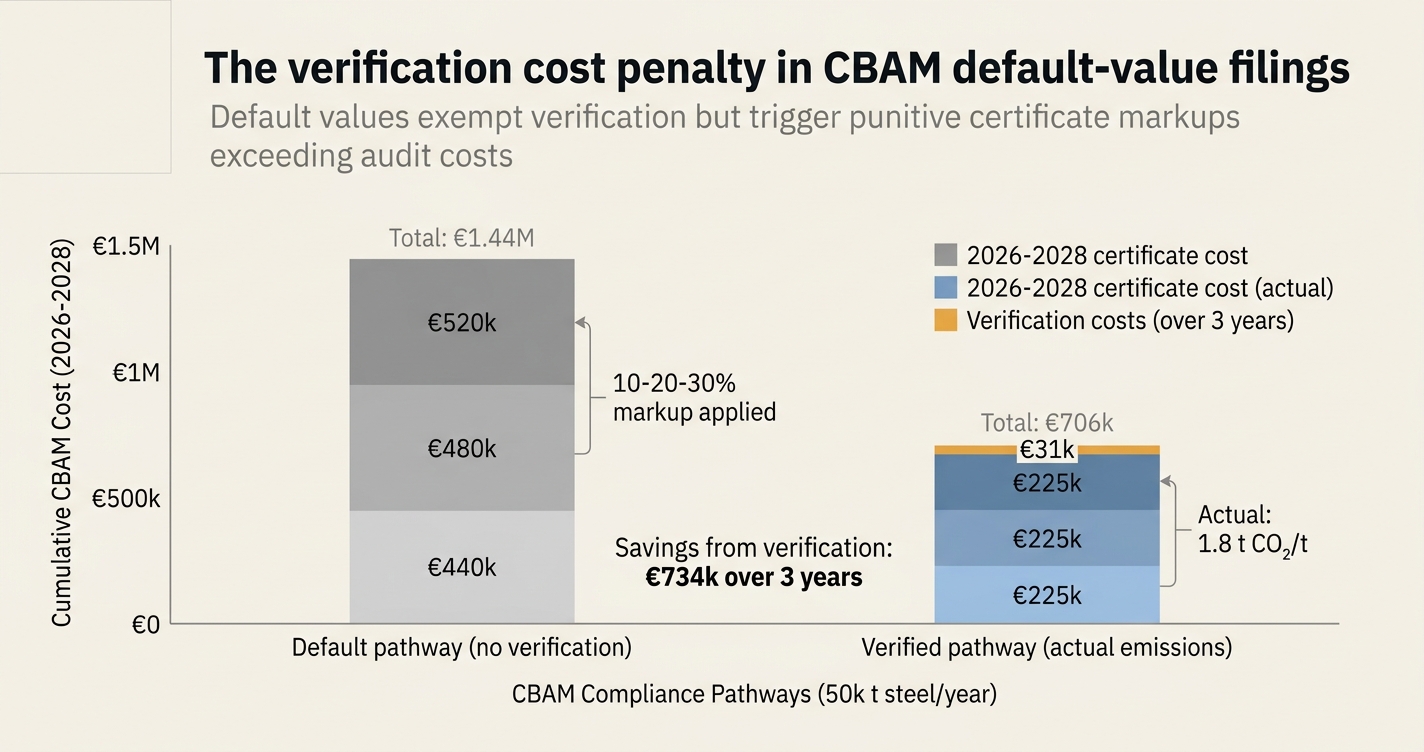
The verification cost penalty in CBAM default-value filings
Here's the issue: Non-EU exporters facing CBAM declarations in 2026 must choose between using default emission values published by the European Commission or providing verified actual emissions from their production installations. The default route appears simpler—no third-party verifier engagement, no on-site audit, no monitoring plan documentation. For many facilities shipping cement, steel, aluminium, fertilizers, or hydrogen into the EU, the path of least administrative resistance is to let the EU importer declare using country-average defaults and accept whatever certificate cost results. The apparent cost is zero upfront verification fees. The hidden cost is a punitive markup: 10% in 2026, 20% in 2027, and 30% from 2028 onward, applied to baseline emission intensities that are already set 2-5 times higher than efficient installations actually emit.
However, a CBAM filing consists of two things: the embedded emissions number reported in the annual declaration, and the verification status of that number. The first determines the baseline certificate liability. The second determines whether a markup applies.
The embedded emissions number on its own has no value in cost optimization. The verification status is what the CBAM certificate pricing mechanism is actually penalizing. Under Article 8 of Regulation (EU) 2023/956 as amended by Regulation (EU) 2025/2083, importers who use actual emissions must have that data verified by an accredited body registered in the CBAM Registry starting September 1, 2026[1]. Importers who use default values are exempt from verification but face the markup. The exemption is not a neutral choice—it is the mechanism by which the regulation incentivizes measurement and disclosure.
While verification has become more structured with accreditation requirements and registry timelines, the cost of not verifying has become exponentially more expensive. If an Indian steel installation emits 1.8 tonnes CO₂ per tonne of crude steel but the Commission default for India is 3.2 tonnes with a 10% markup (3.52 tonnes in 2026), and the importer ships 50,000 tonnes annually, the certificate cost differential is approximately €43,000 per year at €25 per CBAM certificate—before the markup escalates to 20% in 2027[2]. The verification engagement for that installation might cost €8,000-€15,000. By 2028, when the markup reaches 30%, the annual penalty for avoiding verification will exceed €60,000 for that single facility and product line.
How do you solve this? I think the operators we work with who have moved early into verification readiness in 2026 are not doing so to comply with a legal mandate—they are doing so because their EU customers have done the cost arithmetic and will not accept default-value shipments beyond Q2 2026. The commercial pressure precedes the regulatory penalty. For now, the verification market is undersupplied and lead times are long, which makes Q1 2026 the correct time to engage a verifier, even if your first formal declaration is not due until September 2027.
The shape of the argument, visualized below.
The default value vs actual emissions decision matrix
The table below compares the two compliance pathways available to non-EU exporters whose goods fall under CBAM scope. Each criterion reflects costs, risks, or administrative requirements that accumulate between January 2026 and the September 30, 2027 declaration deadline.
| Criterion | Default Values (No Verification) | Actual Emissions (Verified) | Advantage |
|---|---|---|---|
| Upfront verification cost (2026-2027) | €0 | €8,000–€15,000 per installation per verification cycle | Default |
| Certificate cost markup (2026) | +10% on baseline default emissions | 0% (actual emissions used as-is) | Actual |
| Certificate cost markup (2027) | +20% on baseline default emissions | 0% | Actual |
| Certificate cost markup (2028+) | +30% on baseline default emissions | 0% | Actual |
| Baseline emissions intensity | Country-average, typically 2-5x facility actual | Installation-measured, reflects efficiency | Actual |
| Annual certificate cost (50k tonne steel, €25/cert, India default 3.2 t CO₂/t) | ~€440,000 (2026), ~€480,000 (2027), ~€520,000 (2028) | ~€225,000 (assumes 1.8 t actual) | Actual |
| EU importer cost allocation pressure | High—importer seeks alternative suppliers with verified data | Low—importer can optimize certificate purchases | Actual |
| Verifier engagement timeline | None required | Must engage by Q2 2026 for Sept 2027 declaration | Default |
| On-site audit requirement | None | Physical audit of production installation | Default |
| Monitoring plan and emissions report | Not required | Required per IR 2025/2547 | Default |
| Precursor emissions transparency | Uses default for all upstream inputs (further markup) | Can use supplier actual data to lower total embedded emissions | Actual |
| Commercial risk (loss of EU customers) | High if competitors provide verified data | Low | Actual |
The crossover point—where cumulative verification costs are recovered by certificate savings—occurs in year one for most installations shipping more than 20,000 tonnes annually into the EU, and within six months for high-volume exporters[3].
Why default values inflate certificate liability by design
The European Commission publishes default emission values under Implementing Regulation (EU) 2025/2621, broken down by country, production route, and CN code. These defaults are not neutral estimates. They are set at the country-level average emission intensity, deliberately higher than the performance of efficient facilities, and then marked up by an additional percentage each year to create a financial incentive for measurement and verification.
For example:
- Indian cement (ordinary Portland, dry kiln): default baseline approximately 0.92 t CO₂ per tonne clinker, before markup.
- Turkish rebar steel (electric arc furnace): default baseline approximately 0.58 t CO₂ per tonne steel, before markup.
- Chinese aluminium (primary, coal-based electricity): default baseline approximately 16.8 t CO₂ per tonne aluminium, before markup.
A facility operating below these averages—due to newer equipment, renewable electricity purchasing, or process optimization—pays a certificate cost anchored to emissions it did not produce. The markup then applies on top of that already-inflated baseline. By 2028, a facility emitting 40% below the country average will be purchasing certificates as if it emits 91% of the country average (the baseline less 40% efficiency gain, plus 30% markup). This is the intended cost structure: the regulation uses financial pressure to drive data transparency[4].
"Importers who rely on default values published under Implementing Regulation (EU) 2025/2621 are exempt from third-party verification. Default values are set at the average emission intensity for the country and product type, with a mark-up of 10% in 2026, 20% in 2027, and 30% from 2028 onward. The exemption from verification for default users comes at a financial cost: the punitive mark-up is designed precisely to incentivize importers to invest in actual measurement and verification rather than accepting the default penalty."[1]
The markup is not an administrative error. It is the policy instrument.
The verification timeline bottleneck in 2026
Third-party verification under CBAM follows principles similar to EU ETS Monitoring and Reporting Regulation (MRR) and Accreditation and Verification Regulation (AVR). Verifiers must be accredited under ISO 14065 and registered in the CBAM Registry, which opened for registrations on September 1, 2026[1]. The verification cycle for a 2026 calendar year production period begins in early 2027 and must be completed before the September 30, 2027 annual declaration deadline.
This creates a 21-month window from January 2026 to September 2027 in which exporters must:
- Develop an installation-level monitoring plan per IR 2025/2547.
- Collect emissions data across the full 2026 calendar year.
- Compile an operator's emissions report.
- Engage an accredited verifier.
- Host an on-site audit.
- Receive a verification report.
- Transmit verified data to the EU importer in time for the importer to file the annual declaration.
The bottleneck is verifier capacity. As of Q1 2026, fewer than 200 verifiers globally are accredited and registered in the CBAM Registry for non-EU jurisdictions. India, Turkey, China, and Ukraine—four of the highest-volume CBAM exporting countries—have a combined estimated 12,000+ installations requiring verification for steel, cement, aluminium, and fertilizers alone[5]. Average engagement lead time is 12-16 weeks from initial contact to contract signature, and audit scheduling extends another 8-12 weeks depending on installation complexity and verifier travel logistics.
Exporters who wait until Q4 2026 to engage verifiers will not receive verification reports in time for the September 2027 deadline. Their EU importers will be forced to declare using default values for the 2026 reporting year, triggering the 10% markup and likely triggering contract renegotiations or supplier substitutions.
Precursor emissions and the upstream data cascade
CBAM embedded emissions are calculated using a top-down methodology: total installation emissions are attributed to production processes, then converted to specific embedded emissions per tonne of output. For many goods, 40-70% of total embedded emissions come not from the final production installation but from precursor materials—the upstream inputs purchased from other suppliers[6].
Examples:
- Steel production: iron ore pellets, scrap metal, electrode carbon.
- Cement: clinker (if purchased rather than produced on-site).
- Aluminium: alumina, carbon anodes.
- Fertilizers: ammonia (for urea or nitrates).
If the final goods producer uses default values for its own direct emissions, the entire supply chain defaults cascade. If the producer uses actual verified emissions for its direct emissions but cannot obtain verified precursor data from its suppliers, it must apply default values to the precursor portion of the calculation. Those defaults also carry the annual markup.
This creates a two-tier verification problem. An Indian steel mill that completes its own verification but sources iron ore pellets from a supplier who has not completed verification will still face inflated embedded emissions totals due to the precursor default. The EU importer will see lower certificate costs than a fully-defaulted competitor, but higher costs than a competitor whose entire supply chain is verified. Commercial leverage flows upstream: EU importers pressure their direct suppliers to verify, and those suppliers pressure their precursor suppliers to verify. By mid-2027, tier-2 supplier verification will become a contract requirement in high-volume CBAM supply chains[7].
How Emission3 fits into CBAM verification readiness
Emission3 is positioned as productized CBAM implementation supported by compliance infrastructure. The platform ingests source documents—energy invoices, utility bills, purchase orders for precursors, production logs—and converts them into installation-level emissions calculations with full lineage from document to declaration. Every emissions figure is reproducible, with evidence packs structured for verifier review.
For non-EU exporters preparing for verification, the workflow is:
- Document ingestion: Upload utility bills, fuel receipts, and supplier invoices for the 2026 production year.
- Monitoring plan alignment: The platform structures data fields to match IR 2025/2547 requirements (installation ID, production process, emissions source, calculation factor).
- Operator's emissions report generation: Emission3 compiles the report in the format verifiers expect, with line-item breakdowns and precursor emissions separated from direct emissions.
- Pre-verification audit: Before engaging the verifier, the platform flags missing data, default value assumptions, or calculation discrepancies that would trigger verifier queries.
- Verifier handoff: The emissions report and evidence pack are exported as a PDF bundle, which the verifier uses as the basis for the on-site audit.
The platform does not replace the verifier. It replaces the manual Excel-and-email workflow that most facilities use to prepare for verification, and which most verifiers reject as insufficient audit trail. Emission3 customers typically complete verifier handoff in 6-8 weeks from initial data upload, compared to 16-20 weeks for manual preparation[8].
The 2027 compliance arithmetic for exporters
For a non-EU steel exporter shipping 50,000 tonnes annually into the EU, the cost comparison between default and verified pathways over three years is:
Default pathway (no verification):
- 2026 certificate cost: 50,000 t × 3.52 t CO₂/t (3.2 default + 10%) × €25 = €440,000
- 2027 certificate cost: 50,000 t × 3.84 t CO₂/t (3.2 default + 20%) × €25 = €480,000
- 2028 certificate cost: 50,000 t × 4.16 t CO₂/t (3.2 default + 30%) × €25 = €520,000
- Three-year total: €1,440,000
- Verification cost: €0
- Net cost: €1,440,000
Verified pathway (actual emissions 1.8 t CO₂/t):
- 2026 certificate cost: 50,000 t × 1.8 t CO₂/t × €25 = €225,000
- 2027 certificate cost: 50,000 t × 1.8 t CO₂/t × €25 = €225,000
- 2028 certificate cost: 50,000 t × 1.8 t CO₂/t × €25 = €225,000
- Three-year total: €675,000
- Verification cost (one-time setup + annual): €15,000 (2026) + €8,000 (2027) + €8,000 (2028) = €31,000
- Net cost: €706,000
Savings from verification: €734,000 over three years, or approximately €245,000 annually. The first-year payback on verification investment is 1.5 months of certificate purchases.
These figures assume stable CBAM certificate pricing at €25. As of April 2026, EU ETS allowance prices (to which CBAM certificates are linked) are trading between €60-€75. If CBAM certificates track closer to €65, the three-year savings from verification exceed €1.9 million for this single installation and product line[2].
Why EU importers will not accept default values beyond Q2 2026
The financial liability for CBAM certificates falls on the EU importer, not the exporter. However, the data required to minimize that liability originates at the exporter's installation. This creates a principal-agent problem: the party with the lowest cost of producing verified data (the exporter) is not the party bearing the cost of not producing it (the importer).
In practice, this misalignment resolves through contract terms. EU importers with multiple sourcing options will preferentially contract with suppliers who provide verified actual emissions, because those contracts carry lower certificate liability. Importers locked into single-source or long-term supply agreements will renegotiate pricing to allocate the certificate cost differential back to the supplier. By Q2 2026, most high-volume EU importers of steel, cement, and aluminium had already issued supplier notifications requiring verified data for 2026 shipments, with contractual penalties or price adjustments for non-compliance[3].
Exporters who delay verification are not avoiding a regulatory obligation—they are accepting a commercial penalty that their customers will enforce through procurement decisions.
What to do now
If you are a non-EU exporter of CBAM goods and have not yet engaged a verifier, the action list for May 2026 is:
- Identify your installations in scope: List every production facility that manufactures goods covered under CBAM (steel, cement, aluminium, fertilizers, hydrogen, electricity). Separate by CN code and production route.
- Request default values from the Commission: Download the applicable default emission intensities for your country and product type from IR 2025/2621. Calculate your 2026 certificate cost exposure assuming defaults + 10% markup.
- Estimate your actual emissions: If you have utility bills, fuel receipts, or production logs for 2025, calculate installation-level emissions using IPCC or GHG Protocol factors. Compare to defaults.
- Calculate the break-even point: Multiply the emissions difference (default minus actual) by your annual shipment volume and the current CBAM certificate price. Subtract estimated verification cost (€8,000-€15,000). If the result is positive, verification pays for itself in year one.
- Engage a verifier by end of May 2026: Search the CBAM Registry for accredited verifiers operating in your jurisdiction. Request proposals from 2-3 firms. Contract signature should occur by July 2026 to allow time for monitoring plan approval and 2026 data collection.
- Notify your EU customers: Confirm that verified data will be available for the September 2027 declaration. Request any supplier data templates or formats they require.
The verification decision is not a compliance question—it is a cost-of-goods question. Exporters who treat it as the former will miss the commercial deadline. Exporters who treat it as the latter will engage verifiers in Q2 2026, before capacity constraints make September 2027 delivery impossible.
How Emission3 supports the CBAM verification workflow
Emission3 does not perform third-party verification—that is the legal role of accredited verifiers under ISO 14065. What the platform does is prepare the upstream data pipeline so that verifiers can complete their engagement in weeks rather than months.
The workflow:
- Book a CBAM readiness call: We map your installations, shipment volumes, and current data infrastructure. We calculate your default-versus-actual cost exposure and identify gaps in monitoring plan documentation[9].
- Upload source documents: Utility bills, fuel invoices, purchase orders for precursors, production logs. The platform parses line items and converts them into emissions factors per IR 2025/2547.
- Generate the operator's emissions report: Emission3 compiles the report structure verifiers expect, with breakdowns by production process, emissions source, and precursor vs direct emissions.
- Pre-verification review: The platform flags missing data, default assumptions, or calculation discrepancies before you hand off to the verifier.
- Export evidence pack: PDF bundle with emissions report, supporting invoices, and calculation lineage. This is what the verifier audits.
Customers typically move from initial data upload to verifier-ready emissions report in 6-8 weeks. The verifier then conducts the on-site audit, reviews the evidence pack, and issues the verification report—usually 8-12 additional weeks. Total timeline from Emission3 onboarding to verified data delivery: 14-20 weeks, which fits comfortably within the September 2027 declaration deadline if started in May 2026.
If you are evaluating whether verification is worth the cost, the readiness call is the correct starting point. We do not onboard customers into the platform until we have quantified the certificate cost differential and confirmed that verified data will reduce their annual CBAM liability by more than the cost of producing it. CBAM is not an ESG disclosure—it is a tariff mechanism. The business case must close before the workflow begins.
Book a CBAM readiness call to map your installations, calculate your default-versus-actual exposure, and determine whether verification delivers positive ROI for your 2026 shipments[9].
References & Sources
External Sources
- [1]CBAM Verification 2026: What Verifiers Check and How to Find One
Official guidance on CBAM verification requirements, verifier registration timeline, and the default value markup structure (10%, 20%, 30%) designed to incentivize actual emissions measurement.
- [2]EU CBAM 2026 Explained: Default Values, EU-Approved Verification & Carbon Costs
Video explainer detailing exporter responsibilities, verification workflow, precursor data requirements, and quantified impact of default values on final CBAM certificate costs.
- [3]What EU Importers and Non-EU Manufacturers Need to Understand About CBAM Verification
SCS Global analysis of definitive CBAM period changes, voluntary pre-verification, and the 30 September 2027 declaration timeline for verified emissions data.
- [4]Understanding CBAM Regulation (Carbon Border Adjustment Mechanism)
Technical overview of CBAM data requirements, the shift from equivalent methods to installation-specific data in 2026, and the verification principles aligned with EU ETS.
- [5]CBAM: Your Guide to the EU Carbon Border Adjustment Mechanism
Comprehensive guide covering CBAM's impact on producers and importers, new EU benchmark values, cost exposure modeling, and supply chain optimization strategies.
- [6]EU CBAM Emissions Data: Monitoring, Reporting & Verification
Detailed breakdown of monitoring methodologies under IR 2025/2547, operator's emissions report structure, and the distinction between actual values and default values with markup.
Related Content
- [7]The tier-2 supplier data gap in California SB 253 Scope 3 filings
Analysis of upstream data cascade problems in Scope 3 disclosure, directly applicable to CBAM precursor emissions verification requirements.
- [8]How Emission3 handles CBAM
Platform overview of CBAM-specific workflows: installation-level data ingestion, monitoring plan alignment, operator's emissions report generation, and verifier handoff.
- [9]Book a CBAM readiness call
All Emission3 engagements start with a readiness call where we map installations, calculate default-versus-actual cost exposure, and confirm ROI before onboarding.