The tier-2 data gap in supplier-specific Scope 3 Category 1 emissions calculation
The tier-2 data gap in supplier-specific Scope 3 Category 1 emissions calculation
Here's the issue: moving from spend-based estimation to supplier-specific primary data in Scope 3 Category 1 (Purchased Goods and Services) feels like the obvious answer to low-quality disclosure. Procurement teams run engagement campaigns, suppliers return PCF declarations, and reported emissions shift from industry averages to facility-specific values. The disclosed number now has a name attached to it.
However, Category 1 consists of two things: tier-1 supplier engagement and tier-2 emissions allocation. Tier-1 engagement is the process of collecting data from direct suppliers—the invoices, product carbon footprints, or facility-level disclosures. Tier-2 emissions allocation is the upstream carbon embedded in the materials, components, and services your tier-1 suppliers procured to produce what they sold to you.
Tier-1 engagement on its own has no value under limited assurance. Tier-2 emissions allocation is what the auditor is actually asking for when they review your Scope 3 methodology documentation. A tier-1 supplier can provide a PCF for the steel they sold you, but if that PCF is based on spend-based estimates for the iron ore, energy, and logistics inputs they purchased, your reported number is still grounded in industry averages—just one supply layer deeper.
While tier-1 engagement has become cheaper—PCF calculators, supplier portals, and Carbon Data Networks reduce the cost per supplier contact—tier-2 emissions allocation has become more expensive. If your tier-1 suppliers collectively represent 70 percent of spend but their upstream data is spend-based, the assurance gap for your Category 1 total might be larger than if you had used spend-based estimation across the board and documented the limitations transparently. Auditors price for methodology consistency and data lineage, not supplier response rates.
How do you solve this? I think the operators we work with are starting to treat tier-2 visibility as a procurement qualification, not a sustainability side request. For now, that means prioritizing suppliers who can provide PCFs with documented upstream primary data coverage, rather than prioritizing suppliers who provide any PCF at all. The cost of assurance escalation when tier-2 data is missing often exceeds the cost of switching to a supplier who can document their upstream emissions.
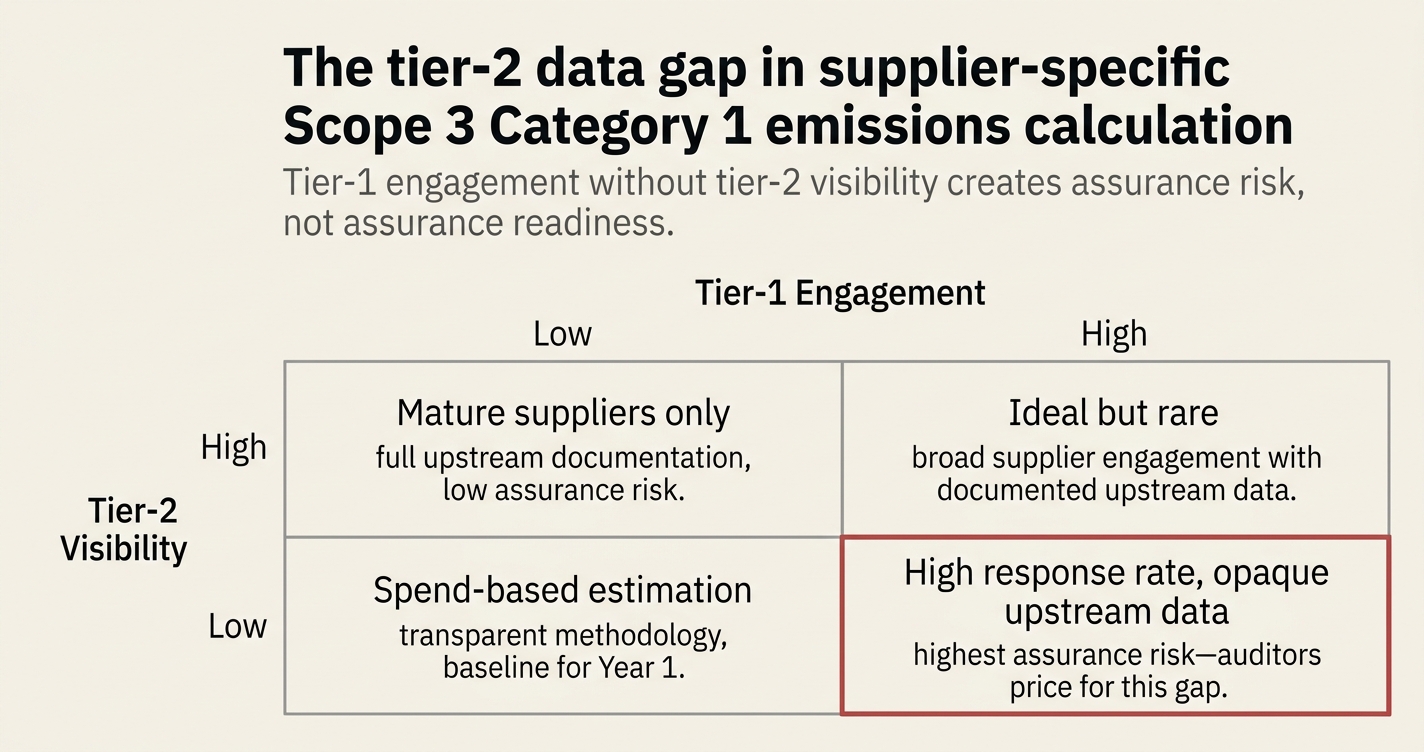
The shape of the argument, visualised below.
Myth 1: Primary supplier data always improves Scope 3 accuracy
Reality: Primary data from tier-1 suppliers improves accuracy only if those suppliers also use primary data for their upstream emissions. A 2026 analysis by EcoVadis and Watershed found that when tier-1 suppliers calculate their own product carbon footprints using spend-based estimation for purchased materials, the resulting PCF can be less accurate than a well-calibrated industry average applied at the buyer level [1]. The reason: supplier-specific spend-based estimates compound estimation error across two calculation layers (tier-1 applying averages to tier-2, then you applying tier-1's output). One Normative customer case study showed that switching from spend-based to supplier activity data increased reported Category 1 emissions from 41,496 to 65,734 tonnes CO2e—not because performance worsened, but because better accounting revealed underestimation [2].
Myth 2: High supplier response rates equal good Scope 3 data
Reality: Response rate measures engagement success, not data quality. A procurement team can achieve 80 percent supplier response on a PCF request and still have zero tier-2 visibility if all responding suppliers submit PCFs calculated using regional spend-based averages. IntegrityNext's 2026 supplier engagement research found that "meaningful emissions reductions typically emerge over several years" because early-stage supplier data often lacks the upstream granularity needed for reduction prioritisation [3]. Assurance standards such as ISAE 3410 and ISAE 3000 (applied under AASB S2, UK SRS, and CSRD) evaluate data lineage and methodology consistency, not supplier participation counts. An auditor will flag a portfolio of tier-1 PCFs that trace back to unverifiable tier-2 estimates.
Myth 3: Spend-based estimation is always less accurate than supplier-specific data
Reality: Spend-based estimation using high-resolution emission factors (such as EXIOBASE or BEIS supply chain factors) can outperform supplier-specific data when the supplier's own methodology is poorly documented or based on outdated assumptions. Eco-shaper's analysis of Australia's AASB S2 Group 2 reporting requirements notes that "spend-based estimates are accepted in Year 1 but the expectation is clear movement toward supplier-specific data by Year 2"—the implication being that regulators recognise spend-based as a transparent, reproducible baseline [4]. The UK Sustainability Reporting Standards, published in February 2026 and aligned with IFRS S1 and S2, similarly accept spend-based data as a starting point while requiring disclosure of estimation uncertainty and plans to improve data granularity [4]. The error in spend-based estimation is known and can be quantified; the error in poorly documented tier-1 PCFs is opaque.
Myth 4: Supplier engagement is a sustainability function, not a procurement function
Reality: Effective Scope 3 supplier engagement is a procurement function with sustainability inputs. Green Project Technologies' 2025 analysis argues that "forward-looking procurement teams are using this data not just for compliance, but to inform sourcing decisions and support suppliers with the biggest opportunities for reduction" [5]. When supplier carbon data becomes a contract qualification criterion—as it has for major CPG brands requiring PCF data as a mandatory procurement requirement—procurement owns the engagement cadence, penalty clauses, and timeline [7]. Sustainability teams provide the methodology, auditor requirements, and assurance context, but procurement controls whether tier-2 visibility becomes a supplier KPI or remains a voluntary side request.
Myth 5: PCF declarations from tier-1 suppliers are auditor-ready
Reality: A PCF declaration is auditor-ready only if it includes methodology documentation, emission factor sources, and upstream data lineage for significant inputs. Auria's 2025 Corporate Sustainability Report states that "Purchased Goods and Services (Category 1) remains the primary driver of Scope 3 emissions" and notes that "data coverage and accuracy continue to improve as part of ongoing efforts to enhance primary data collection and supplier engagement" [6]. The phrase "data coverage and accuracy continue to improve" signals that reported PCFs in 2025 were not yet at limited assurance quality. Auditors under CSRD ESRS E1, AASB S2, and California SB 253 require traceability to source documents or verifiable calculation inputs. A tier-1 PCF without upstream allocation detail creates an assurance gap, not assurance readiness.
Myth 6: Carbon Data Networks solve the tier-2 data gap
Reality: Carbon Data Networks (such as EcoVadis, PACT, and others) solve the data exchange problem—they standardise PCF formats, enable interoperability, and reduce duplicate supplier requests—but they do not solve the tier-2 data quality problem unless the PCFs exchanged include upstream primary data. EcoVadis's March 2026 partnership with Watershed to "close the Scope 3 data gap" explicitly positions the EcoVadis PCF Calculator as "powered by suppliers' primary data" [8]. The implication: a Carbon Data Network that routes spend-based tier-1 PCFs at scale is a logistics improvement, not a data quality improvement. The tier-2 gap persists unless the network enforces upstream data standards.
Myth 7: Assurance costs are proportional to the number of suppliers engaged
Reality: Assurance costs are proportional to the number of suppliers with incomplete or undocumented upstream data. A portfolio of 500 tier-1 suppliers providing PCFs with documented tier-2 data lineage is cheaper to audit than a portfolio of 50 tier-1 suppliers providing PCFs based on regional averages. The auditor's sample size is set by methodology risk, not supplier count. IntegrityNext's supplier engagement framework notes that "while early wins are possible, meaningful emissions reductions typically emerge over several years" [3]—the timeline reflects the difficulty of backfilling tier-2 data retroactively. Teams that accept undocumented tier-1 PCFs in 2025 to meet a response-rate KPI often face higher 2026 assurance fees than teams that used spend-based estimation transparently and planned a phased transition to tier-2 primary data.
Summary: The tier-2 visibility hierarchy
| Data Type | Tier-1 Engagement | Tier-2 Visibility | Assurance Risk | 2026 Use Case |
|---|---|---|---|---|
| Spend-based (buyer-applied) | None required | Documented industry average | Low (known estimation uncertainty) | Baseline for Wave 2 CSRD, SB 253 Year 1 |
| Tier-1 PCF (spend-based upstream) | High (supplier portal, PCF request) | None (tier-2 = regional average) | High (opaque upstream assumptions) | Avoid unless methodology doc is explicit |
| Tier-1 PCF (partial tier-2 primary) | Medium (targeted supplier subset) | Partial (hot-spot materials only) | Medium (auditor will flag coverage gaps) | CSRD limited assurance, SB 253 Year 2 |
| Tier-1 PCF (full tier-2 primary) | Low (mature suppliers only) | Full (upstream allocation documented) | Low (lineage to source documents) | CSRD reasonable assurance transition |
"By fostering collaboration and providing practical tools, this approach not only streamlines data collection but also strengthens supplier relationships, drives shared sustainability goals, and helps create a more resilient, transparent supply chain." — Green Project Technologies, Supplier Engagement Analysis [5]
The table shows that tier-1 engagement effort (high supplier response rates) does not correlate with low assurance risk. The assurance-ready path is low tier-1 engagement volume with high tier-2 visibility—fewer suppliers, better upstream data—not high tier-1 engagement volume with opaque upstream data.
How Emission3 fits
Emission3 is built for the tier-2 visibility problem. The platform classifies supplier invoices, bills of material, and utility bills into line-item emissions allocations, then traces each allocation back to a source document or calculation input. When a tier-1 supplier provides a PCF, Emission3's document classification engine maps the PCF to the purchased goods line items it covers, then flags any line items where the PCF's upstream allocation is missing or spend-based. The result is a Category 1 total with explicit tier-2 coverage documentation: you can show an auditor which purchased materials have primary upstream data and which remain estimated.
For procurement teams running supplier engagement campaigns, Emission3 integrates with existing PCF request workflows (EcoVadis, PACT, CDP Supply Chain) but adds a tier-2 data quality filter: when a supplier submits a PCF, the platform checks whether the PCF's upstream allocation is documented. If the PCF is spend-based, Emission3 flags the gap and calculates the cost of assurance escalation (auditor sample size increase, methodology documentation rework, etc.) versus the cost of sourcing from a supplier with better upstream data. That trade-off becomes a procurement decision, not a sustainability report footnote.
For CFOs budgeting 2026 assurance fees under CSRD ESRS E1, AASB S2, or California SB 253, Emission3 provides a Category 1 assurance readiness score: the percentage of spend covered by tier-1 PCFs with documented tier-2 primary data. That percentage determines the auditor's methodology risk assessment and sample size. A score below 50 percent typically triggers a scope expansion or qualification; a score above 70 percent positions the engagement as limited assurance with a path to reasonable assurance. The platform exports the score, the supporting evidence pack, and the lineage documentation as a single auditor handoff.
Call to action
If you are running a Scope 3 Category 1 supplier engagement program in 2026, the tier-2 data gap is the difference between a compliance report and an assurance-ready filing. Book a CBAM readiness call with Emission3 [9]—we will map your tier-1 supplier portfolio, identify which PCFs have documented upstream data, and calculate the assurance cost difference between your current supplier mix and a tier-2-ready supplier mix. The call is not a product demo; it is a readiness diagnostic. All customers start with a readiness call: we map suppliers, gaps, and implementation, no anonymous self-serve onboarding.
If you are evaluating whether to accept tier-1 PCFs without upstream documentation, read our analysis of the population-completeness gap in ISAE 3410 limited assurance engagements for Scope 3 emissions [10]. That post explains why auditors price for data lineage, not supplier response rates, and how incomplete tier-2 data increases sample size and audit fees even when tier-1 engagement is high.
References & Sources
External Sources
- [1]EcoVadis and Watershed partner to close the Scope 3 data gap
Analysis of how tier-1 PCFs based on spend-based upstream data can be less accurate than well-calibrated industry averages applied at the buyer level, March 2026.
- [2]Scope 3 Supplier Engagement: Primary Carbon Data - Normative
Normative case study showing Category 1 emissions increase from 41,496 to 65,734 tonnes CO2e when switching from spend-based to supplier activity data, demonstrating improved accounting rather than worsening performance.
- [3]Supplier Engagement Strategy for Reducing Scope 3 Emissions
IntegrityNext analysis of supplier engagement timelines, noting that meaningful emissions reductions typically emerge over several years due to upstream data granularity challenges.
- [4]Scope 3 Spend-based data vs Supplier-specific: Which to use
Eco-shaper analysis of AASB S2 Group 2 and UK SRS requirements for Scope 3 data quality progression from spend-based to supplier-specific data.
- [5]Traversing the Primary Data Chasm: Supplier Engagement: A Win-Win for Scope 3 Emissions
Green Project Technologies analysis of procurement-led supplier engagement and the shift to using carbon data for sourcing decisions, July 2025.
- [6]2025 Corporate Sustainability Report - Auria
Auria case study showing Category 1 as primary Scope 3 driver and noting ongoing improvements in data coverage and supplier engagement, 2025.
- [7]CPG scope 3 emissions suppliers: Why your carbon data determines your contracts
CO2 AI analysis of major CPG brands making carbon data a mandatory procurement requirement, transforming supplier qualification criteria, February 2026.
- [8]EcoVadis and Watershed partner to close the Scope 3 data gap
EcoVadis PCF Calculator launch positioning suppliers' primary data as the foundation for Carbon Data Network quality, March 2026.
Related Content
- [9]Book a CBAM readiness call
All customers start with a readiness call: we map suppliers, gaps, and implementation, no anonymous self-serve onboarding.
- [10]The population-completeness gap in ISAE 3410 limited assurance engagements for Scope 3 emissions
Analysis of how auditors price for data lineage and population completeness rather than supplier response rates in Scope 3 limited assurance.