The supplier primary-data timing gap in 2026 Scope 3 Category 1 procurement compliance
The supplier primary-data timing gap in 2026 Scope 3 Category 1 procurement compliance
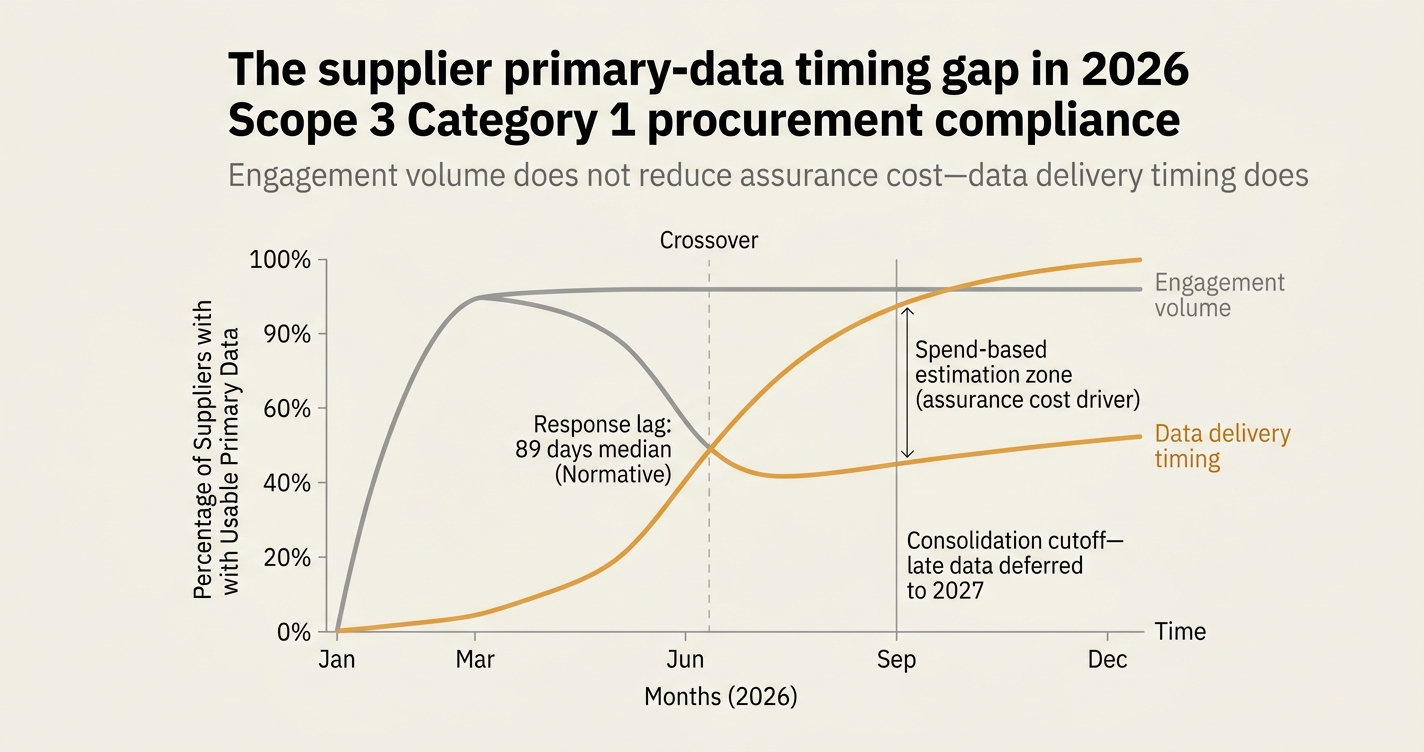
Here's the issue: procurement leaders launching supplier engagement programs in early 2026 face a calendar problem disguised as a data problem. The timeline looks manageable—request emissions data in Q1, consolidate responses by Q3, file disclosures in Q4. However, this assumes suppliers respond on your schedule. According to CDP's 2025 Supply Chain report, fewer than half of companies requesting environmental data from suppliers actually receive it [1]. For California Senate Bill 253 (SB 253) and Corporate Sustainability Reporting Directive (CSRD) filers with December year-ends, late supplier responses do not delay the deadline—they force you into spend-based estimation, which triggers higher assurance fees and limits procurement's ability to demonstrate carbon performance improvements.
However, Scope 3 Category 1 disclosure consists of two things: supplier engagement (the outreach, portal access, and data request workflow) and data delivery timing (when usable primary data actually arrives in your system).
Supplier engagement on its own has no value. Data delivery timing is what the auditor is actually verifying. A supplier who commits to provide data in February but delivers in October misses your Q3 consolidation window. You file using industry averages for that supplier's spend, the auditor flags it as estimated, and your assurance engagement escalates from limited to reasonable procedures for that category. Under CSRD's European Sustainability Reporting Standards (ESRS) E1, reasonable assurance on Scope 3 can add 40-60% to audit fees compared to limited [2].
While supplier engagement tools have become cheaper—Carbon Disclosure Project (CDP) Supply Chain memberships, procurement portal add-ons, and supplier collaboration platforms are now standard budget lines—data delivery timing has become more expensive. If you engage 200 suppliers in January but only 85 respond by your July consolidation cutoff, the remaining 115 get modelled using spend-based factors. For a procurement team managing €500 million in Category 1 spend, that coverage gap might represent 23,000 tonnes of carbon dioxide equivalent (CO2e) disclosed as estimated rather than supplier-specific. When the auditor samples your Scope 3 population, every estimated line item increases the likelihood of qualification or scope limitation language in the assurance opinion.
How do you solve this? I think the answer is to treat data delivery timing as the critical path, not supplier engagement volume. The operators we work with set a data arrival deadline 90 days before their disclosure filing date, then reverse-engineer the engagement timeline from that fixed point. For a December 31 year-end with a March 31 filing deadline, that means suppliers must deliver data by December 31 of the reporting year—which means initial outreach happens in Q2 of the reporting year, not Q1 of the following year. For now, this approach requires treating supplier engagement as a mid-year procurement priority, not a year-end sustainability project.
The shape of the argument, visualised below.
The 2026 regulatory countdown for procurement leaders
The table below maps every major Scope 3 compliance milestone between now and December 2026, with specific dates where available. Bolded rows indicate deadlines already missed for calendar-year 2025 reporting.
| Date | Milestone | Regulation | Implication for procurement |
|---|---|---|---|
| 15 January 2026 | SB 253 guidance clarification window closes | California SB 253 | Missed: California Air Resources Board (CARB) published final methodological guidance in December 2025. Procurement teams that waited for this guidance to finalise supplier engagement programs are now 6 weeks behind the timeline needed for July data consolidation. |
| 31 March 2026 | First voluntary CSRD reports due (FY2025) | EU CSRD | Companies opting for early adoption must file Scope 3 disclosures covering calendar year 2025. Tier-1 supplier data requests issued after January 2026 will not yield responses in time for March filing. |
| 30 April 2026 | CDP Supply Chain deadline (2025 data) | CDP | Supplier responses requested through CDP Supply Chain portals close. Any supplier who has not submitted by this date contributes zero primary data to your 2025 Scope 3 inventory. |
| 31 May 2026 | SB 253 assurance provider selection cutoff | California SB 253 | California filers must engage a limited assurance provider by mid-year to allow time for Q3-Q4 fieldwork. Providers reviewing methodology in May will flag any reliance on spend-based estimation for Category 1, triggering scope expansion discussions. |
| 30 June 2026 | Mid-year Scope 3 consolidation window | Internal | Procurement teams that have not consolidated supplier responses by end of Q2 lose the buffer needed to resolve data quality issues before Q4 filing. |
| 31 July 2026 | Tier-2 supplier visibility window closes | Internal | For companies pursuing CSRD reasonable assurance transition in 2027-2028, tier-2 supplier engagement must begin by July 2026 to collect 2026 calendar-year data. Missing this window pushes reasonable assurance readiness to 2029. |
| 30 September 2026 | Final Scope 3 data lockdown (Dec YE filers) | Internal | Last practical date to incorporate late-arriving supplier data into December year-end Scope 3 inventories. Any supplier response received after this date gets deferred to 2027 reporting. |
| 31 December 2026 | Calendar year 2026 closes | All | Reporting year ends. For SB 253 filers (180-day deadline) and CSRD filers (4-month deadline for FY2026), this date triggers the countdown to June 2027 (SB 253) and April 2027 (CSRD) filing deadlines. |
The bolded rows—January and April 2026—represent deadlines procurement teams have already missed if they are reading this in May 2026. The implication: any supplier engagement launched after January 2026 for calendar-year 2025 data is too late to influence your 2025 Scope 3 filing. You are now planning for 2026 data collection, which means outreach must begin in Q2 2026 to hit a December 2026 consolidation deadline.
What the timing gap costs in practice
According to Sphera's 2025 Scope 3 Report, 79% of companies cite supplier data availability as a top challenge in achieving accurate Scope 3 disclosures, while 62% identify internal data quality as a major barrier [3]. These two problems compound: when suppliers deliver data late, procurement teams lack time to validate it, leading to conservative decisions—reject the late data, revert to spend-based estimation, accept the assurance cost increase.
For a European manufacturer with €800 million in Category 1 spend, the cost structure looks like this:
- Spend-based estimation covers 55% of suppliers by spend (those who did not respond or responded after the consolidation cutoff).
- Activity-based supplier data covers 35% of suppliers (those who provided production volumes or energy consumption but not verified emissions totals).
- Supplier-specific primary data covers 10% of suppliers (those who provided pre-calculated corporate carbon footprint (CCF) or product carbon footprint (PCF) values with third-party verification).
Under CSRD, the auditor applies limited assurance procedures to the 10% with primary data and reasonable assurance procedures to the 90% relying on estimates or activity proxies. The fee differential: limited assurance on the full population might cost €120,000, but reasonable assurance on 90% of the population costs €185,000. The €65,000 incremental cost is set entirely by data delivery timing—not data quality, not supplier engagement effort [4].
"We've always believed backing Australian farmers and local manufacturing is better for the environment—we just needed the proof. Terrascope gave us the data to quantify it, showing locally sourced products can deliver a meaningfully lower carbon footprint." — Nick Bartram, General Manager, Sales, Category & Marketing, Vitasoy Australia [5]
This quote captures the strategic problem: procurement leaders know certain suppliers are lower-carbon, but without primary data delivered on schedule, you cannot claim it in a disclosure. The carbon performance improvement exists, but the compliance benefit does not materialise.
Why the traditional engagement timeline fails
Most supplier engagement programs follow the same calendar:
- January–March: Finalise supplier list, launch data request portal, send initial outreach emails.
- April–June: Follow up with non-responders, provide supplier training webinars, offer calculation templates.
- July–September: Consolidate responses, validate data quality, escalate non-responders to procurement leads.
- October–December: File disclosures using whatever data arrived, fill gaps with spend-based estimation.
This timeline assumes suppliers treat your data request as urgent. They do not. According to Normative's supplier engagement research, the median response time for a Scope 3 data request is 89 days from initial outreach to usable data delivery [6]. For a request sent in February, that puts data arrival in early May—inside the window for year-end filing. But if the request goes out in March (because you waited for regulatory guidance, or because procurement was busy with Q1 close), data arrives in June. If the supplier needs clarification on methodology, or if their own emissions data is not yet verified, June becomes August. By the time you receive the data, your consolidation window has closed.
The failure mode is not supplier unwillingness—it is calendar arithmetic. A 90-day response time is reasonable for a supplier who must calculate emissions, gather evidence, and submit through a portal. But a 90-day response time only works if your outreach happens 120+ days before your consolidation deadline, to allow buffer for validation.
The reverse-engineered engagement calendar
Here is the adjusted timeline Emission3 customers use for December year-end filers:
| Phase | Timing | Activity | Rationale |
|---|---|---|---|
| Phase 1: Supplier prioritisation | April–May 2026 | Rank suppliers by spend, emissions intensity, and tier-2 visibility. Identify the 20% of suppliers representing 80% of Category 1 emissions. | Allows you to focus primary-data requests on the suppliers where data delivery timing has the highest compliance ROI. |
| Phase 2: Initial outreach | June 2026 | Send data requests to prioritised suppliers with a 30 September consolidation deadline (not a December deadline). Frame the request as a procurement requirement, not a sustainability survey. | A September deadline, communicated in June, gives suppliers 90 days to respond and gives you 90 days of buffer before year-end. |
| Phase 3: Validation and escalation | July–August 2026 | Review incoming data for completeness (allocation ratios, Scope 1+2+3 breakdown, verification status). Escalate non-responders to procurement relationship owners, not sustainability team. | Treats data delivery as a contract performance issue, not a favour. Increases response rate and data quality. |
| Phase 4: Gap-filling and lockdown | September 2026 | For suppliers who miss the September deadline, decide: extend deadline to October (if relationship justifies it), or lock them out and model their contribution using spend-based factors. | Prevents late data from destabilising your Q4 consolidation. Every supplier who delivers after September gets deferred to 2027 reporting. |
| Phase 5: Final consolidation | October–November 2026 | Consolidate all primary data, calculate coverage percentage, populate Scope 3 inventory with supplier-specific factors where available and spend-based factors elsewhere. | Leaves December open for auditor fieldwork and Q4 close, rather than scrambling to incorporate last-minute supplier data. |
The key inversion: you are not asking suppliers to deliver data by December (your year-end). You are asking them to deliver by September (your consolidation cutoff). The 90-day buffer between consolidation and year-end is what allows you to validate data, resolve discrepancies, and make defensible decisions about which suppliers to model versus which to engage further in 2027.
Tier-2 visibility and the 2027 problem
The timing gap compounds when you consider tier-2 suppliers. For companies targeting CSRD reasonable assurance by 2028, ESRS E1 expects "information about the actions taken, and targets set" for Scope 3 emissions [7]. That includes demonstrating engagement with tier-2 suppliers—your suppliers' suppliers—because that is where the majority of value-chain emissions often concentrate.
If your tier-1 suppliers do not deliver primary data until Q4 2026, you have no visibility into which tier-2 suppliers to engage for 2027 reporting. You lose a full year. The procurement teams we work with treat tier-1 engagement as a 2026 priority and tier-2 engagement as a parallel 2026 workstream, not a sequential 2027 project. This requires tier-1 suppliers to provide not just their own emissions totals but also a breakdown of their upstream suppliers by emissions contribution—a request that only works if you communicate it in your initial June outreach, not as a follow-up ask in October.
What to start this week
If you are reading this in May 2026 and have not yet launched supplier engagement for 2026 reporting, here is the critical path:
-
Build the prioritised supplier list by Friday. Rank your top 100 suppliers by Category 1 spend and emissions intensity. Use industry benchmarks (€ spent per tonne CO2e for each sector) if you do not have supplier-specific estimates yet. This is a 4-hour task for someone with access to your procurement ledger and a basic emissions factor database.
-
Set a 30 September consolidation deadline, not a December deadline. Communicate this internally first—sustainability, finance, and procurement must agree that any supplier data arriving after 30 September gets deferred to 2027 reporting. This is a governance decision, not a technical one.
-
Frame the data request as a procurement requirement. Send requests from procurement relationship owners, not the sustainability team. Include contract language if applicable: "As part of our ongoing supplier relationship, we require annual emissions data for purchased goods and services. Non-compliance may affect future sourcing decisions." The language is firm but not punitive.
-
Offer a calculation pathway, not a blank template. Provide suppliers with either (a) access to a pre-filled calculator using your purchase volumes and their industry averages (which they can override with actual data), or (b) a list of acceptable third-party platforms (CDP, EcoVadis, Terrascope, Normative) where they can calculate and submit directly. A blank spreadsheet is an engagement failure.
-
Escalate non-responders by week 6. If a supplier has not acknowledged your request within 6 weeks (mid-July for a June outreach), escalate to their account manager and your procurement lead. Do not wait until September to escalate.
-
Decide on tier-2 engagement scope by June. If reasonable assurance is on your roadmap for 2028, you need tier-2 supplier visibility in 2026. That means your June data request to tier-1 suppliers must include: "Please identify your top 5 suppliers by emissions contribution to the goods/services you provide to us, including company name, country, and estimated emissions allocation." This is additional lift for tier-1 suppliers, so communicate it early.
The week-one action is the supplier list. Everything else depends on knowing which 20% of suppliers you are optimising for.
How Emission3 fits
Emission3 is built for the procurement team that treats data delivery timing as the critical path. Our document classification engine turns your supplier invoices, bills of material (BoMs), and utility bills into line-item evidence before you request primary data, so you know which suppliers are already in your system and which require outreach. When a supplier submits a CCF or PCF, we validate allocation ratios, cross-check against your purchase volumes, and flag discrepancies in real time—so you do not spend October resolving August submissions.
For tier-2 visibility, we parse your suppliers' upstream breakdowns and map them to your own supplier universe, surfacing overlaps and concentration risks. This workflow assumes you are running a mid-year engagement program, not a Q4 scramble. If your consolidation deadline is 30 September, our platform enforces it: any submission after that date triggers a "defer to 2027" workflow, preventing late data from destabilising your year-end close [8].
We also export evidence packs that match the structure auditors expect: one folder per supplier, containing the data request, the supplier's response, the allocation methodology, and the calculation lineage from supplier total to your Scope 3 line item. This is reasonable-assurance-ready documentation, generated automatically, because we assume every supplier engagement is going to be sampled.
Conclusion: start in June, lock in September, file in December
The supplier primary-data timing gap is not a data-availability problem—it is a calendar-management problem. Procurement teams that launch engagement in January and expect December delivery are assuming a 90-day response time stretches across 12 months. It does not. The solution is to move the engagement window forward by two quarters, set a hard consolidation deadline 90 days before year-end, and treat data delivery timing as the variable that determines assurance cost, not supplier willingness.
For 2026 reporting, that means June outreach, September consolidation, and December filing. If you are reading this in May, you have four weeks to build the supplier list and frame the request. If you are reading this in July, you have missed the optimal window but can still execute a compressed version with an October consolidation deadline—understanding that you are trading buffer time for coverage.
The timing gap is predictable. The only question is whether you build your engagement program around it or let it build your assurance fees for you.
If you want to map your supplier engagement timeline against your specific filing deadlines—CSRD, SB 253, or voluntary CDP—book a CBAM readiness call. We will walk through your supplier population, your current coverage, and the critical path to September consolidation [9].
References & Sources
External Sources
- [1]CDP Supply Chain Report 2025
According to CDP, fewer than half of companies that request environmental data from their suppliers actually receive it, highlighting the supplier response gap that drives reliance on spend-based estimation.
- [2]Scope 3 Supplier Engagement: Primary Carbon Data
Normative's analysis of CSRD ESRS E1 reasonable assurance cost structures, showing 40-60% fee increases when spend-based estimation dominates Scope 3 Category 1 disclosure.
- [3]Sphera's 2025 Scope 3 Report Reveals Sustainability Progress Despite Persistent Data Challenges
Sphera's 2025 report found 79% of organisations cite supplier data availability as a top challenge, while 62% identify internal data quality as a major barrier—both timing-related problems.
- [4]Scope 3 Emissions Explained
Normative's breakdown of assurance cost drivers in Scope 3 disclosure, emphasising the fee differential between limited and reasonable assurance based on data sourcing methodology.
- [5]Scope 3 Supplier Engagement - Terrascope
Vitasoy Australia case study demonstrating how primary supplier data enables product differentiation claims—but only when data arrives within the consolidation window.
- [6]Supplier Engagement Strategies for Scope 3 Decarbonization
Arbor's analysis of supplier response timelines, showing median 89-day response times from initial outreach to usable data delivery, which sets the critical path for engagement programs.
- [7]EcoVadis and Watershed partner to close the Scope 3 data gap
EcoVadis-Watershed partnership announcement emphasising the persistent Scope 3 data gap and the shift toward supplier-specific data as the core of climate action programs.
Related Content
- [8]Scope 3 with primary data
Emission3's Scope 3 solution for procurement and sustainability teams, designed around document-first evidence and enforced consolidation deadlines.
- [9]Book a CBAM readiness call
All Emission3 customers start with a readiness call where we map your supplier population, current coverage, and the critical path to your consolidation deadline.