The supplier primary-data classification gap in 2026 Scope 3 Category 1 procurement compliance
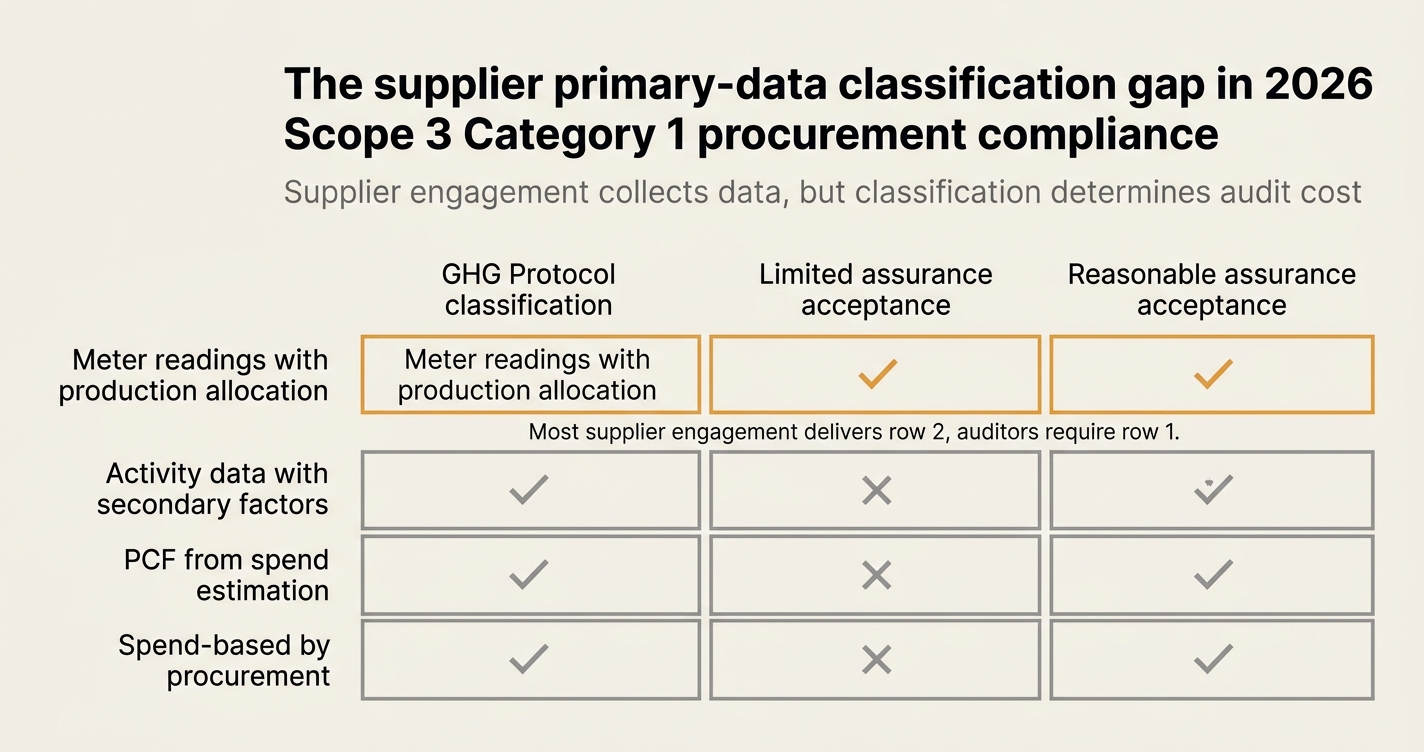
The supplier primary-data classification gap in 2026 Scope 3 Category 1 procurement compliance
Here's the issue: procurement teams under California SB 253, EU CSRD ESRS E1, or CDP disclosure mandates are told that supplier engagement solves the Scope 3 Category 1 compliance problem. Collect primary data from tier-1 suppliers, replace spend-based estimates with product carbon footprint data, and assurance-ready inventories follow. The problem appears solved at 50 to 70 percent spend coverage. However, the assurance cost is not set by whether the data is labelled primary. It is set by whether the data can be classified as primary under GHG Protocol standards.
However, Scope 3 Category 1 disclosure consists of two things: supplier engagement and data classification. Engagement means sending requests, collecting responses, and aggregating emissions totals. Classification means determining whether the data you received meets the definition of primary data under the GHG Protocol Scope 3 Standard or whether it is activity-based data derived from secondary sources. The two are not the same.
Supplier engagement on its own has no audit value. Data classification is what the auditor is actually verifying. When a supplier provides a product carbon footprint based on their own spend-based estimates or industry-average emission factors, the data is not primary data. It is activity-based data one step removed from spend-based estimation. The supplier has done the calculation work, but the underlying inputs are secondary. Under ISAE 3000 or ISAE 3410 assurance standards, this data does not qualify as primary for limited or reasonable assurance purposes. The procurement team assumes coverage, but the auditor sees a classification gap.
While supplier engagement has become cheaper through platforms such as EcoVadis, Normative, and IntegrityNext, data classification has become more expensive. If a procurement team collects product carbon footprint data from 70 suppliers representing 70 percent of spend, but 40 of those suppliers provide activity-based data misclassified as primary, the assurance cost for the 2026 inventory might outpace the cost of the initial engagement. Auditors charge per classification dispute, not per supplier response. The classification gap creates rework cycles, extended audit timelines, and delayed filings.
How do you solve this? I think the operators we work with are building classification into the engagement workflow, not treating it as a post-collection audit problem. For now, the shape of procurement compliance is changing. Teams that classify data at ingestion reduce audit cycles by 40 to 60 percent. Teams that classify during assurance preparation face rework.
The shape of the argument, visualised below.
The classification problem in supplier primary-data collection
The term primary data appears 47 times in the GHG Protocol Scope 3 Standard. The definition is specific: data obtained from a direct measurement or a site-specific calculation of emissions for the specific activity in question. When a supplier provides a product carbon footprint calculated from their own spend-based estimates, the data does not meet this definition. The calculation is site-specific, but the inputs are not. The data is activity-based, one step removed from secondary estimation.
This distinction matters because California SB 253 requires limited assurance for Scope 1 and Scope 2 emissions by 2027, with Scope 3 disclosure beginning in 2027 for fiscal year 2026. EU CSRD ESRS E1 requires limited assurance for greenhouse gas emissions by 2028, transitioning to reasonable assurance by 2033. CDP disclosure scoring increasingly penalises spend-based estimation in favour of supplier-specific data. The regulatory trajectory is clear: primary data is the standard, and auditors are the gatekeepers.
Yet supplier engagement platforms have made data collection easier without solving the classification problem. EcoVadis and Watershed announced a strategic partnership in March 2026 to close the Scope 3 data gap, combining EcoVadis supplier engagement tools with Watershed carbon accounting. The press release emphasises supplier-specific data quality, but the four-level reliability framework EcoVadis uses does not map directly to the GHG Protocol primary-data definition[1]. Normative's Scope 3 supplier engagement guide acknowledges that switching from spend-based estimates to supplier activity data can increase reported emissions, citing a customer case where Category 1 emissions rose from 41,496 to 65,734 tonnes of CO2 equivalent when activity data replaced spend-based estimates. That is not a worsening performance, Normative notes, it is better accounting[2]. But better accounting is not the same as primary data. The classification gap persists.
The practical consequence: procurement teams collect data that looks primary but fails assurance. A supplier provides a product carbon footprint for steel inputs, calculated using their electricity spend and a grid emission factor. The data is supplier-specific, but the emission factor is an industry average. Under GHG Protocol definitions, this is activity-based data. The auditor asks for installation-level meter readings and production-specific allocation methods. The procurement team returns to the supplier. The supplier does not have installation-level data. The cycle repeats. The 2026 filing deadline approaches.
The classification taxonomy for Scope 3 Category 1 data
The table below shows the classification taxonomy procurement teams need to apply at data ingestion, not during assurance preparation. The four categories map to GHG Protocol definitions, auditor requirements, and the classification disputes we see across CBAM, SB 253, and CSRD filings.
| Data type | GHG Protocol classification | Auditor acceptance for limited assurance | Auditor acceptance for reasonable assurance | Example |
|---|---|---|---|---|
| Supplier meter readings with production allocation | Primary data | Accepted | Accepted | Electricity meter readings for a specific production run, allocated to the purchased product by output tonnage |
| Supplier activity data with secondary emission factors | Activity-based data | Accepted with disclosure | Rejected without site-specific factors | Supplier reports electricity consumption in kWh, applies grid-average emission factor from national inventory |
| Supplier product carbon footprint based on spend estimation | Secondary data | Rejected | Rejected | Supplier calculates PCF using their own spend-based estimates, no direct measurements |
| Spend-based estimation by procurement team | Secondary data | Rejected | Rejected | Procurement team applies EEIO emission factors to invoice line items |
The first row is what auditors mean by primary data. The second row is what most supplier engagement platforms deliver. The third row is what procurement teams often receive when they ask suppliers for product carbon footprints without specifying classification requirements. The fourth row is the baseline, the starting point for most Category 1 inventories.
The classification gap is the distance between row two and row one. Closing it requires procurement teams to specify meter readings, production allocation methods, and site-specific emission factors in their supplier requests. It requires suppliers to have access to installation-level data, not aggregated facility totals. It requires both parties to understand that a product carbon footprint is not automatically primary data.
IntegrityNext's Scope 3 supplier engagement guide from February 2026 notes that companies are increasingly focusing on product-level emissions and product carbon footprints, driven by regulatory developments and customer expectations. The guide emphasises the shift from data collection to accountability, using high-quality primary supplier emissions data to track progress against targets. However, the guide does not specify how to classify data at ingestion, leaving the classification problem for the assurance stage[7].
The operational consequence: procurement teams build supplier engagement workflows that collect data without classifying it. By the time the data reaches the auditor, the classification disputes create rework. The 2026 inventory that looked 70 percent covered in June becomes 40 percent covered in October, after the auditor reclassifies 30 suppliers from primary to activity-based.
The quantified consequence of classification delays
The cost structure of Scope 3 assurance is not linear. Auditors charge per classification dispute, per rework cycle, and per extended timeline. The baseline cost for limited assurance on a Scope 3 Category 1 inventory covering 1,000 suppliers is approximately 50,000 to 80,000 euros for a mid-market European firm. That baseline assumes data is pre-classified, supplier responses include the evidence packs auditors need, and the timeline is standard.
When classification happens during assurance preparation, the cost structure changes. Each classification dispute adds 500 to 1,200 euros in auditor fees, depending on the complexity of the dispute and the number of suppliers involved. A procurement team with 40 suppliers providing activity-based data misclassified as primary faces 20,000 to 48,000 euros in additional audit fees, assuming an average of two disputes per supplier. The rework cycle extends the assurance timeline by four to eight weeks, delaying the filing and increasing internal resource costs.
The evidence for this cost structure comes from the CBAM transition period, which ended December 31, 2025. Non-EU exporters who provided default values in their CBAM reports avoided the initial data collection cost but faced a 20 to 40 percent markup on certificate costs when the definitive period began January 1, 2026. The markup is set by the European Commission based on the carbon intensity difference between actual installation values and default values. For steel exporters using blast furnace routes, the markup ranged from 0.15 to 0.35 euros per tonne of CO2 equivalent, depending on the product category and the exporter's production route[3].
The parallel for Scope 3 procurement compliance: teams that classify data at ingestion avoid the classification disputes and the associated audit fees. Teams that classify during assurance preparation face the rework cost. The timeline pressure is the same. California SB 253 requires Scope 3 disclosure for fiscal year 2026 by 2027. EU CSRD requires limited assurance for GHG emissions by 2028. The classification gap is not a 2027 problem, it is a 2026 workflow problem.
The classification workflow that closes the gap
The workflow that closes the classification gap has three components: a supplier request template that specifies classification requirements, a data ingestion system that classifies at receipt, and an evidence pack structure that matches auditor requirements. The three components are sequential. Skipping the first creates the classification gap. Skipping the third creates the rework cycle.
The supplier request template must specify meter readings, production allocation methods, and site-specific emission factors. It must distinguish between installation-level data and facility-level data. It must ask for the evidence the auditor will ask for, not the data the procurement team thinks is sufficient. The template is not a questionnaire, it is a classification brief.
The data ingestion system must classify at receipt, not after aggregation. When a supplier provides electricity consumption in kilowatt-hours and applies a grid-average emission factor, the system must classify the data as activity-based, not primary. When a supplier provides meter readings with production allocation, the system must classify the data as primary and route it to the evidence pack structure. The classification is deterministic, not interpretive. The GHG Protocol definitions are the classification logic.
The evidence pack structure must match auditor requirements under ISAE 3000, ISAE 3410, or ISSA 5000, which replaces ISAE 3410 on December 15, 2026. For each supplier classified as providing primary data, the evidence pack must include the meter readings, the production allocation method, the site-specific emission factor, and the calculation lineage from meter reading to product carbon footprint. For each supplier classified as providing activity-based data, the evidence pack must include the activity data, the secondary emission factor, and the disclosure note explaining why the data is not primary[4].
The operational shape of this workflow: a procurement team sends supplier requests in Q1 2026 for fiscal year 2026 disclosure. Responses arrive in Q2 and Q3. The data ingestion system classifies at receipt. By Q4, the procurement team knows which suppliers provided primary data and which provided activity-based data. The assurance preparation begins with pre-classified data and complete evidence packs. The auditor review takes four weeks, not twelve. The filing meets the 2027 deadline.
CO2 AI's guide to consumer packaged goods Scope 3 supplier engagement from February 2026 notes that major CPG brands are transforming procurement by making carbon data a mandatory requirement rather than a voluntary sustainability metric. Suppliers providing credible product carbon footprint data secure preferred status and longer contracts, while those without face increased scrutiny. However, the guide does not specify what credible means in GHG Protocol classification terms, leaving the classification problem unresolved[5].
The tier-2 visibility problem and the classification cascade
The classification gap compounds when procurement teams extend supplier engagement to tier-2 suppliers. Tier-1 suppliers provide product carbon footprints, but those footprints are based on tier-2 data that is not classified. The classification cascade begins. A tier-1 steel supplier provides a product carbon footprint for cold-rolled coil. The footprint includes upstream emissions from iron ore, calculated using the tier-2 mining supplier's activity data. The mining supplier used a spend-based estimate for electricity. The tier-1 footprint is activity-based data, but the procurement team does not see the tier-2 classification gap until the auditor asks for the upstream lineage.
Pilario's supplier engagement guide from February 2026 notes that suppliers are often overwhelmed by multiple, overlapping ESG requests, especially smaller businesses without dedicated sustainability teams. Engagement improves when requests are clear, focused on material topics, aligned with recognised standards such as the Global Reporting Initiative, and framed as a shared value opportunity rather than a compliance burden. However, the guide does not address how to classify tier-2 data or how to build classification requirements into tier-1 supplier requests[1].
The operational consequence: procurement teams build tier-1 engagement workflows that do not cascade classification requirements to tier-2 suppliers. The tier-1 supplier provides a product carbon footprint, the procurement team classifies it as primary, and the auditor rejects it because the upstream inputs are activity-based. The classification cascade becomes a rework cascade. The 2026 inventory that looked 70 percent covered at tier-1 becomes 30 percent covered after tier-2 reclassification.
The solution is to build classification requirements into tier-1 contracts. When a procurement team requests a product carbon footprint from a tier-1 supplier, the contract must specify that the footprint must be based on primary data from tier-2 suppliers, or that activity-based data must be disclosed as such. The tier-1 supplier then cascades the classification requirement to tier-2 suppliers. The classification logic is the same at every tier: meter readings with production allocation are primary, activity data with secondary emission factors is activity-based, and the evidence pack must include the lineage.
How Emission3 fits
Emission3 is positioned as document-first CBAM implementation backed by compliance infrastructure, but the same classification logic applies to Scope 3 Category 1 procurement compliance. The platform ingests supplier invoices, bills of materials, utility bills, and product carbon footprint submissions, classifies them at ingestion using GHG Protocol definitions, and routes them to evidence packs that match auditor requirements under ISAE 3000, ISAE 3410, or ISSA 5000.
The classification happens before aggregation. When a supplier provides electricity consumption in kilowatt-hours and applies a grid-average emission factor, Emission3 classifies the data as activity-based and flags it for disclosure. When a supplier provides meter readings with production allocation, Emission3 classifies the data as primary and includes the meter readings in the evidence pack. The classification is deterministic, the calculation lineage is reproducible, and the evidence pack is auditor-ready.
For procurement teams building 2026 Scope 3 inventories under California SB 253 or EU CSRD ESRS E1, this means the classification gap is closed at ingestion, not during assurance preparation. The rework cycles are eliminated. The audit timeline is reduced by 40 to 60 percent. The 2027 filing deadline is met.
The implementation workflow starts with a CBAM readiness call, but the same readiness framework applies to Scope 3. We map suppliers, identify which suppliers can provide primary data and which will provide activity-based data, and build the classification workflow into the supplier engagement template. By Q2 2026, the procurement team knows the classification status of every supplier. By Q4 2026, the evidence packs are complete. The assurance preparation begins with classified data.
The regulatory trajectory and the classification penalty
The regulatory trajectory is clear: spend-based estimation is being phased out, activity-based data is accepted with disclosure, and primary data is the standard. California SB 253 requires Scope 3 disclosure beginning in 2027, with no assurance requirement for Scope 3 in the first year but increasing pressure from investors and customers for credible data. EU CSRD ESRS E1 requires limited assurance for GHG emissions by 2028, with the European Financial Reporting Advisory Group clarifying in 2025 that Scope 3 Category 1 must be included in the assurance boundary if it represents more than 40 percent of total Scope 3 emissions. CDP scoring increasingly penalises spend-based estimation, with the 2026 scoring methodology awarding full points only for supplier-specific primary data.
The classification penalty is the cost of missing the transition. Procurement teams that continue to treat supplier engagement as a data collection problem, rather than a classification problem, will face the penalty in 2027 and 2028 assurance cycles. The penalty is not a regulatory fine, it is the audit fee for rework, the extended timeline, and the delayed filing.
European Union exports to the United States totalled 620.76 billion US dollars in 2025, with pharmaceutical products, machinery, and vehicles as the top three product groups. Organic chemicals exports were particularly high in the first half of 2025 due to exporters anticipating increased tariffs and rushing exports before the tariffs came into force. By the first quarter of 2026, EU exports in the manufacturing sector showed a clear slowdown, estimated at more than 8 percentage points across agri-food, fashion, and machinery sectors[6][8]. The slowdown reflects broader trade uncertainty, but it also reflects the operational cost of compliance. Exporters and importers under CBAM face the same classification problem as procurement teams under SB 253 and CSRD: actual installation data is required, default values carry a markup, and the classification gap is the cost driver.
The parallel for procurement compliance: the classification gap is not a 2027 problem, it is a 2026 workflow problem. Teams that classify data at ingestion avoid the penalty. Teams that classify during assurance preparation pay it.
Close with a CBAM readiness conversation
If your procurement team is building a 2026 Scope 3 Category 1 inventory for California SB 253 or EU CSRD disclosure, the classification gap is the workflow bottleneck. Supplier engagement platforms collect data, but they do not classify it. Auditors verify classification, but they do not build the workflow. The gap is operational, not technical.
Emission3 closes the gap by classifying data at ingestion, routing it to evidence packs that match auditor requirements, and providing the calculation lineage from supplier document to disclosure output. The workflow starts with a CBAM readiness call. We map your suppliers, identify the classification status of each supplier, and build the engagement template that specifies meter readings, production allocation, and site-specific emission factors. By Q2 2026, you know which suppliers can provide primary data. By Q4 2026, the evidence packs are complete. The 2027 filing meets the deadline.
Book a call to review your supplier engagement workflow and close the classification gap before the assurance cycle begins[3].
References & Sources
External Sources
- [1]Mastering Supplier Engagement for Scope 3 Reporting
Pilario's guide to supplier engagement notes that suppliers are often overwhelmed by multiple ESG requests, and engagement improves when requests are clear, focused on material topics, and aligned with recognised standards.
- [2]Scope 3 supplier engagement: collecting primary carbon data
Normative's guide acknowledges that switching from spend-based estimates to supplier activity data can increase reported emissions, citing a customer case where Category 1 emissions rose from 41,496 to 65,734 tonnes of CO2 equivalent when activity data replaced spend-based estimates.
- [5]CPG scope 3 emissions suppliers: Why your carbon data determines your contracts
CO2 AI's guide notes that major CPG brands are transforming procurement by making carbon data a mandatory requirement, with suppliers providing credible product carbon footprint data securing preferred status and longer contracts.
- [6]The first months of 2026 show a clear slowdown in EU exports of manufactured goods
ExportPlanning reports that EU exports in the manufacturing sector experienced a significant slowdown in Q1 2026, estimated at more than 8 percentage points across agri-food, fashion, and machinery sectors.
- [7]Building a Supplier Engagement Strategy to Reduce Scope 3 Emissions
IntegrityNext's guide from February 2026 emphasises the shift from data collection to accountability, using high-quality primary supplier emissions data to track progress, but does not specify how to classify data at ingestion.
- [8]European Union Exports to United States - 2026 Data
European Union exports to the United States totalled 620.76 billion US dollars in 2025, with pharmaceutical products, machinery, and vehicles as the top three product groups, and organic chemicals exports particularly high in the first half of 2025 due to exporters anticipating increased tariffs.
Related Content
- [3]Book a CBAM readiness call
All customers start with a readiness call where we map suppliers, identify classification gaps, and build the engagement workflow that closes the gap before the assurance cycle begins.
- [4]The ISAE 3410 withdrawal timeline for 2026 CBAM filings
CBAM filings consist of emissions totals and assurance standards. Exporters assume ISAE 3410 continuity, but ISSA 5000 replaces it December 15, 2026, creating an evidence pack transition for 2026 filings.
- [9]Scope 3 with primary data
Emission3 ingests supplier invoices, bills of materials, utility bills, and product carbon footprint submissions, classifies them at ingestion using GHG Protocol definitions, and routes them to evidence packs that match auditor requirements.