The supplier-engagement timing problem in 2026 CBAM actual-emissions filings
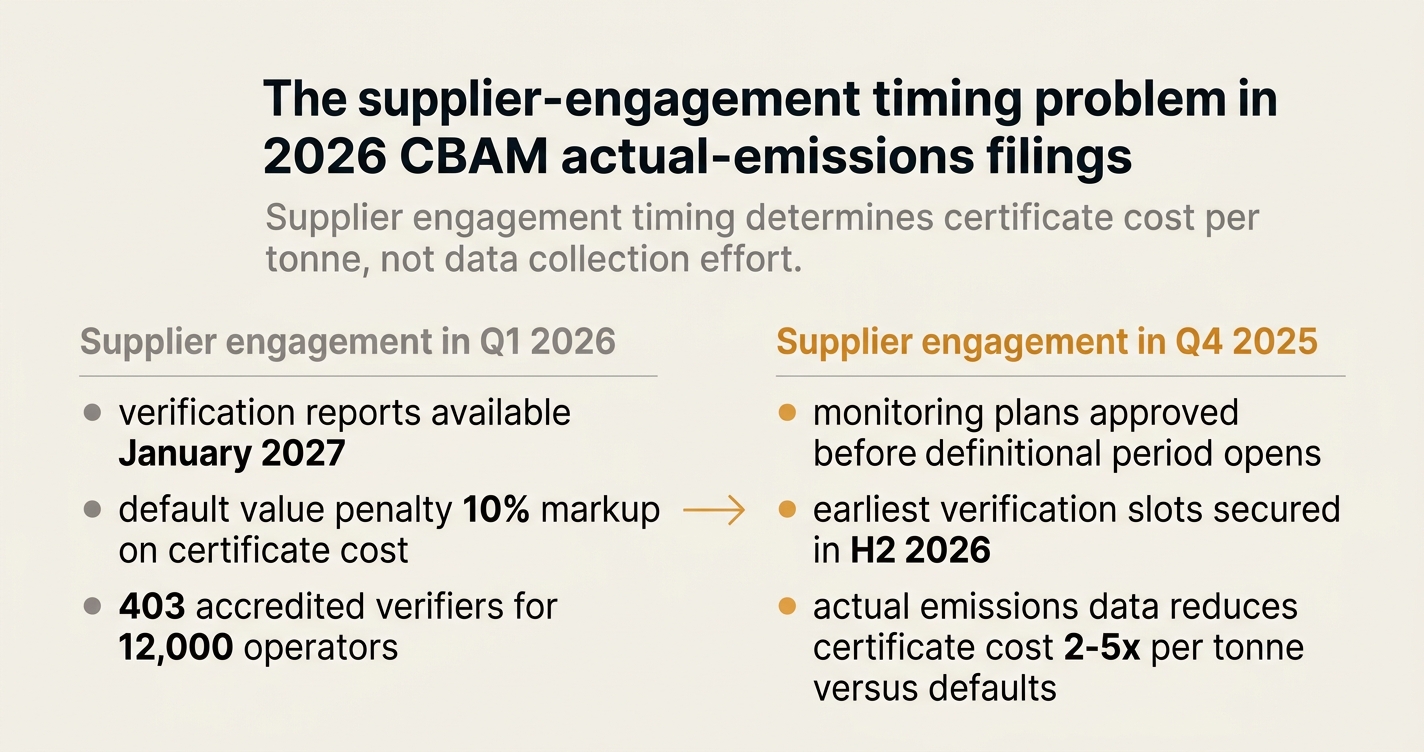
The supplier-engagement timing problem in 2026 CBAM actual-emissions filings
Here's the issue: when the Carbon Border Adjustment Mechanism definitional period begins on January 1, 2026, EU importers and non-EU exporters face a new cost structure. Actual-value declarations become mandatory. Default values now carry a 10% markup in 2026, rising to 20% in 2027 and 30% from 2028 onward. Most companies have budgeted for the reporting work—few have budgeted for the supplier-engagement timeline that determines the final certificate cost. The first quarterly filing under the definitional regime is due by April 30, 2026, covering January–March 2026 imports. Suppliers who have not yet built monitoring, reporting and verification systems will miss the Q1 deadline.
However, a Carbon Border Adjustment Mechanism filing consists of two things: supplier engagement and verification timing.
Supplier engagement on its own has no value. Verification timing is what the accredited verifier is actually auditing, and what the CBAM declarant is paying for. A supplier engagement cycle initiated in February 2026 delivers data too late for Q1 verification. The importer absorbs the default-value penalty for at least one quarter, even if the supplier eventually provides actual emissions data. The cost is not the engagement—it is the quarters spent under default values while verification capacity scales.
While supplier engagement has become easier through digital tools, verification timing has become more constrained. Accredited CBAM verifiers are not expected to be operating before September 2026. Verification of an installation's actual 2026 emissions cannot be completed before the first annual CBAM declaration is due on September 30, 2027. If an importer waits until Q1 2026 to request supplier data, the cost of missed verification timing might outpace the administrative savings of delayed engagement by a factor of 2–5x per tonne of embedded carbon.
How do you solve this? I think the operators we work with start supplier engagement in Q4 2025, not Q1 2026. They map installations, identify monitoring gaps, and scope verification timelines before the definitional period opens. For now, this buys the earliest possible verification slot and minimizes exposure to default values during the 2026 transition.
The shape of the argument, visualised below.
Step 1: Map your CBAM-covered product scope by CN code and supplier installation
Action: Extract all CN codes for goods you import under CBAM Annex I categories: steel, cement, aluminium, fertilizers, hydrogen, and electricity. For each CN code, list the non-EU installations that manufacture the goods, not just the trading intermediary.
Owner: Procurement and customs compliance teams.
Evidence artifact produced: A supplier-installation register with columns for CN code, installation name, installation address, production route, and contact person responsible for emissions data provision.
✅ Done when: Every CBAM-covered shipment maps to a specific installation, and no supplier is listed as "TBD" or represented only by a trading entity.
Step 2: Issue formal data requests to each installation by October 31, 2025
Action: Send a structured data request to each installation operator specifying the Carbon Border Adjustment Mechanism requirements for actual emissions: installation-level direct emissions, electricity consumption and its carbon intensity, precursor materials embedded emissions, and production volumes. Reference Implementing Regulation 2025/2547 for monitoring methodology.
Owner: Procurement lead, with legal review of the request template.
Evidence artifact produced: A tracking log showing request date, recipient contact, and acknowledgment status for each installation.
✅ Done when: Every installation has received the request in writing, and you have documented proof of delivery.
Step 3: Assess which suppliers can provide actual emissions data by December 31, 2025
Action: Review responses from installations. Classify each supplier as (a) ready—already monitoring under EU ETS-equivalent methodology, (b) capable—can build a monitoring plan by Q1 2026, or (c) not ready—no MRV system in place and no timeline to implement one.
Owner: Sustainability and procurement teams jointly.
Evidence artifact produced: A supplier-readiness matrix with status, risk level, and fallback plan for each installation.
✅ Done when: You have a binary yes/no answer for each supplier's ability to provide verified actual data for 2026, and a documented fallback plan for suppliers who cannot.
Step 4: Budget for default-value exposure for suppliers classified as not ready
Action: For each supplier in the not-ready category, calculate the default-value penalty. Multiply the Commission's default embedded emissions value for the CN code by the 10% markup for 2026, then multiply by the anticipated import volume in tonnes and the quarterly average EU ETS auction price. The Commission published 75.36 euros per tonne for Q1 2026 and 75.28 euros for Q2 2026.[1]
Owner: Finance and sustainability teams.
Evidence artifact produced: A line-item CBAM cost forecast by supplier, showing actual-value scenario versus default-value scenario with markup.
✅ Done when: Finance has approved the cost exposure and allocated budget for default-value quarters, or procurement has identified alternative suppliers who can provide actual data.
Step 5: Require suppliers to submit a monitoring plan by January 31, 2026
Action: For suppliers classified as capable or ready, require submission of a monitoring plan that defines system boundaries, attribution methodology for direct emissions, precursor emissions scope, and data sources for electricity carbon intensity. The monitoring plan is the document the verifier will audit.
Owner: Sustainability team, with procurement enforcement.
Evidence artifact produced: A monitoring plan file per installation, stored in a shared repository accessible to the importer's CBAM team.
✅ Done when: Every supplier has submitted a monitoring plan, or you have documented refusal and escalated to procurement for supplier substitution.
Step 6: Validate that monitoring plans comply with Implementing Regulation 2025/2547
Action: Review each monitoring plan against the methodology requirements in Implementing Regulation 2025/2547. Check that system boundaries match the installation perimeter, that activity data sources are identified (fuel invoices, utility bills, process measurements), and that emission factors are either default Tier 1 from the regulation or measurement-based Tier 2/3 where allowed.
Owner: Sustainability team, optionally with pre-verification support from an accredited CBAM verifier.
Evidence artifact produced: A compliance checklist per monitoring plan, marking each requirement as met, not met, or needs clarification.
✅ Done when: Every monitoring plan has been reviewed and either approved or returned to the supplier with specific gaps identified.
Step 7: Engage an accredited CBAM verifier by March 31, 2026
Action: Contract an accredited third-party verifier to audit the installation's 2026 emissions data. National accreditation bodies began CBAM accreditation in April 2026, and accredited verifiers can register in the CBAM Registry from September 2026.[2] Verification reports can be issued from January 2027. Check the accreditation certificate of any verifier you contract.
Owner: Sustainability team, with procurement support for verifier selection.
Evidence artifact produced: A signed verification engagement letter per installation, specifying scope, timeline, and deliverable format.
✅ Done when: You have a contracted verifier for every supplier classified as ready or capable, and the verifier has confirmed availability for a site visit in H2 2026.
Step 8: Ensure suppliers collect quarterly data snapshots for the full calendar year 2026
Action: Require suppliers to close quarterly data snapshots covering January–March, April–June, July–September, and October–December 2026. Each snapshot must include direct emissions, electricity consumption, precursor materials embedded emissions, and production volumes for the goods covered by your import contracts.
Owner: Procurement team, with sustainability oversight.
Evidence artifact produced: Quarterly data files per installation, stored in a version-controlled repository.
✅ Done when: You have received all four quarterly snapshots by January 15, 2027, giving the verifier time to complete the audit before the September 30, 2027 annual declaration deadline.
Step 9: Request verification reports by March 31, 2027
Action: Coordinate with the verifier to complete the site visit and issue the verification report. The report must include installation-level emissions, attribution to CBAM goods, conformity with the monitoring plan, and a statement of assurance. The verification report can be transmitted via the CBAM Registry if the operator is registered, or by other means if not registered.[3]
Owner: Sustainability team, with supplier and verifier coordination.
Evidence artifact produced: A verification report per installation, covering the full calendar year 2026.
✅ Done when: You have received the verification report, confirmed it meets the template requirements in the regulation, and uploaded it to your CBAM declaration system.
Step 10: Submit the annual CBAM declaration by September 30, 2027
Action: Use the verified actual emissions data to complete the annual CBAM declaration covering 2026 imports. Input installation-level data, attach verification reports, calculate the total embedded emissions, apply any carbon price already paid in the country of origin, and determine the net certificate cost.
Owner: Customs and sustainability teams jointly.
Evidence artifact produced: A completed CBAM declaration submitted via the CBAM Registry, with all required attachments.
✅ Done when: The declaration is submitted, the certificate cost is paid, and you have received confirmation from the national competent authority.
Step 11: Compare actual certificate cost to default-value scenario
Action: Calculate the certificate cost you would have paid if you had used default values with the 10% markup for all suppliers. Compare this to the cost paid using verified actual data. Document the cost differential per installation and per CN code.
Owner: Finance and sustainability teams.
Evidence artifact produced: A cost-savings analysis showing euros saved per tonne and total euros saved across all 2026 imports.
✅ Done when: Finance has reviewed the analysis and approved the business case for continuing actual-data collection in 2027 and beyond.
Step 12: Build a recurring quarterly data-collection cycle for 2027 onward
Action: Transition from annual to quarterly data requests. Starting in 2027, request updated emissions data every quarter, covering the previous 12 months. This rolling dataset keeps your CBAM declarations current and reduces the risk of data gaps at year-end.
Owner: Procurement and sustainability teams.
Evidence artifact produced: A quarterly data-request calendar, with scheduled send dates and response deadlines for each installation.
✅ Done when: You have issued the first quarterly request for Q1 2027 data by April 15, 2027, and received responses by May 15, 2027.
Step 13: Monitor verifier capacity and book 2027 verification slots early
Action: Track the number of accredited verifiers available in your suppliers' jurisdictions. As of early 2026, only 403 accredited verifiers were registered in the Union Registry, compared to nearly 12,000 economic operators that had submitted CBAM authorization applications.[4] Book 2027 verification slots in Q1 2027, not Q4 2027.
Owner: Sustainability team.
Evidence artifact produced: A verifier booking log showing contracted slots for 2027 site visits, by installation and by quarter.
✅ Done when: You have confirmed 2027 verification capacity for all installations before the end of Q1 2027.
Step 14: Document supplier refusals and trigger procurement escalation
Action: For any supplier that refuses to provide actual emissions data or cannot meet the monitoring requirements, document the refusal in writing and escalate to procurement for supplier review. Calculate the default-value penalty for continuing to source from that supplier, and compare it to the cost of qualifying an alternative supplier.
Owner: Procurement lead, with sustainability and finance input.
Evidence artifact produced: A supplier-escalation memo showing the cost of default values, the timeline to qualify a replacement, and a recommendation on whether to continue or substitute.
✅ Done when: Procurement has made a sourcing decision—either accept the default-value cost or initiate supplier substitution—and documented the rationale in the supplier register.
Step 15: Archive all monitoring plans, verification reports, and data files for audit
Action: Store all CBAM-related documents in a single audit-ready repository. Include monitoring plans, quarterly data snapshots, verification reports, CBAM declarations, and correspondence with suppliers and verifiers. Retention period is at least four years after the declaration year.
Owner: Sustainability team, with IT support for secure storage.
Evidence artifact produced: A version-controlled document archive with folder structure by installation, by year, and by declaration cycle.
✅ Done when: All documents for the 2026 declaration cycle are archived, indexed, and accessible to internal audit and external verifiers on request.
How Emission3 fits
Emission3 is built for importers and exporters who need to operationalize the checklist above, not just read it. The platform pulls invoices, utility bills, supplier inputs, and monitoring plans into a single system of record, so every reported figure keeps its evidence and its audit trail. The supplier-assessment module tracks engagement status, flags missing data, and automates quarterly data requests. The cost-modeling dashboard shows, in euros per tonne, what each data gap adds to your certificate bill—so finance can see the penalty for waiting until Q1 2026 to engage suppliers, instead of starting in Q4 2025.
Because the same installation-level data that feeds CBAM also feeds CSRD ESRS E1 Scope 3 disclosures and California SB 253 limited-to-reasonable assurance transitions, Emission3 collects supplier emissions once and maps them to multiple reporting obligations. The verification handoff is built in: monitoring plans export in the format verifiers expect, and verification reports upload directly to the declaration workflow. This is not generic SaaS—it is productized CBAM implementation backed by compliance infrastructure we already built.[5]
If you are an EU importer covering steel, cement, aluminium, fertilizers, or electricity, or a non-EU exporter facing CBAM certificate cost pressure from your customers, book a CBAM readiness call. We map suppliers, identify MRV gaps, scope verification timelines, and deliver a plan to first verified filing. No anonymous self-serve onboarding—every customer starts with a readiness conversation.[6]
The timeline determines the cost
The 2026 CBAM shift is not a reporting exercise. It is a procurement dependency with a recurring cost penalty for missing supplier data. Importers who wait until Q1 2026 to engage suppliers will absorb the default-value penalty for at least one quarter, and potentially for the full 2026 year if verification capacity is unavailable. Exporters who defer MRV setup will lose competitive position as importers prioritize suppliers who can provide actual-value data without the 10% markup.
The constraint is not intent—it is fragmented inputs, disconnected workflows, and figures that cannot be traced back to their source when a verifier asks. The checklist above is the operational structure that prevents that fragmentation. Start with supplier mapping in Q4 2025, not Q1 2026. Budget for default-value exposure where suppliers cannot deliver. Book verification capacity early, before the 403 accredited verifiers in the Union Registry are fully allocated. And archive every monitoring plan, every quarterly snapshot, and every verification report, because the audit starts the day you submit your first declaration.
Book a CBAM readiness call to map your supplier engagement timeline and avoid the default-value penalty in 2026.[6]
References & Sources
External Sources
- [1]EU CBAM 2026: How to calculate your liability
Analysis of CBAM certificate pricing, default value markups, and the financial impact of using default versus actual emissions data for 2026 filings.
- [2]Guest Post: Whose CBAM is it anyway? Of Default Values and Accreditation
Overview of CBAM verifier accreditation timelines, registry registration schedules, and the capacity gap between accredited verifiers and installations requiring verification.
- [3]EU CBAM Emissions Data: Monitoring, Reporting & Verification
Detailed explanation of CBAM monitoring plans, verification report requirements, and the transmission process via the CBAM Registry or alternative means.
- [4]Guest Post: Whose CBAM is it anyway? Of Default Values and Accreditation
Data on the mismatch between the number of accredited verifiers (403 in the Union Registry) and the number of CBAM declarants and authorized economic operators (nearly 12,000 by early January 2026).
Related Content
- [5]How Emission3 handles CBAM
Specific to CBAM exporters and EU importers, shows the installation-data flow, supplier-assessment module, and verification handoff workflow.
- [6]Book a CBAM readiness call
All customers start with a readiness call: we map suppliers, identify MRV gaps, scope verification timelines, and deliver a plan to first verified filing. No anonymous self-serve onboarding.