The supplier-data participation problem in Scope 3 Category 1 primary collection programs
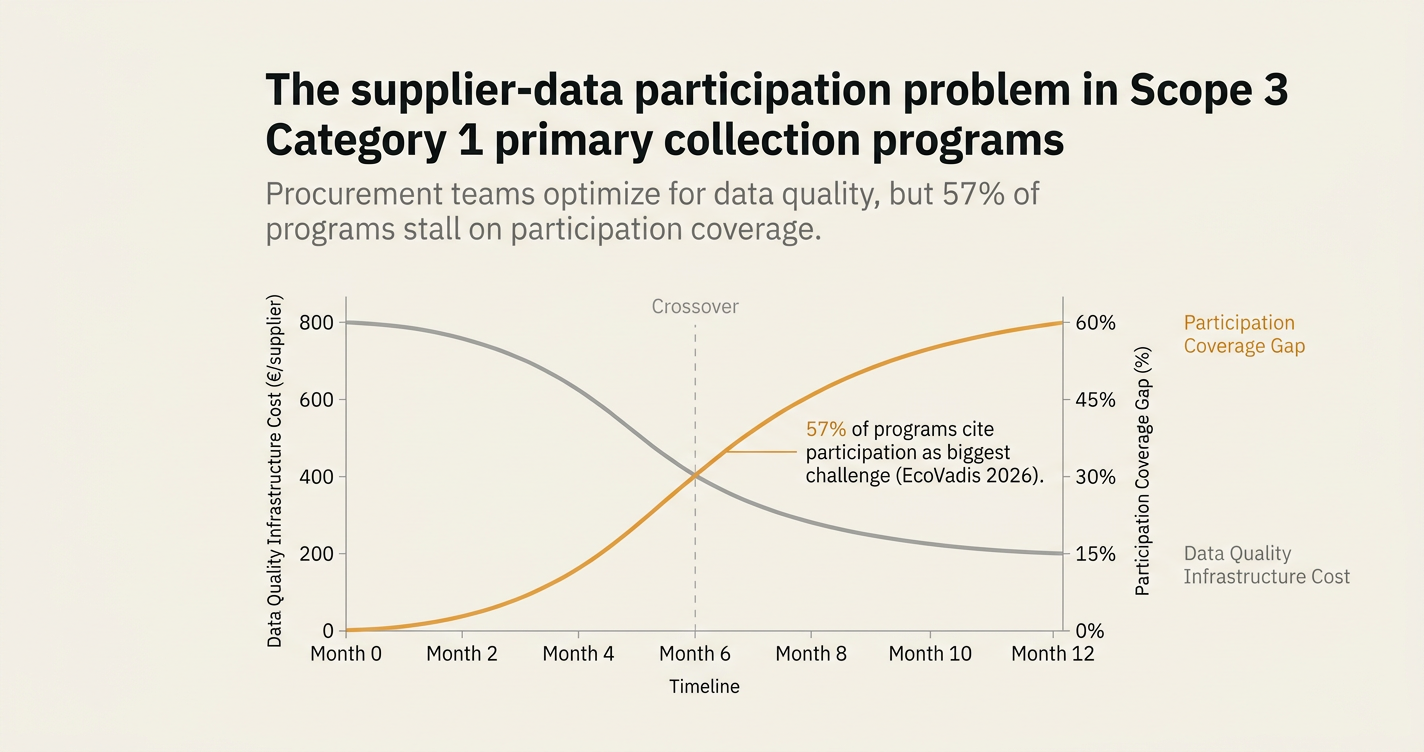
The supplier-data participation problem in Scope 3 Category 1 primary collection programs
Here's the issue: your procurement team has identified suppliers representing 80% of purchased goods spend, built a data collection template aligned with the GHG Protocol, and sent engagement requests with a 90-day deadline. Six months later, response rates sit at 22%, and most submissions are estimates rather than facility-specific data. The program appears comprehensive on paper, but auditors and carbon registries care about participation coverage, not template sophistication.
However, Scope 3 primary collection consists of two things: supplier participation and data quality. Procurement teams naturally focus on the second—building templates that capture emissions factors, activity data, and calculation methodologies—because these are the inputs that feed carbon accounting systems. The first component, participation itself, is treated as a communications problem rather than a structural constraint.
Supplier participation on its own has no value if the data is fabricated or non-representative. But data quality is what auditors and regulatory frameworks are actually verifying—and most procurement systems lack the infrastructure to prove that submitted data reflects actual production processes rather than industry averages. A supplier can return a completed template with spend-based estimates that look identical to primary data in your carbon platform, but limited assurance engagements and CBAM verifiers will reject both the number and the coverage calculation if the lineage cannot be reproduced from source documents.
While data quality has become cheaper through standardized templates and carbon platforms, participation coverage has become more expensive. According to EcoVadis, 57% of companies currently reporting Scope 3 using supplier-specific data say supplier data collection is their biggest challenge, with mature reporters continuing to struggle with participation, accuracy, and consistency [1]. If your program achieves 25% tier-1 participation but those suppliers represent only 40% of Category 1 emissions, the coverage gap might force you to revert to spend-based estimates for the majority of your footprint, negating the audit-trail advantage of primary collection entirely.
How do you solve this? I think the programs that achieve 70%+ participation coverage treat supplier engagement as a procurement function, not a sustainability side project. The operators we work with at Emission3 structure supplier requests around mutual commercial benefit—longer payment terms for suppliers providing facility-specific data, preferred sourcing status for those with product-level carbon footprints—rather than abstract sustainability alignment. For now, this means integrating carbon data requirements directly into RFPs and supplier scorecards, not sending standalone surveys that compete with dozens of other ESG questionnaires.
The shape of the argument, visualized below.
The participation timeline that most programs miss
The table below maps the critical milestones in a 12-month primary collection program, showing when most programs discover participation gaps and what percentage of suppliers typically respond at each stage:
| Month | Milestone | Typical Participation Rate | What Auditors Verify |
|---|---|---|---|
| 0-1 | Supplier identification and prioritization | 100% (internal activity) | Completeness of supplier universe |
| 2-3 | Initial outreach and template distribution | 85% delivery confirmation | Documented engagement timeline |
| 4-6 | First deadline, follow-up requests | 22% submission rate [1] | Response rate by emissions weight |
| 7-9 | Data quality review, resubmission requests | 18% usable primary data | Source document lineage |
| 10-12 | Final collection, gap-filling with estimates | 35% coverage of emissions | Population completeness evidence |
Most programs treat the Month 4-6 participation rate as a communications failure rather than a structural signal. When 78% of tier-1 suppliers do not respond to initial requests, procurement teams typically add more follow-up emails or extend deadlines. But the operators achieving 60-70% participation do something different: they move non-responsive suppliers into a "commercial negotiation" track where carbon data provision becomes a contract requirement for the next sourcing cycle, not a voluntary sustainability initiative.
The participation problem compounds when you examine emissions weight rather than supplier count. Normative reports that one customer switching from spend-based estimates to supplier activity data for Category 1 saw total reported emissions increase from 41,496 to 65,734 tonnes CO2e—not because performance worsened, but because better accounting revealed that actual emissions exceeded industry averages [2]. If your 22% participation rate represents only the suppliers with below-average emissions intensity (the ones most willing to disclose), your reported footprint will systematically understate your actual exposure, creating a hidden liability when you expand coverage.
Why tier-2 visibility determines participation success
The procurement teams that achieve high participation rates understand that 40% of purchased goods emissions typically hide in tier-2 suppliers—the manufacturers your direct suppliers source from [3]. When you ask a tier-1 distributor for primary data, they face the same participation problem you do with their upstream suppliers. If they lack infrastructure to collect and aggregate tier-2 data, they will either decline your request or provide spend-based estimates that auditors will classify as secondary data.
The solution is not to expand your data collection program to tier-2 suppliers directly (most organizations lack the procurement leverage to enforce this). Instead, the programs that work prioritize tier-1 suppliers who already have carbon accounting infrastructure in place. According to a survey by MIT, supplier data availability is cited as the biggest Scope 3 challenge, with 53% of respondents also identifying lack of standardized methodologies and calculation complexity as key barriers [3]. This means your participation rate is structurally capped by your suppliers' own accounting maturity, not just their willingness to engage.
The practical implication: when you identify suppliers representing 80% of purchased goods spend, segment them by accounting maturity rather than emissions intensity. Suppliers with ISO 14064 verification, CDP disclosure, or existing product carbon footprint programs will provide primary data within 60 days. Suppliers without these systems will take 12-18 months to build the capability, regardless of how many follow-up emails you send [4]. Your participation timeline should reflect this maturity split, not assume uniform 90-day response windows across all suppliers.
What 70% participation coverage actually requires
"Leading companies are now prioritizing supplier engagement to collect primary scope 3 emissions data. Active supplier engagement provides: more accurate emissions calculations, better identification of reduction opportunities, ability to track supplier progress, enhanced credibility of reporting." —Optera Climate [5]
The operators achieving 70%+ participation coverage follow a five-phase structure:
Phase 1: Internal alignment (Months 0-2) Build cross-functional partnerships with procurement, supply chain, and finance teams. Establish clear roles and responsibilities for data collection. Secure executive sponsorship for program success. Align supplier engagement goals with broader business objectives [5]. The participation bottleneck is rarely sustainability team capacity—it is procurement team prioritization. If carbon data requests compete with cost reduction initiatives or quality audits, they will lose.
Phase 2: Supplier segmentation (Months 1-3) Categorize suppliers by accounting maturity, not just emissions intensity. Identify which suppliers are ready to provide facility-specific data versus those requiring 12-18 months of capability building [4]. Use platforms like EcoVadis, CDP Supply Chain, or Together for Sustainability to source existing carbon disclosures before sending new data requests [6]. This reduces your net-new collection burden by 30-40%.
Phase 3: Commercial integration (Months 2-4) Integrate carbon data requirements into RFPs, supplier scorecards, and contract renewal terms. Offer preferred payment terms, longer contracts, or volume commitments for suppliers providing high-quality emissions data [7]. Major CPG brands like Unilever, P&G, and Nestlé now require supplier engagement representing 70% of emissions by 2024, with phased timelines extending product-level PCF data requirements to 2026-2028 [7]. If you frame carbon data as a compliance checkbox rather than a procurement advantage, participation will remain sub-30%.
Phase 4: Education and support (Months 3-6) Provide training workshops on Scope 1, 2, and 3 emissions. Host Q&A sessions for suppliers at different maturity levels. Offer technical support for emissions calculation. Create resources to help suppliers identify reduction opportunities [5]. The suppliers who do not respond to initial requests often lack capability rather than willingness—offering co-development support can increase participation by 20-30 percentage points.
Phase 5: Continuous monitoring (Months 6-12+) Set up progress tracking, benchmarking, and trend analysis. Consider data privacy and confidentiality for collected data. Share feedback with suppliers themselves to demonstrate value [5]. The programs that sustain 70%+ participation over multiple years treat it as an ongoing procurement function with quarterly reviews, not a one-time data collection campaign.
The procurement decision that determines coverage
The participation gap is not evenly distributed across your supplier base. According to CO2 AI, 40-60% of product footprints typically come from tier-1 suppliers, with 20-30% of suppliers by count representing 60-80% of purchased goods emissions [7]. This concentration means your participation strategy should differentiate between:
- High-impact, high-maturity suppliers: Provide primary data within 60 days, require minimal support, represent 30-40% of emissions.
- High-impact, low-maturity suppliers: Require 12-18 months of capability building, represent 20-30% of emissions, determine whether you hit 70% coverage.
- Low-impact suppliers: Can remain on spend-based estimates without materially affecting footprint accuracy or audit outcomes.
Most procurement teams treat all tier-1 suppliers uniformly, sending the same data request template and expecting similar response timelines. The programs that achieve 70%+ participation allocate 80% of engagement resources to the high-impact, low-maturity segment—offering co-development support, technical training, and commercial incentives that make capability building economically rational for the supplier.
The participation decision ultimately comes down to procurement leverage. If you represent 5% of a supplier's revenue, your carbon data request is a low-priority sustainability survey. If you represent 30% of their revenue and frame the request as a contract requirement for the next sourcing cycle, participation becomes a commercial imperative. This is why major CPG brands achieve 70% participation while smaller buyers stall at 20-30%—the difference is procurement weight, not template quality.
How Emission3 fits
Emission3 is built for procurement and supply chain teams running primary collection programs that need to prove 70%+ participation coverage to auditors. The platform classifies supplier submissions at document level—invoices, bills of material, facility-specific energy statements—and generates coverage reports that show what percentage of purchased goods spend is backed by primary data versus spend-based estimates. When a supplier submits data, Emission3 validates it against source documents and flags submissions that rely on industry averages rather than facility-specific activity data.
The participation tracking is designed for procurement functions, not sustainability teams. You can see which suppliers have responded, which have provided primary versus secondary data, and which represent the largest coverage gaps in your footprint. For CBAM filings, the platform generates supplier-evidence coverage reports that match the structure of quarterly declarations, showing embedded emissions by CN code with lineage to source documents. For California SB 253 and EU CSRD assurance, it exports audit-ready evidence packs that prove population completeness—the percentage of your supplier universe that provided verified data versus estimates.
The infrastructure is document-first because participation coverage is ultimately a lineage question: can you prove this number came from a supplier's facility-specific data rather than an industry average? Most carbon platforms accept supplier inputs at face value and generate emissions totals without checking whether the underlying data is reproducible from source documents. Emission3 generates the coverage proof that auditors and CBAM verifiers actually ask for.
If you are running a primary collection program and facing sub-30% participation rates, the bottleneck is probably not your template quality or follow-up cadence—it is the commercial structure of your supplier engagement. Book a CBAM readiness call [8] to map your supplier universe, identify the high-impact low-maturity segment, and design a participation strategy that treats carbon data as a procurement function rather than a sustainability side project.
What to start this week
If you are launching or expanding a Scope 3 primary collection program, the first step is segmenting your supplier base by accounting maturity rather than emissions intensity. Pull your tier-1 supplier list, cross-reference it with CDP Supply Chain or EcoVadis ratings to identify which suppliers already have carbon accounting infrastructure, and calculate what percentage of purchased goods spend they represent. This is your baseline participation ceiling—the coverage you can achieve in 60-90 days without capability-building investment.
For the high-impact suppliers without existing carbon programs, draft a commercial proposal that ties carbon data provision to preferred sourcing status, extended payment terms, or volume commitments. Frame the request as a contract requirement for the next RFP cycle, not a voluntary sustainability initiative. If you represent less than 10% of a supplier's revenue, consider pooling requests with other buyers through industry initiatives like Together for Sustainability or the CDP Supply Chain program to increase procurement leverage.
Finally, audit your current data collection infrastructure to confirm it can distinguish primary data from spend-based estimates at document level. If your carbon platform accepts supplier submissions without validating them against source documents (invoices, energy bills, production logs), you are building a participation rate that auditors will not accept as primary coverage. The participation problem is solvable, but it requires treating supplier engagement as a procurement function with commercial incentives, not a communications campaign with sustainability messaging.
References & Sources
External Sources
- [1]How to Build a Credible Scope 3 Reporting Program in 2026
EcoVadis survey finding that 57% of companies reporting Scope 3 using supplier-specific data cite supplier data collection as their biggest challenge, with mature reporters continuing to struggle with participation, accuracy, and consistency.
- [2]Scope 3 supplier engagement: collecting primary carbon data
Normative case study showing that switching from spend-based estimates to supplier activity data for Category 1 increased reported emissions from 41,496 to 65,734 tonnes CO2e, demonstrating that actual emissions often exceed industry averages.
- [3]Supplier data availability cited as biggest Scope 3 challenge, MIT survey finds
MIT survey of 1,200 professionals across 97 countries finding that supplier data availability is the biggest Scope 3 challenge, with 53% citing lack of standardized methodologies and calculation complexity as key barriers.
- [4]Traversing the Primary Data Chasm: Supplier Engagement: A Win-Win for Scope 3 Emissions
Green Project Technologies guidance on prioritizing suppliers ready to provide primary data and setting realistic timelines of 12-18 months for initial data collection from suppliers without existing carbon accounting infrastructure.
- [5]Supplier engagement: The key to accurate scope 3 emissions data
Optera Climate framework for supplier engagement including internal alignment, data collection infrastructure, supplier education and incentives, and continuous monitoring and feedback loops.
- [6]Supplier engagement for Scope 3 reductions
SustainCERT guidance on supplier prioritization criteria including leverage, maturity assessment, and use of platforms like EcoVadis and CDP Supply Chain for sourcing existing carbon disclosures.
- [7]CPG scope 3 emissions suppliers: Why your carbon data determines your contracts
CO2 AI analysis of how major CPG brands (Unilever, P&G, Nestlé, Coca-Cola, PepsiCo) are integrating carbon data into procurement decisions, with phased timelines for tier-1 supplier disclosure by 2024 and product-level PCF data by 2026-2028.
Related Content
- [8]Book a CBAM readiness call
All Emission3 customers start with a readiness call where we map suppliers, identify coverage gaps, and design implementation strategies. No anonymous self-serve onboarding.
- [9]Scope 3 with primary data
Emission3's Scope 3 solution for supply-chain leaders and sustainability managers, designed for primary data collection and audit-ready evidence generation at document level.