The methodology-lock penalty in CSRD limited-to-reasonable assurance escalation for Wave-1 and Wave-2 filers
The methodology-lock penalty in CSRD limited-to-reasonable assurance escalation for Wave-1 and Wave-2 filers
Here's the issue:
Wave-1 filers report under limited assurance from January 2026. Wave-2 filers follow in January 2027. Both waves face the same escalation: limited assurance ends, reasonable assurance begins after the European Commission's October 2028 feasibility assessment. The escalation window is narrow—24 months for Wave 1, 12 months for Wave 2—but the cost driver is not the timeline. The cost driver is the methodology the auditor tested during the limited-assurance engagement. If that methodology relied on spend-based proxies, activity-based defaults, or incomplete Scope 3 lineage, the 2028 reasonable-assurance engagement requires a full methodology rebuild, mid-audit. For a Wave-2 filer with 150 Scope 3 suppliers, that rebuild costs €120,000–€180,000 in re-engagement fees, supplier re-contact cycles, and executive-liability premiums.
However, CSRD assurance consists of two things: the emissions total the auditor verifies, and the methodology that produces the total.
The emissions total is what the board sees in the sustainability statement. The methodology is what the auditor tests during the engagement—factor selection, data lineage, boundary definitions, estimation hierarchies. Under limited assurance, the auditor samples transactions and confirms that the methodology applied is plausible and documented. Under reasonable assurance, the auditor re-performs calculations, tests primary-data provenance, and validates that the methodology is not just plausible but reproducible at line-item level. The methodology is the bottleneck.
The emissions total on its own has no value. The methodology is what the auditor is actually testing—and what 2028 escalation pricing is based on.
A spend-based Scope 3 Category 1 estimate might pass 2026 limited assurance because the calculation is documented and the factor source is disclosed. But the same estimate fails 2028 reasonable assurance because the auditor cannot re-perform the calculation without access to supplier-specific primary data. The methodology that worked in 2026 becomes the re-pricing trigger in 2028. This is the inversion: the methodology the team selected to minimise 2026 compliance cost is the same methodology that maximises 2028 escalation cost. The cheaper the 2026 methodology, the more expensive the 2028 transition.
While limited-assurance fees have stabilised at €90,000–€240,000 for Wave-1 filers, reasonable-assurance escalation fees for methodology rebuilds range from €120,000 to €180,000, depending on how many Scope 3 categories require supplier re-engagement.
Lexology reports that the European Commission must adopt limited-assurance standards by delegated act no later than 1 October 2026, with the deadline potentially extended to 1 July 2027.[1] Accountancy Europe confirms that the CSRD foresees a transition to reasonable assurance in 2028, subject to the Commission's positive assessment of feasibility for undertakings and assurance practitioners.[2] The feasibility assessment window closes in October 2028. After that date, the methodology locked in during the 2026 or 2027 limited-assurance engagement cannot be revised without triggering a full re-audit. For a Wave-2 filer reporting on FY 2026 data in early 2027, the methodology-lock penalty is the cost of rebuilding Scope 3 lineage in 2028 when the auditor escalates to reasonable assurance.
How do you solve this?
I think the operators we work with are treating 2026–2027 limited assurance as the reasonable-assurance dry run. This means selecting methodologies in 2026 that are already reasonable-assurance-compatible—primary data over proxies, supplier-specific emissions factors over spend-based defaults, line-item lineage over category-level aggregates. This approach costs more in 2026 because primary-data collection is slower than activity-based modelling. But it eliminates the 2028 re-pricing shock because the methodology the auditor tested in 2026 is already reasonable-assurance-ready. For a Wave-2 filer with 150 Scope 3 suppliers, the incremental cost of primary-data collection in 2026 is approximately €40,000 in supplier engagement and data validation. The avoided cost in 2028—rebuilding the inventory mid-audit plus the executive-liability premium—ranges from €120,000 to €180,000, depending on how many suppliers must be re-contacted after the 2026 filing.
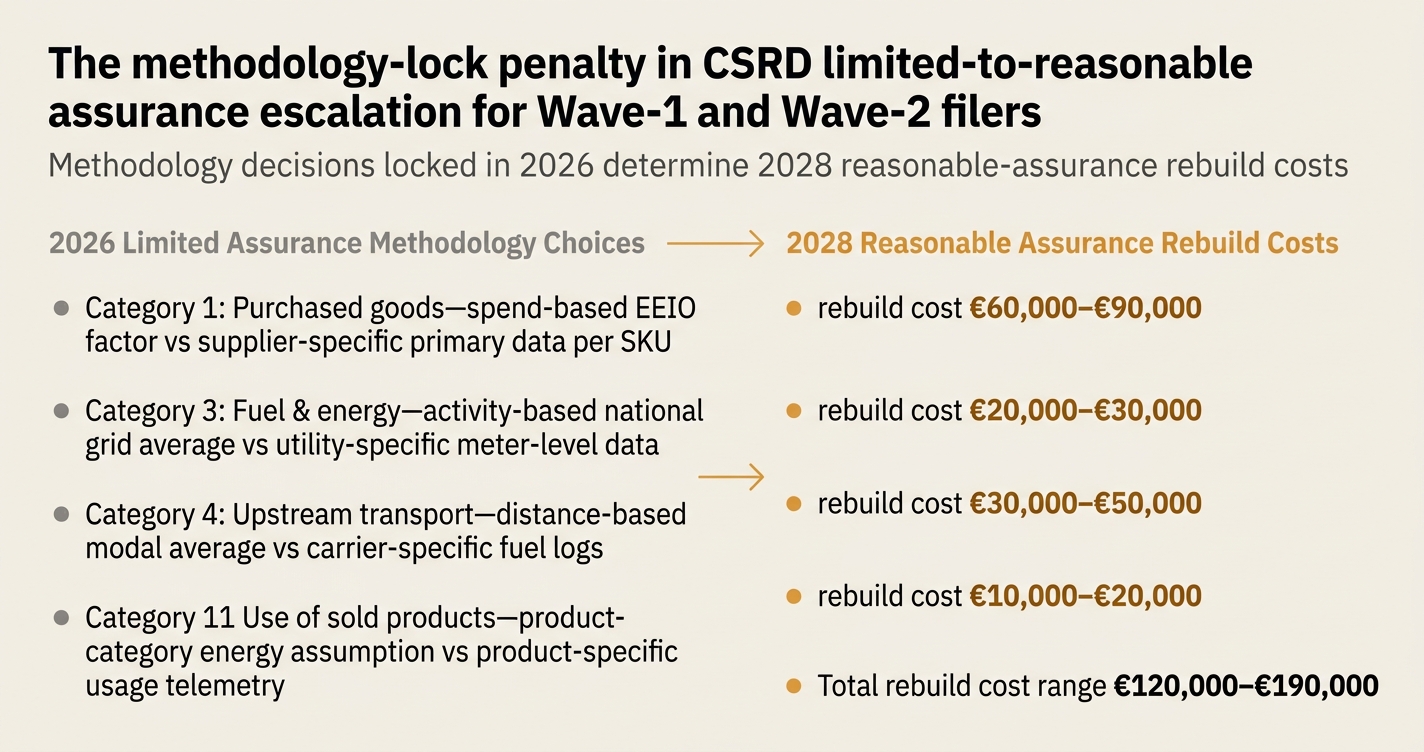
The shape of the argument, visualised below.
The methodology choices that pass 2026 limited assurance but fail 2028 reasonable assurance
| Scope 3 Category | Limited-Assurance Methodology (2026) | Reasonable-Assurance Requirement (2028) | Methodology Rebuild Cost (€) |
|---|---|---|---|
| Category 1: Purchased goods | Spend-based EEIO factor (€/€ revenue) | Supplier-specific primary data per SKU | 60,000–90,000 |
| Category 3: Fuel & energy | Activity-based national grid average | Utility-specific meter-level data | 20,000–30,000 |
| Category 4: Upstream transport | Distance-based modal average (tkm) | Carrier-specific fuel consumption logs | 30,000–50,000 |
| Category 11: Use of sold products | Product-category energy assumption | Product-specific usage telemetry | 10,000–20,000 |
| Total | 120,000–190,000 |
The rebuild cost is not the cost of calculating the emissions—it is the cost of re-engaging suppliers, validating primary data, and re-auditing the methodology after the 2026 engagement locked in a different approach. Emission3 reports that the avoided cost for a Wave-2 filer with 150 suppliers ranges from €120,000 to €180,000, depending on how many categories require supplier re-contact.[3]
The five methodology decisions that determine 2028 escalation pricing
1. Factor hierarchy: primary data or proxy defaults
✅ Done when: Every Scope 3 category has a documented factor-selection hierarchy, and the hierarchy prioritises supplier-specific primary data over industry averages, national defaults, or spend-based proxies.
Owner: Sustainability lead, in consultation with auditor.
Evidence artifact: Factor-selection hierarchy matrix, one per Scope 3 category, specifying (a) preferred factor source, (b) fallback factor source if primary data is unavailable, (c) documentation standard for each tier.
Under limited assurance, the auditor samples transactions and confirms that the hierarchy is applied consistently. Under reasonable assurance, the auditor re-performs the calculation and validates that the primary-data factor matches the supplier's disclosure. If the 2026 methodology used spend-based proxies, the auditor cannot re-perform the calculation in 2028 without re-contacting suppliers. The rebuild cost is the cost of moving from tier-3 proxies to tier-1 primary data, mid-audit.
Commonwealth Climate Law notes that companies should "establish mechanisms for data collection, controls, governance and oversight of reporting" during the 2026 capacity-building year, before mandatory reporting begins in 2027.[4]
2. Boundary definition: entity-level or installation-level
✅ Done when: Every Scope 3 category has a boundary definition documented at installation level, not entity level, and the definition specifies which installations are included, which are excluded, and why.
Owner: Financial controller, in consultation with sustainability lead.
Evidence artifact: Boundary-definition memo, one per Scope 3 category, specifying (a) included installations, (b) excluded installations with materiality threshold, (c) boundary change log if the definition is revised between reporting periods.
Under limited assurance, the auditor confirms that the boundary is disclosed and that exclusions are justified. Under reasonable assurance, the auditor tests whether the boundary is reproducible—i.e., whether a third-party auditor could reconstruct the same boundary from the documentation. If the 2026 boundary definition was entity-level ("all European suppliers") rather than installation-level ("suppliers at facilities X, Y, Z producing materials A, B, C"), the 2028 auditor must rebuild the boundary from scratch. The rebuild cost is the cost of re-mapping suppliers to installations and re-validating exclusions.
3. Estimation hierarchy: actual metered values or modelled assumptions
✅ Done when: Every Scope 3 category has an estimation hierarchy documented, and the hierarchy prioritises actual metered values (meter readings, fuel logs, carrier manifests) over modelled assumptions (industry averages, activity-based defaults).
Owner: Data lead, in consultation with auditor.
Evidence artifact: Estimation-hierarchy matrix, one per Scope 3 category, specifying (a) preferred data source (e.g., supplier-provided meter reading), (b) fallback data source if metered values are unavailable (e.g., activity-based default), (c) documentation standard for each tier.
The estimation hierarchy is the second-level breakdown of the factor hierarchy. If the factor hierarchy says "use supplier-specific emissions factor," the estimation hierarchy says "use supplier's actual meter reading, not supplier's modelled assumption." Under reasonable assurance, the auditor tests whether the metered value is reproducible—i.e., whether the supplier can provide the underlying meter log, utility bill, or fuel receipt. If the 2026 methodology used modelled assumptions, the 2028 auditor must re-contact suppliers to obtain metered values. The rebuild cost is the cost of re-requesting documentation from suppliers who already provided data in 2026.
4. Lineage documentation: line-item traceability or category-level aggregates
✅ Done when: Every emissions line item has a lineage trail that traces the number from source document (invoice, bill of materials, utility bill) to the sustainability statement, and the trail is stored in a format the auditor can replay.
Owner: Data lead, in consultation with auditor.
Evidence artifact: Lineage log, one per emissions line item, specifying (a) source document ID, (b) extraction timestamp, (c) calculation steps, (d) final emissions value reported in the statement.
Under limited assurance, the auditor samples a subset of line items and confirms that the lineage exists. Under reasonable assurance, the auditor tests the entire population and validates that every line item is reproducible. If the 2026 methodology aggregated emissions at category level ("Category 1 total: 45,000 tCO₂e") without line-item traceability, the 2028 auditor must rebuild the lineage from scratch. The rebuild cost is the cost of re-extracting data from source documents and re-calculating line items.
Keller and Heckman reports that the Commission intends to issue targeted guidance on assurance requirements before finalizing limited-assurance standards, in response to concerns about excessive assurance procedures raised by first-wave CSRD reporters.[5]
5. Change-control log: methodology revisions between reporting periods
✅ Done when: Every methodology revision between reporting periods is documented in a change-control log, and the log specifies (a) what changed, (b) why it changed, (c) how the change affects comparability with prior periods.
Owner: Sustainability lead, in consultation with auditor.
Evidence artifact: Change-control log, one per reporting period, specifying (a) methodology revisions, (b) rationale for each revision, (c) recalculated prior-period emissions if the revision affects comparability.
Under reasonable assurance, the auditor tests whether methodology revisions are justified and disclosed. If the 2026 methodology was revised between FY 2024 and FY 2025 without a change-control log, the 2028 auditor cannot validate whether the revision was appropriate. The rebuild cost is the cost of reconstructing the change history and re-auditing prior-period comparability.
The reasonable-assurance cost structure for Wave-1 and Wave-2 filers
| Engagement Component | 2026 Limited (€) | 2028 Reasonable (€) | Increase (€) | Driver of Increase |
|---|---|---|---|---|
| Methodology review | 90,000 | 95,000 | 5,000 | Minimal—methodology already tested in 2026 |
| Scope 1 & 2 verification | 60,000 | 75,000 | 15,000 | Re-performance of calculations, not just sampling |
| Scope 3 lineage testing | 70,000 | 160,000 | 90,000 | Primary-data provenance required, not proxies |
| Executive certification | 20,000 | 60,000 | 40,000 | Legal review of officer liability exposure |
| Total | 240,000 | 390,000 | 150,000 | 62.5% increase |
The €90,000 increase in Scope 3 lineage testing is the cost of validating primary-data provenance when the 2026 methodology used spend-based proxies or activity-based defaults. The €40,000 increase in executive certification is the cost of legal review when the 2028 engagement escalates to reasonable assurance and board members become personally liable for material misstatements. Emission3 reports that the avoided cost of rebuilding Scope 3 lineage mid-audit ranges from €120,000 to €180,000 for a Wave-2 filer with 150 suppliers.[3]
The methodology-selection timeline for Wave-1 and Wave-2 filers
"From the financial year 2024 onwards, companies obligated to comply with the CSRD must provide limited external assurance for all sustainability information. Limited Assurance Engagement provides credibility to companies' reported information."[6]
The critical dates for methodology lock-in:
- March 31, 2026: Wave-1 filers complete internal double-materiality assessment. Late completion delays auditor scoping by 4–6 weeks.
- June 30, 2026: Primary-data collection for Scope 3 Categories 1, 3, 4 closed. Missing this date forces reliance on spend-based estimates, incompatible with 2028 reasonable assurance.
- October 1, 2026: European Commission publishes final limited-assurance standards. Methodologies locked after this date cannot be revised without re-audit.
- December 31, 2026: FY 2025 reporting period closes for Wave-2 filers. All activity data must be finalised by this date.
- January 31, 2027: Wave-2 auditor scoping call for 2026 limited-assurance engagement. Scope changes after this date incur re-pricing.
- April 30, 2027: Wave-2 limited-assurance engagement concludes. Methodology is now locked until October 2028.
- October 31, 2028: European Commission completes feasibility assessment. Reasonable assurance begins for Wave-1 and Wave-2 filers.
- January 31, 2029: Wave-2 reasonable-assurance engagement begins. Any methodology revisions trigger re-audit fees.[3]
The window for methodology revision closes on October 1, 2026, when the Commission publishes final limited-assurance standards. After that date, the methodology the auditor tested during the 2026 or 2027 limited-assurance engagement becomes the baseline for 2028 reasonable-assurance pricing.
The executive-liability exposure under reasonable assurance
Under limited assurance, the auditor provides a negative-form conclusion: "nothing has come to our attention to suggest the sustainability statement is materially misstated." The board's liability exposure is limited to gross negligence or fraud. Under reasonable assurance, the auditor provides a positive-form conclusion: "in our opinion, the sustainability statement is fairly presented in all material respects." The board's liability exposure escalates to material misstatement, including errors caused by methodology selection rather than intentional fraud.
GetGoodLab notes that limited assurance is "provided in a negative form of expression by stating that the practitioner has identified no matter to conclude that the subject matter is materially misstated."[7] Reasonable assurance requires the practitioner to provide a positive conclusion that the subject matter is fairly presented.
For a Wave-2 filer, the executive-liability exposure begins in January 2029, when the first reasonable-assurance engagement concludes. If the 2027 methodology used spend-based proxies and the 2029 auditor identifies material misstatements in Scope 3 lineage, the board's liability exposure includes:
- Re-audit fees: €120,000–€180,000.
- Legal review of executive-officer statements: €40,000–€60,000.
- Restatement of prior-period emissions: €20,000–€40,000.
- Potential regulatory penalties if the misstatement is material: jurisdiction-dependent.
The total exposure is €180,000–€280,000, in addition to the baseline reasonable-assurance engagement fee of €390,000.
How Emission3 fits
Emission3 is designed for teams treating 2026–2027 limited assurance as the reasonable-assurance dry run. Every Scope 3 line item in Emission3 has a lineage trail that traces the number from source document to the sustainability statement, and the trail is stored in a format auditors can replay. Factor hierarchies are documented at installation level, not entity level. Estimation hierarchies prioritise supplier-specific meter readings over activity-based defaults. Change-control logs track methodology revisions between reporting periods.
For a Wave-2 filer with 150 Scope 3 suppliers, Emission3's document-first workflow means primary-data collection in 2026 produces line-item lineage the auditor can test in 2027, then re-test in 2029 without methodology rebuild. The incremental cost in 2026 is the cost of slower primary-data collection compared to spend-based modelling. The avoided cost in 2029 is the cost of rebuilding Scope 3 lineage mid-audit when the auditor escalates to reasonable assurance. See the audit-ready exports artifact at /solutions/audit and the deterministic AI layer that auditors can replay at /product/ai.
If your team is a Wave-2 filer reporting on FY 2026 data in 2027, the next step is a CBAM readiness call.
We start every customer engagement with a readiness conversation: we map your Scope 3 suppliers, identify which categories can use primary data in 2026, and scope the methodology decisions that determine 2028 escalation pricing. No anonymous self-serve onboarding—just a structured conversation about factor hierarchies, boundary definitions, and lineage documentation. Book a CBAM readiness call at /book-demo.
References & Sources
External Sources
- [1]how the Final Omnibus reshapes the CSRD and CSDDD
European Commission's deadline for adopting EU limited-assurance standards via delegated act, with potential extension to July 2027.
- [2]CSRD & CSDDD: key provisions and concepts
CSRD's transition from limited to reasonable assurance in 2028, subject to European Commission's feasibility assessment.
- [3]The executive-liability cost cascade in CSRD limited-to-reasonable assurance transitions
Methodology-lock timelines, reasonable-assurance cost structures, and rebuild cost ranges for Wave-1 and Wave-2 filers.
- [4]CSRD reporting post-Omnibus I: what directors need to know in 2026
Capacity-building guidance for Wave-2 companies preparing for mandatory CSRD reporting, including data collection mechanisms and governance.
- [5]The Omnibus Package: Changes in Sustainability and Due Diligence Reporting Requirements Under the CSRD and the CSDDD
European Commission's targeted guidance on assurance requirements in response to first-wave CSRD reporter concerns about excessive procedures.
- [6]CSRD Assurance | Limited and Reasonable Assurance Engagement
Definition of limited assurance under CSRD and the requirement for external assurance from financial year 2024 onwards.
- [7]CSRD Audit & Assurance: How to Prepare for Compliance
Limited assurance definition as negative-form conclusion and CSRD assurance timeline for EU member states.
Related Content
- [8]Audit-ready exports in Emission3
Evidence lineage artifacts for auditors and CFOs, showing the document-to-filing trail Emission3 produces for every emissions line item.
- [9]The Emission3 AI layer
The deterministic LLM layer that auditors can replay, producing reproducible line-item lineage from source documents to sustainability statements.
- [10]Book a CBAM readiness call
All customers start with a readiness call: we map suppliers, gaps, and implementation, no anonymous self-serve onboarding.