The default-value penalty for non-EU steel exporters under CBAM
The default-value penalty for non-EU steel exporters under CBAM
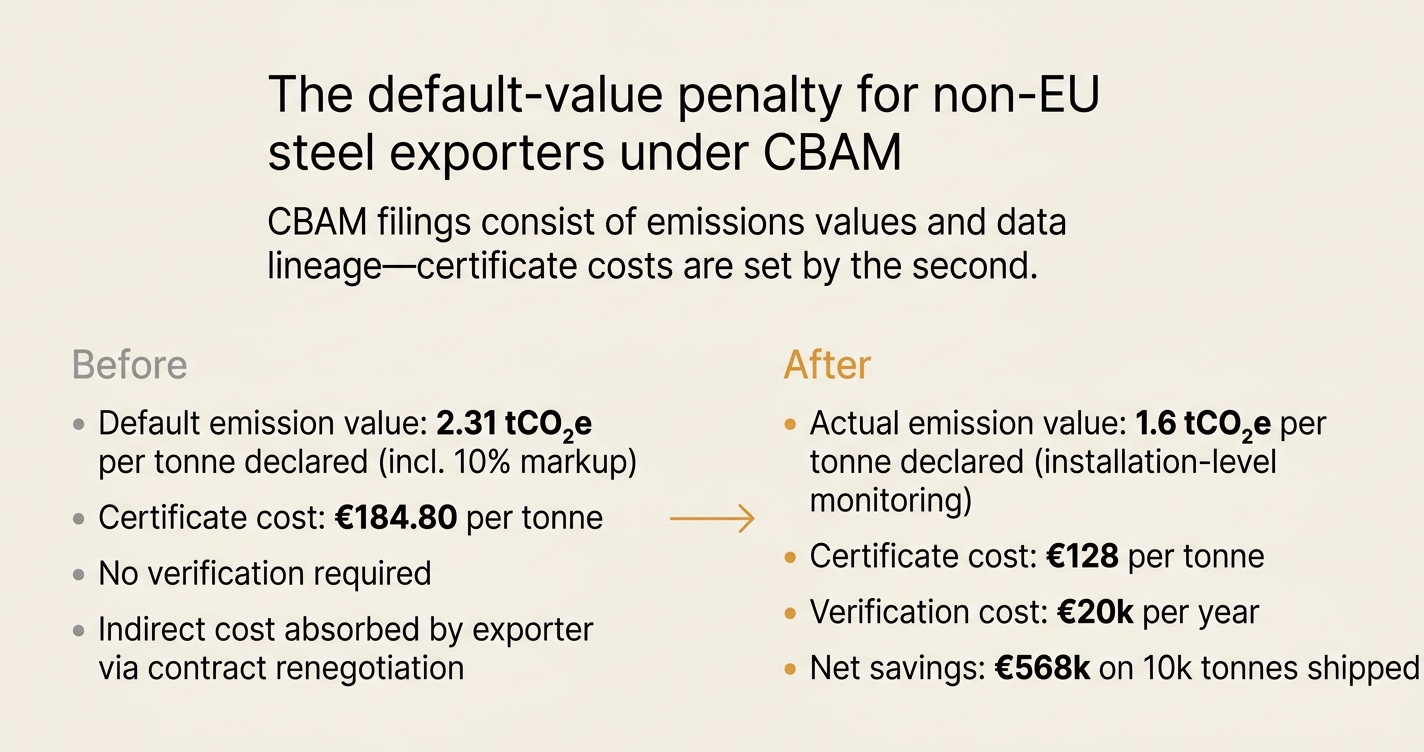
Here's the issue: a UK steel exporter with modern blast furnace-basic oxygen furnace (BF-BOF) equipment ships 10,000 tonnes of hot-rolled coil to an EU buyer in 2026. The exporter does not provide verified actual emissions data. The EU importer files the CBAM declaration using the Commission's default value for UK steel: 2.1 tCO₂e per tonne, plus a 10% markup. At an assumed ETS allowance price of €80 per tonne, the CBAM certificate cost is €168,000 for the year. The exporter's actual embedded emissions, if measured at installation level, are 1.6 tCO₂e per tonne. The difference—0.5 tCO₂e per tonne, compounded by the markup—costs €44,000 in avoidable certificate liability. The buyer pushes that cost back to the supplier in the next contract negotiation.
However, a CBAM filing consists of two things: the embedded emissions value declared, and the data lineage behind that value.
The embedded emissions value on its own has no compliance meaning. The data lineage—whether the value comes from verified installation-level monitoring or from a Commission default—is what the CBAM declarant is actually paying for, and what determines the certificate cost per tonne shipped.
While default values have become administratively simpler, the financial cost of using them has become steeper. If an exporter's actual emissions are 25% below the country default, and the default carries a 10% markup in 2026, the cost of avoiding verification might exceed €40 per tonne shipped—rising to €60 per tonne in 2027 when the markup reaches 20%, and €80 per tonne from 2028 onward when the markup hits 30%[1].
How do you solve this? I think the operators we work with are starting to frame it as a data infrastructure problem, not a one-time compliance task. If you build the monitoring plan, document the calculation factors, and run the installation-level data collection in 2026, verification becomes a scheduled cost in 2027, not an emergency retrofit. For now, the question is whether your EU buyers are absorbing the default-value penalty or shifting it back to you in the form of lower contract prices.
The shape of the argument, visualised below.
The two-part structure of a CBAM filing
Every CBAM declaration submitted by an EU importer consists of two components: the quantity of CBAM certificates surrendered, calculated from the embedded emissions of the goods imported, and the data source used to determine those emissions. The first component—certificate quantity—is visible to finance teams and appears in quarterly accruals. The second component—data source—determines whether the certificate quantity is based on actual installation-level monitoring or on a Commission default value with a punitive markup.
The table below maps the relationship:
| Data source | Embedded emissions basis | Markup applied | Verification requirement | Cost to exporter (direct) | Cost to exporter (indirect) |
|---|---|---|---|---|---|
| Actual values | Installation-level monitoring | None | Third-party verifier, on-site inspection | Verification fee (€8k–€25k per installation per year) | None, assuming actual < default |
| Default values | Country-average intensity | 10% (2026), 20% (2027), 30% (2028+) | None | None | Certificate cost differential pushed back by buyer in contract negotiation |
The cost structure inverts when you consider who pays. The exporter does not purchase CBAM certificates—the EU importer does. But the importer's certificate cost is determined by the exporter's data. If the exporter provides verified actual emissions, the importer pays for certificates based on real installation performance. If the exporter does not provide data, the importer pays for certificates based on a conservative default plus markup, and typically recoups that cost by reducing the contract price or switching suppliers[2].
The markup schedule and its compounding effect
Under Implementing Regulation (EU) 2025/2621, the Commission set default embedded emission values for each CBAM-covered product by country of origin, using the best available data from national inventories, industry associations, and international databases. Where country-specific data was unavailable, the Commission used the average of the top 10 exporting countries. These defaults are intentionally conservative—they reflect average intensity across all installations in a country, not the performance of efficient modern plants[3].
On top of the default value itself, the regulation imposes a markup:
- 2026: 10% above the calculated default
- 2027: 20% above the calculated default
- 2028 and beyond: 30% above the calculated default
The markup is designed to incentivise actual value submission. It is not a penalty for non-compliance—using default values is legally compliant—but it is a penalty for information asymmetry. The Commission assumes that producers who cannot or will not provide data are likely to have higher emissions than those who can, and prices the default accordingly.
For a worked example, consider the UK steel exporter from the opening paragraph. The installation produces hot-rolled coil via the BF-BOF route. The Commission default for UK steel (BF-BOF, hot-rolled coil) is 2.1 tCO₂e per tonne. The exporter's actual emissions, if measured, are 1.6 tCO₂e per tonne. The importer files using the default plus 10% markup: 2.31 tCO₂e per tonne. At €80 per tonne of CO₂, the certificate cost is:
- Using default: 2.31 × €80 = €184.80 per tonne of steel
- Using actual: 1.6 × €80 = €128 per tonne of steel
- Difference: €56.80 per tonne of steel
Over 10,000 tonnes shipped in 2026, the avoidable cost is €568,000. That cost does not appear on the exporter's balance sheet directly—it appears on the importer's—but the exporter absorbs it indirectly when the importer renegotiates the contract price downward or shifts volume to a competitor who provides verified data.
"Default emission-intensity values are typically conservative and may exceed actual emissions, incentivizing firms to report installation-level data. On top of that, the EU even imposed an extra mark-up value, which is a 10 percent–30 percent surcharge, for companies that choose to apply the default values. The rate grows by year, designed to incentivize actual value submission."[4]
The verification timeline and the 2027 declaration deadline
Verification of actual emissions for calendar year 2026 cannot be completed before the data exists. Accredited CBAM verifiers are expected to be operational by September 2026, but the first full-year verification cycle will run from January 2027 through mid-2027, with verified reports issued in time for the 30 September 2027 annual CBAM declaration deadline[5].
This creates a practical sequencing problem for exporters. To use actual values in the 2027 declaration (covering 2026 imports), the exporter must:
- Implement a CBAM-compliant monitoring plan by 1 January 2026
- Collect installation-level data throughout calendar year 2026
- Prepare an operator's emissions report by Q1 2027
- Commission an accredited verifier to conduct an on-site inspection and issue a verification report by Q3 2027
- Transmit the verified data to the EU importer before 30 September 2027
If any step in this sequence fails or delays, the importer must fall back to default values for the entire year. There is no partial credit. The declaration is binary: verified actual data, or default values with markup.
The timing constraint is why most exporters should assume that default values will apply for at least the first declaration cycle, even if they begin monitoring in January 2026. The window between year-end 2026 and the September 2027 deadline is tight, and verification capacity is still scaling up. Exporters who start monitoring now are not aiming to avoid default values in 2027—they are aiming to avoid them in 2028 and beyond, when the markup rises to 20% and then 30%[1].
The independent verification requirement and cost structure
CBAM verification must be conducted by an accredited verifier, independent of the production installation. A verifier employed by, jointly owned with, or contracted exclusively to the exporter does not satisfy the independence requirement under Delegated Regulation (EU) 2025/2551. The importer cannot rely on verification commissioned by the exporter alone unless the importer verifies that the exporter's verifier meets the EU independence standard[6].
Verification costs vary by installation complexity, production route, and the number of product categories covered. Indicative ranges based on early market pricing:
- Single-installation, single-product-category, straightforward monitoring: €8,000–€12,000 per year
- Multi-product-category installation with complex precursor chains: €15,000–€25,000 per year
- Multi-installation group with shared upstream processes: €25,000–€50,000 per year
These costs are borne by the party commissioning the verification—typically the exporter, though some EU importers with significant volume from a single supplier have begun negotiating shared verification cost structures.
The financial comparison is straightforward. If the default-value penalty (certificate cost differential times tonnage shipped) exceeds the annual verification cost, verification pays for itself in year one. For the UK steel exporter shipping 10,000 tonnes at a €56.80 per tonne differential, the certificate savings are €568,000. If verification costs €20,000, the return on investment is 28:1.
The comparison becomes more favourable as the markup increases. In 2027, when the markup rises to 20%, the differential widens to €70.40 per tonne, or €704,000 over the same volume. In 2028 and beyond, the 30% markup pushes the differential to €84 per tonne, or €840,000[3].
The competitive dynamics of supplier data provision
CBAM does not directly regulate non-EU exporters. It regulates EU importers. But the mechanism creates a powerful indirect incentive: importers who source from suppliers providing verified actual data pay lower certificate costs than importers who source from suppliers using default values. Over time, this cost differential sorts suppliers into two tiers.
First-tier suppliers provide verified actual emissions data, enabling their EU buyers to minimise CBAM liability. These suppliers are more attractive contract partners, all else equal, and can negotiate contract terms that reflect the certificate savings they generate.
Second-tier suppliers do not provide verified data. Their EU buyers must use default values with markup, and either absorb the incremental cost or pass it back to the supplier through lower contract prices. These suppliers face volume risk as buyers shift to first-tier competitors[7].
The sorting process is already underway. EU importers with diversified supplier bases are running scenario analyses to quantify the certificate cost by supplier, and are beginning to incorporate data provision requirements into RFQs and contract renewals. Exporters who treat CBAM as a reporting obligation their buyer will handle are discovering that their buyer is treating it as a cost variable they will manage by adjusting supplier mix.
The dynamic is particularly acute in commoditised product categories where price is the primary differentiator. In differentiated product categories, buyers may absorb the default-value penalty to maintain supplier relationships. In steel, aluminium, cement, and fertiliser—where product specifications are standardised and switching costs are low—buyers have less tolerance for avoidable cost.
How Emission3 fits
Emission3 is positioned for non-EU exporters who need to provide verified actual emissions data to EU buyers under CBAM. We treat this as a document-first problem, not a platform problem. The operator's emissions report required for verification is a structured compilation of:
- Installation-level monitoring data (activity data, calculation factors, emissions sources)
- Production process attribution (which emissions belong to which products)
- Precursor data (embedded emissions in purchased inputs)
- Data quality and methodology documentation
All of these are derived from source documents: utility bills, production logs, supplier invoices, bills of materials, emission factor references. Emission3 ingests those documents, extracts the relevant data points, maps them to the CBAM calculation methodology per Implementing Regulation (EU) 2025/2547, and generates the operator's emissions report and supporting evidence pack in the format verifiers expect[8].
We do not replace the verifier. We prepare the data package the verifier will audit, in a way that makes the on-site inspection efficient and the verification report defensible. For exporters who operate multiple installations or produce multiple CBAM-covered products, we maintain the monitoring plan, track data collection gaps, and generate reports on a per-installation, per-product basis.
The output is a verification-ready emissions report, a full evidence lineage from source document to declared value, and a transmission package the EU importer can submit with confidence. The structure is deterministic: every number in the report is reproducible from the source documents, with a full audit trail.
The decision framework for 2026–2027
Exporters facing CBAM for the first time should evaluate three questions:
- What is the certificate cost differential between default values and my actual emissions?
- What is the annual verification cost for my installation(s)?
- When does the payback period make verification worthwhile?
For most modern installations in regulated industries (steel, aluminium, cement), actual emissions are materially lower than country defaults, and the payback period is immediate. For marginal installations operating at or above country-average intensity, the case for verification is weaker, and using default values may be the rational choice until emissions performance improves.
The markup schedule adds a forward-looking dimension. Even if verification does not pay for itself in 2026, it may pay for itself in 2027 or 2028 as the markup escalates. Exporters should model the certificate cost trajectory over a multi-year horizon, not just the first declaration cycle.
Finally, exporters should account for the competitive signal. Providing verified data signals to EU buyers that the supplier is operationally transparent, emissions-efficient, and capable of meeting evolving regulatory requirements. Not providing data signals the opposite. In a market where buyers are actively sorting suppliers by data provision, the signal matters as much as the cost.
If you are a non-EU exporter shipping CBAM-covered goods to the EU, and you want to model the certificate cost impact of actual versus default values for your specific installation and product mix, the place to start is a CBAM readiness call. We map your production processes, identify data gaps, estimate verification cost, and quantify the certificate savings. Book a CBAM readiness call here[9].
References & Sources
External Sources
- [1]EU CBAM 2026: How to calculate your liability
Detailed explanation of default value markup schedule (10% in 2026, 20% in 2027, 30% from 2028) and financial impact on certificate costs.
- [2]What the EU's carbon market is costing American industry
Analysis of how CBAM costs pass back to exporters when EU buyers cannot absorb the tariff or shift to other suppliers.
- [3]EU CBAM Emissions Data: Monitoring, Reporting & Verification
Overview of actual versus default values under CBAM, including how country-specific defaults are set and why using actual data reduces certificate costs.
- [4]What the EU's carbon market is costing American industry - Default values explanation
Direct quote on the default value markup structure and its design as an incentive mechanism for actual value submission.
- [5]CBAM Verifier 2026: How to Find One, Costs, and What They Check
Timeline and process requirements for CBAM verification, including the September 2027 deadline for first annual declarations.
- [6]What EU Importers and Non-EU Manufacturers Need to Understand About CBAM Verification
Explanation of the verifier independence requirement and the distinction between actual values (verification required) and default values (no verification).
- [7]CBAM Verification & Compliance - Normec Verifavia
Discussion of how failure to provide verified data makes exporters less competitive and how EU buyers shift volume to suppliers who provide actual emissions data.
- [8]CBAM Verification: Carbon Border Adjustment Mechanism - DNV
Overview of the calculation and verification process for embedded emissions under CBAM, and how verification reduces financial exposure.
Related Content
- [9]Book a CBAM readiness call
All customers start with a readiness call: we map suppliers, identify data gaps, estimate verification cost, and quantify certificate savings.
- [10]How Emission3 handles CBAM
Specific to CBAM exporters, shows the installation-data flow from source documents to verification-ready operator's emissions report.