The default-value markup in 2026 CBAM filings for non-EU exporters
The default-value markup in 2026 CBAM filings for non-EU exporters
Here's the issue: Non-EU exporters selling steel, aluminium, or cement into the European Union face a new cost line as of January 1, 2026. The Carbon Border Adjustment Mechanism requires EU importers to purchase certificates covering embedded emissions in imported goods. If the exporter cannot provide verified actual emissions data, the importer must use default values published by the European Commission. Most exporters assume these defaults are simply conservative estimates and plan to provide actual data later. The certificate cost looks manageable in 2026, and the verification requirement seems like a problem for 2027.
However, a CBAM filing consists of two things: the embedded emissions number and the markup applied when that number comes from default values rather than verified actuals.
The embedded emissions number on its own has no financial consequence. The markup is what the EU importer is actually paying for. The Commission published Implementing Regulation (EU) 2025/2621 in December 2025, setting default values by country, production route, and CN code, and establishing a markup schedule: 10% in 2026, 20% in 2027, and 30% from 2028 onward.[1] The markup is applied to the gross certificate cost before the CBAM phase-in factor, meaning the penalty compounds as the phase-in percentage rises from 2.5% in 2026 to 100% in 2034.
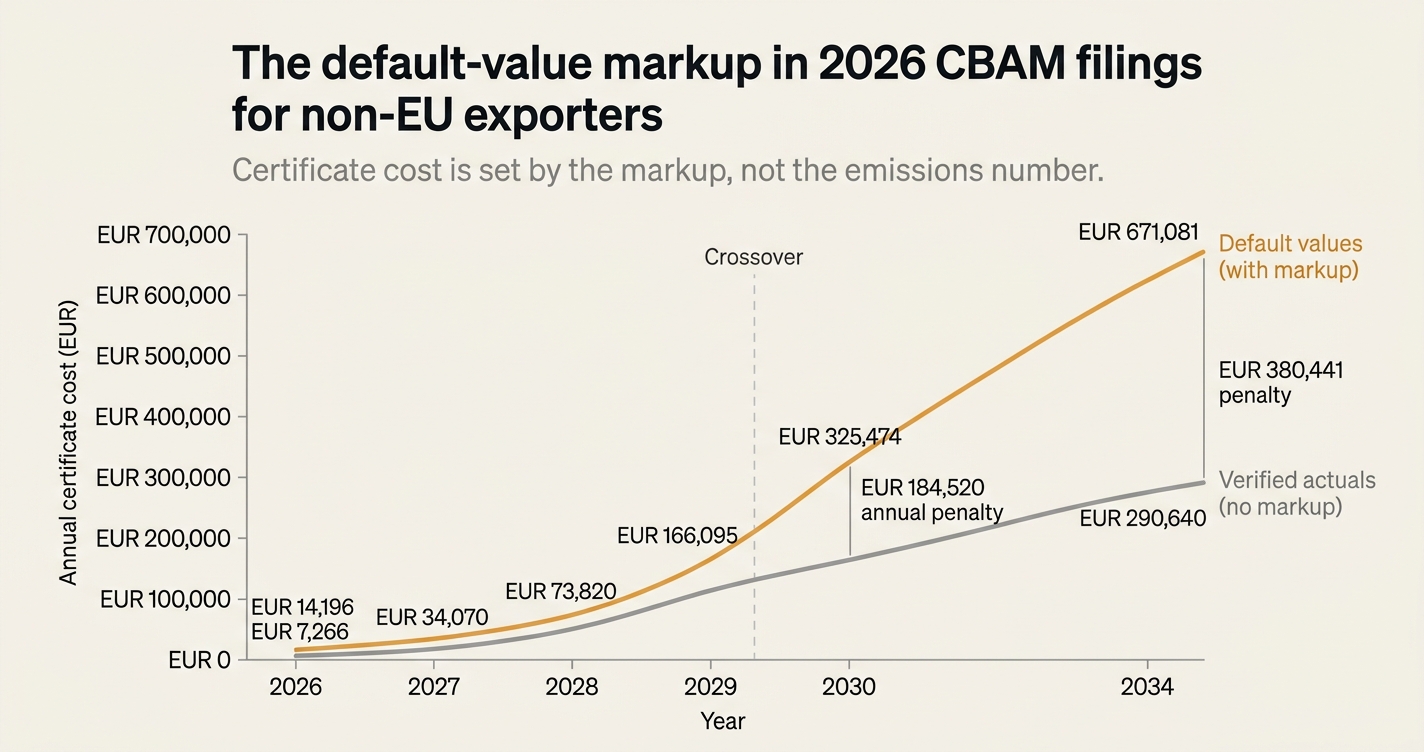
While the 2026 phase-in factor is low, the markup creates a permanent cost differential that scales over time. If an exporter ships 5,000 tonnes of hot-rolled steel coil from the UK using the blast furnace, basic oxygen furnace route, the default benchmark is 1.370 tCO2e per tonne. At an EU ETS price of EUR 75.36 per tonne and a 2.5% phase-in factor, the gross certificate cost is EUR 516,216. The 10% markup raises the 2026 net cost to approximately EUR 14,196. That appears small. But by 2030, when the phase-in factor reaches 48.5% and the markup is 30%, the same shipment costs approximately EUR 325,474 per year. At full phase-out in 2034, it is approximately EUR 671,081. If the exporter had provided verified actual emissions of 1.05 tCO2e per tonne—a realistic figure for an efficient UK mill—and documented UK ETS costs paid at production, the 2026 net cost falls to approximately EUR 7,266, a saving of nearly 49%. By 2030, that gap widens to approximately EUR 184,500 per year, and by 2034 to approximately EUR 380,400.[2]
How do you solve this? I think exporters who assume defaults are a neutral fallback are building a structural cost penalty into their supply chain. The operators we work with treat 2026 as a data rehearsal: they monitor installation-level emissions under CBAM methodology now, document precursor inputs and electricity carbon intensity, and engage accredited verifiers so that the first calendar year of imports is backed by compliant data. The verification timeline is the binding constraint, not the emissions calculation. Verification must include a physical site visit in 2026, and verifiers assess the monitoring plan, system boundaries, and precursor emissions before issuing a report.[3] For the 2026 calendar year, verification reports can be issued from January 2027, which creates a tight window before the first annual declaration is due on September 30, 2027. Exporters who start monitoring in mid-2026 will likely miss that deadline and fall back to defaults—and the markup—for at least one cycle.
Visualised:
The arithmetic of the markup
The CBAM certificate cost is calculated per tonne of embedded emissions, then scaled by the annual phase-in factor. The markup applies before the phase-in factor, meaning it inflates the gross liability, not just the net cost. The full calculation for a simple good is:
- Multiply the embedded emissions intensity (tCO2e per tonne of product) by the quantity imported (tonnes).
- Multiply the result by the prevailing EU ETS allowance price (EUR per tonne CO2).
- Apply the default-value markup if actual data is not verified: gross cost × (1 + markup percentage).
- Subtract any deduction for carbon costs paid in the country of origin (if documented and qualifying).
- Multiply the adjusted gross cost by the CBAM phase-in factor for the year.
For complex goods—those manufactured from CBAM-covered precursors—the calculation involves a product-specific benchmark plus precursor-level emissions, and the net liability in early years may be lower than a simple good due to free allocation adjustments. But the markup still applies to the gross cost, and the directional conclusion holds: verified actual data below the default benchmark reduces the certificate cost by more than the emissions difference alone.
| Year | Phase-in factor | Default markup | Net cost (defaults) | Net cost (actuals) | Annual saving |
|---|---|---|---|---|---|
| 2026 | 2.5% | 10% | EUR 14,196 | EUR 7,266 | EUR 6,930 |
| 2027 | 5.0% | 20% | EUR 34,070 | EUR 14,532 | EUR 19,538 |
| 2028 | 10.0% | 30% | EUR 73,820 | EUR 29,064 | EUR 44,756 |
| 2029 | 22.5% | 30% | EUR 166,095 | EUR 65,394 | EUR 100,701 |
| 2030 | 48.5% | 30% | EUR 325,474 | EUR 140,954 | EUR 184,520 |
| 2034 | 100.0% | 30% | EUR 671,081 | EUR 290,640 | EUR 380,441 |
The table above uses the UK steel example from the lead: 5,000 tonnes per year, BF-BOF route, default benchmark 1.370 tCO2e per tonne, verified actual 1.05 tCO2e per tonne, UK ETS deduction EUR 20 per tonne CO2, EU ETS price EUR 75.36. Figures are directional; exact liability depends on precursor mass balance and free allocation rules for complex goods.[2]
Why defaults are punitive by design
The European Commission set default values to prevent carbon leakage, not to approximate actual emissions. Default benchmarks are based on country-level average intensity where reliable data exists, or on the average of the top ten exporting countries where it does not.[4] For most modern installations, the default overstates actual performance. A Bipartisan Policy Center report published in January 2026 noted that US-assigned default values for iron and steel goods are consistently higher than estimates reported by the International Trade Commission, and concluded that more US data is needed to help exporters avoid inflated CBAM liability under conservative defaults.[4]
The markup escalates the penalty. In 2026, the markup is 10%, rising to 20% in 2027 and 30% from 2028 onward. The markup is applied to the gross certificate cost, meaning it compounds with the phase-in factor as the years pass. By 2030, the markup alone adds approximately EUR 97,000 per year to the UK steel example above. By 2034, it adds approximately EUR 205,000. The markup is not a data-quality adjustment; it is a policy lever designed to push exporters toward verified actuals.
The verification bottleneck
Actual emissions data must be verified by an accredited CBAM verifier before it can be used in place of defaults. Verification includes a risk-based assessment of the monitoring plan, system boundaries, precursor emissions, and production route allocations. The verifier applies a 5% materiality threshold: if the emissions report contains misstatements or non-conformities above that level, verification fails and the importer reverts to defaults.[5]
For the first verification covering 2026, a physical on-site visit is mandatory. Subsequent years may allow virtual visits or waivers if there are no significant changes to the installation or its monitoring plan. Verification can only be completed after the calendar year ends, and verifiers must assess emissions in the order they occur in the supply chain. For complex goods with multiple precursors, this creates a sequential verification queue. Importers must submit their annual CBAM declaration by September 30 of the following year, which leaves nine months for the producer to monitor, report, and verify emissions, and for the importer to aggregate and file.[1]
Accredited verifiers are not expected to be operating at scale before September 2026.[2] Exporters who wait until mid-2026 to start monitoring will almost certainly miss the deadline for the 2026 calendar year and fall back to defaults—and the markup—for at least one filing cycle. The cost of that delay is quantifiable: approximately EUR 6,930 in 2026, rising to approximately EUR 184,500 by 2030, for the UK steel shipment above.
The UK ETS deduction
Article 9 of the CBAM Regulation allows EU importers to deduct a carbon price that has genuinely been paid on embedded emissions in the country of origin. For UK exporters, UK ETS costs are a plausible candidate. However, two constraints apply. First, the deduction is only available for emissions on which a carbon price was actually paid. Any free allocation the producer receives under the UK ETS reduces the qualifying deduction. Second, the detailed implementing rules setting out how a third-country carbon price is calculated, certified, and deducted were published in draft form by the European Commission on May 13, 2026, with consultation running to June 10, 2026.[2] Exporters should confirm the finalised rules with their CBAM verifier before locking in a deduction figure.
The deduction applies per tonne of CO2 and is subtracted from the gross certificate cost before the phase-in factor is applied. For the UK steel example, if the mill paid GBP 18 per tonne CO2 under the UK ETS and received no offsetting free allocation, the deduction is approximately EUR 20 per tonne, or EUR 105,000 per year on 5,250 tCO2e of embedded emissions. Without verified actual data, the exporter cannot document the deduction, and the importer forfeits it.
The supplier engagement timeline
EU importers depend entirely on data from non-EU installation operators. For imports in 2026, the full calendar year must be covered. Producers must collect data according to a monitoring plan, report this data to accredited verifiers, and obtain a compliant verification report. The monitoring plan must specify the system boundaries, emission sources, measurement methods, and precursor data sources. The emissions report is a technical compliance document that allows the verifier to trace what was monitored, how calculations were done, and what data sources were used.[5]
For exporters, this means three things. First, the monitoring plan should be in place before January 1, 2026, not designed retrospectively. Second, precursor suppliers must also monitor and verify their emissions if the exporter wants to use their actual data rather than defaults for precursors. Third, the emissions report must be transmitted to the verifier either via the CBAM Registry or by other means, and the report must be in English. Exporters who have not registered with the CBAM Registry should confirm the submission process with their verifier.
The timeline for 2026 imports is:
- January 1, 2026: CBAM definitive phase begins. Embedded emissions in imports start accumulating certificate liability.
- December 31, 2026: Monitoring period for 2026 calendar year ends.
- January–March 2027: Producers compile emissions reports and submit to verifiers.
- March–June 2027: Verifiers conduct site visits, assess data, and issue verification reports.
- June–September 2027: EU importers aggregate verified data and prepare annual declaration.
- September 30, 2027: Deadline for first annual CBAM declaration covering 2026 imports.
Exporters who start monitoring in mid-2026 will likely miss the verification window. The cost of that delay is the markup penalty for one full year, which at 2030 volumes and phase-in rates is approximately EUR 184,500 per year for the UK steel example.
How Emission3 fits
Emission3 is productized CBAM implementation backed by compliance infrastructure. We help non-EU exporters and EU importers become CBAM-ready in weeks, using the compliance infrastructure we already built.
Our document-first ingestion layer pulls installation-level data from invoices, bills of material, utility bills, and production records, and converts it into line-item evidence. Every number is reproducible, with a full lineage from source document to filing. The deterministic LLM layer maps raw inputs to CBAM methodology, assigns system boundaries, and allocates emissions to specific production processes. The output is a CBAM emissions report formatted for verifier submission, plus an evidence pack that satisfies audit requirements.
For the UK steel exporter in the example above, Emission3 would ingest monthly utility bills, production logs, and precursor invoices throughout 2026, monitor embedded emissions per tonne in real time, and generate a compliant emissions report by January 2027. The exporter engages a verifier in February, completes the site visit in March, and receives the verification report in April. The EU importer files the annual declaration in July, two months ahead of the deadline, using verified actuals at 1.05 tCO2e per tonne instead of the default 1.370, and documents the UK ETS deduction. The 2026 certificate cost is EUR 7,266 instead of EUR 14,196. By 2030, the cumulative saving is approximately EUR 825,000.
This is not a generic SaaS product. It is productized implementation supported by compliance infrastructure: we map your suppliers, identify data gaps, build the monitoring plan, and route the emissions report to your verifier. The installation-level data flow is the same infrastructure we built for CBAM, California SB 253, and EU CSRD limited-to-reasonable assurance transitions.
If you are a non-EU exporter facing CBAM or an EU importer managing supplier data, the default-value markup is a structural cost line that scales with the phase-in. The arithmetic is deterministic, the timeline is binding, and the verification requirement is mandatory. The operators who treat 2026 as a data rehearsal will save approximately EUR 6,930 per 5,000 tonnes shipped this year, and approximately EUR 380,000 per year by 2034. The operators who wait will pay the markup—and the penalty compounds.
Book a CBAM readiness call. We start with a supplier map, a gap analysis, and a 12-week implementation timeline. No anonymous self-serve onboarding. Every engagement begins with a workflow conversation.
References & Sources
External Sources
- [1]CBAM reporting requirements & Compliance Guide for 2026
Comprehensive overview of CBAM reporting requirements, including the definitive phase from January 2026, quarterly reporting deadlines, and the shift from default values to verified actuals. Details the markup structure and verification timeline.
- [2]EU CBAM 2026: How to calculate your liability
Worked example of CBAM certificate cost calculation for UK steel exporters using BF-BOF route, comparing default values with verified actuals. Quantifies the markup penalty over the phase-in period from 2026 to 2034.
- [3]CBAM for US Exporters: EU Carbon Border Rules in 2026
Verification process requirements for CBAM, including mandatory site visits per installation and the issuance of verification reports. Explains the operational constraints for exporters seeking to use actual emissions data.
- [4]High CBAM Default Values Underscore the Need for U.S. Data
Bipartisan Policy Center report from January 2026 highlighting that US-assigned default values for iron and steel goods are consistently higher than International Trade Commission estimates. Argues that more US data is needed to avoid inflated CBAM liability.
- [5]EU CBAM Emissions Data: Monitoring, Reporting & Verification
Detailed explanation of CBAM monitoring, reporting, and verification requirements under Implementing Regulations 2025/2547 and 2025/2546. Covers the 5% materiality threshold, site visit requirements, and the compliance interface between importers and suppliers.
- [6]How the EU's New Default Emissions Values Under CBAM Impact US Exporters
O'Melveny legal analysis of the December 2025 EU regulation setting default greenhouse gas emission values and markup system. Explains the 10%, 20%, and 30% markup schedule and its implications for US iron and steel exporters.
Related Content
- [7]How Emission3 handles CBAM
Specific to CBAM exporters, shows the installation-data flow from raw documents to verified emissions reports. Details the document-first ingestion, deterministic LLM layer, and registry-oriented outputs that make CBAM compliance auditor-ready.
- [8]Book a CBAM readiness call
All customers start with a readiness call: we map suppliers, gaps, and implementation, no anonymous self-serve onboarding. CBAM readiness conversations route directly to a 12-week implementation timeline.