The audit-trail terminology gap in 2026 US disclosure assurance
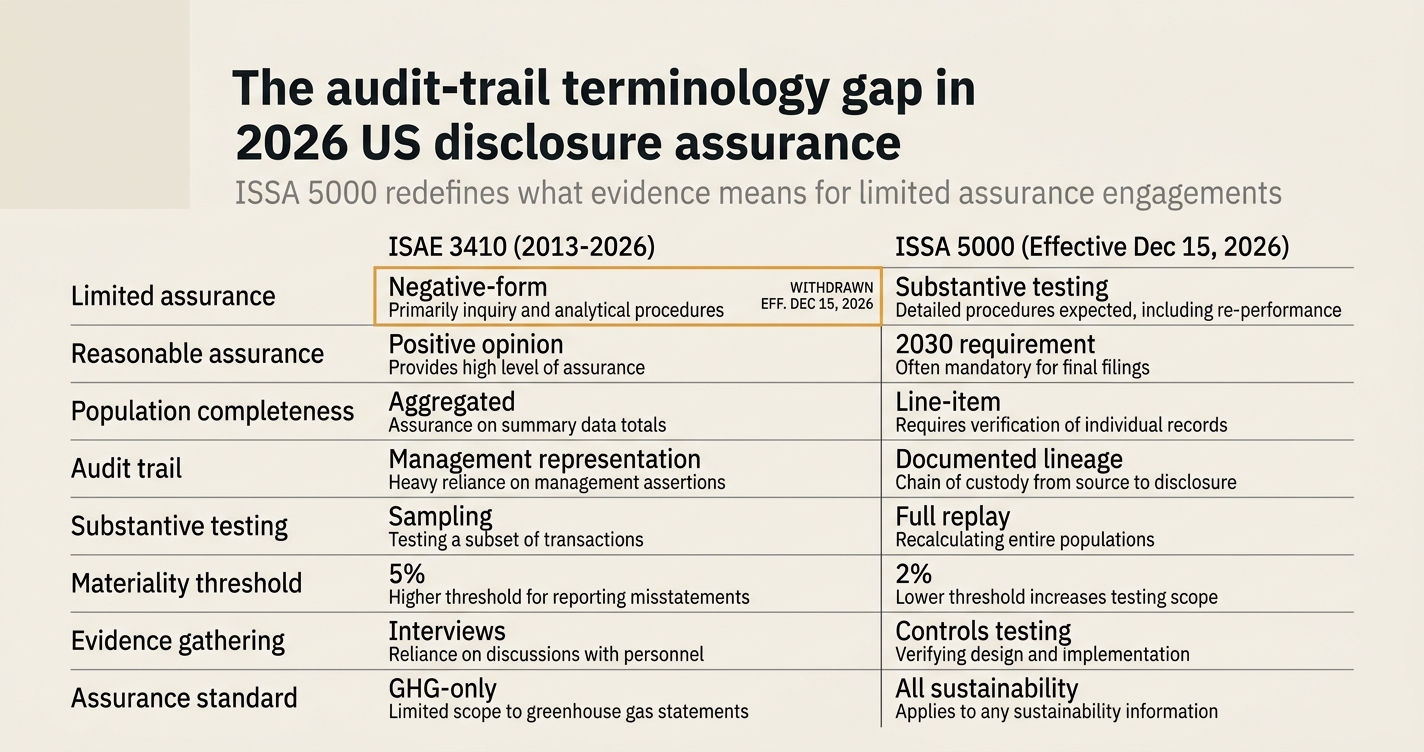
The audit-trail terminology gap in 2026 US disclosure assurance
Here's the issue: when California SB 253 requires limited assurance on Scope 1 and Scope 2 emissions by June 2026, finance teams budget for the engagement fee and assume the assurance provider will follow ISAE 3410, the International Standard on Assurance Engagements for greenhouse gas statements. The standard has been in use since 2013, most auditors know it, and the engagement scope looks contained. A limited assurance engagement for 10,000 tonnes of Scope 2 emissions from utility invoices might cost €25,000, with evidence gathering taking two weeks. The workflow feels manageable.
However, US disclosure assurance in 2026 consists of two things: the assurance standard and the audit trail evidence the standard requires.
The assurance standard on its own has no value. The audit trail evidence is what the assurance provider is actually testing, sampling, and signing. While ISAE 3410 has been stable since 2013, the evidence expectations embedded in that standard—population completeness, calculation lineage, third-party validation—have become more expensive as Scope 3 disclosure expands and as regulators demand line-item proof, not summary totals. The International Auditing and Assurance Standards Board withdrew ISAE 3410 effective December 15, 2026, replacing it with ISSA 5000, a new sustainability assurance standard that includes greenhouse gas emissions but applies broader evidence principles borrowed from financial statement audits[1]. The withdrawal means that any limited assurance engagement covering fiscal year 2025 data and submitted after December 15, 2026, must use ISSA 5000, not ISAE 3410.
While assurance standards have become more unified, the cost of producing audit trail evidence has increased. If a California reporting entity submits its first SB 253 report in June 2026 using ISAE 3410, but the assurance provider identifies material gaps in source data lineage—missing invoices, unclassified supplier emissions, manual spreadsheets with no version control—the engagement may require a second round of evidence gathering to meet ISSA 5000 expectations for the 2027 filing. A recent LRQA verification statement for a U.S. aerospace manufacturer covering fiscal year 2025 emissions noted that limited assurance focused on aggregated data and management interviews, with less source data checking than a reasonable assurance engagement would require[4]. The gap between limited and reasonable assurance is quantified: limited assurance provides negative-form conclusions with lower confidence in completeness and accuracy, while reasonable assurance requires broader control testing and deeper examination of underlying data[8].
How do you solve this? I think the answer depends on whether you are building the audit trail for a single year or for a multi-year escalation timeline. For reporting entities that treat 2026 as a one-time compliance exercise, the risk is that the 2027 engagement under ISSA 5000 will cost more because the evidence base built in 2026 does not meet the new standard's expectations for substantive testing and population completeness. For teams that build a document-first evidence system in 2026—invoice-level lineage, deterministic calculation paths, third-party validation records—the transition to ISSA 5000 becomes a formatting change, not a re-audit. The operators we work with are choosing the second path, because the assurance fee for 2027 is set by the evidence infrastructure you build in 2026.
The shape of the argument, visualised below.
Eight terms auditors will use in 2026 US disclosure engagements
The table below defines the vocabulary that third-party assurance providers will use when scoping limited assurance engagements for California SB 253 Scope 1 and Scope 2 disclosure. Each term is defined in plain English, followed by a worked example and the source regulation or standard.
| Term | Plain-English Definition | Worked Example | Source |
|---|---|---|---|
| Limited assurance | A negative-form conclusion stating that nothing has come to the assurance provider's attention to indicate the information is materially misstated. Evidence gathering is less extensive than reasonable assurance. | An assurance provider reviews aggregated Scope 2 emissions totals, interviews the sustainability manager, and samples 15% of utility invoices. The conclusion states: "Based on our review, nothing has come to our attention that causes us to believe the emissions data is materially misstated." | ISAE 3410 / ISSA 5000[1][7] |
| Reasonable assurance | A positive-form opinion that the information has been prepared, in all material respects, in accordance with the applicable criteria. Requires broader control testing, deeper data examination, and higher evidence thresholds. | An assurance provider tests 100% of emission sources, validates calculation methodologies, inspects internal controls for data capture, and provides a positive opinion: "In our opinion, the emissions data presents fairly, in all material respects, the entity's greenhouse gas inventory." California SB 253 requires this from 2030 for Scope 1 and Scope 2. | ISSA 5000 / California SB 253[2][7] |
| Population completeness | The requirement that all emission sources within the reporting boundary are identified, classified, and included in the inventory, with no systematic omissions. | A reporting entity with 12 manufacturing sites must demonstrate that utility data for all 12 sites is captured. If two sites are excluded because invoices were unavailable, the assurance provider flags the gap as a population completeness failure. | ISSA 5000 / AA1000AS |
| Audit trail | A documented, reproducible chain linking each emissions figure back to its source evidence (invoices, meter readings, supplier certificates) and forward through calculation steps to the final reported total. | A Scope 2 emissions figure of 4,250 tonnes CO2e must trace back to 48 monthly utility invoices, each with a kWh reading, an emission factor source, and a calculation worksheet showing kWh × factor = emissions. The auditor must be able to replay the calculation. | ISSA 5000 / GHG Protocol Corporate Standard |
| Substantive testing | Procedures that test the accuracy and validity of individual transactions or data points, rather than relying solely on management representations or aggregated summaries. | An assurance provider selects 20 utility invoices at random and recalculates the emissions for each invoice using the stated methodology and emission factors. Any discrepancy greater than 2% triggers further investigation. | ISAE 3410 / ISSA 5000[1][8] |
| ISAE 3410 | International Standard on Assurance Engagements 3410, the previous standard for greenhouse gas statement assurance, in use from 2013 to December 15, 2026. Focused narrowly on GHG emissions. | A 2025 limited assurance engagement for a U.S. manufacturer uses ISAE 3410 procedures: the assurance provider reviews aggregated data, samples invoices, and issues a negative-form conclusion. The standard is withdrawn effective December 15, 2026. | IAASB[1] |
| ISSA 5000 | International Standard on Sustainability Assurance 5000, effective December 15, 2026, replacing ISAE 3410. Covers all sustainability information, not just GHG emissions, and applies financial-audit-style evidence principles to sustainability data. | A 2027 limited assurance engagement for California SB 253 uses ISSA 5000 procedures: the assurance provider tests controls, validates calculation methodologies, inspects source documents, and applies materiality thresholds consistent with financial statement audits. | IAASB / ISSA 5000[7] |
| Materiality threshold | The level above which a misstatement or omission would influence the decisions of users relying on the sustainability information. Typically set as a percentage of total emissions (e.g., 5% for limited assurance, 2% for reasonable assurance). | A reporting entity discloses 50,000 tonnes CO2e total emissions. With a 5% materiality threshold, any error or omission exceeding 2,500 tonnes must be corrected before the assurance provider can issue a clean opinion. | ISSA 5000 / ISAE 3410[4] |
Why the terminology gap creates audit-cycle delays
The withdrawal of ISAE 3410 and the adoption of ISSA 5000 introduces a procedural mismatch. Teams that prepared evidence under ISAE 3410 expectations—aggregated data, limited source document review, negative-form conclusions—will find that ISSA 5000 requires stronger evidence for the same limited assurance engagement. The new standard applies financial-audit-style principles: substantive testing of individual transactions, validation of internal controls, and documented lineage from source to reported figure[7].
A 2026 limited assurance engagement under ISAE 3410 might accept management's representation that utility invoices for 48 months are "substantially complete," with the assurance provider sampling 12 invoices (25%) and finding no material errors. The same engagement under ISSA 5000 in 2027 would require the assurance provider to test whether the 48-invoice population is actually complete—were any invoices missing, were any sites excluded, were any billing periods skipped? If the evidence system built in 2026 does not capture invoice completeness, the 2027 engagement must gather that evidence from scratch, adding cost and cycle time.
The California Air Resources Board clarified in an August 2025 workshop that limited assurance must follow "a systematic, independent and documented process for evaluating a Reporting Entity's emissions data report against CARB's reporting procedures and methods for calculation and reporting of GHG emission"[6]. The word "documented" is the load-bearing term. Documentation means line-item evidence, not summary totals. An assurance provider cannot issue a clean opinion if the reporting entity cannot produce the invoices, the calculation worksheets, and the emission factor sources on demand.
"The extent of evidence-gathering for a limited assurance engagement is less than for a reasonable assurance engagement. Limited assurance engagements focus on aggregated data rather than physically checking source data at sites. Consequently, the level of assurance obtained in a limited assurance engagement is lower than the assurance that would have been obtained had a reasonable assurance engagement been performed."[4]
This LRQA verification statement, covering a U.S. aerospace manufacturer's fiscal year 2025 emissions, illustrates the evidence gap. Limited assurance focuses on aggregated data, but ISSA 5000 tightens the aggregation standard. The assurance provider must now document why the aggregation is reliable—what controls prevented omissions, what validation steps confirmed completeness, what source documents support each aggregated total. If those controls and documents do not exist, the engagement stalls.
The enforcement-notice trap for 2026 filers
California's enforcement notice for the first SB 253 reporting cycle, published December 2024, states that reporting entities may submit Scope 1 and Scope 2 data by June 30, 2026, even if limited assurance is not yet complete[6]. The notice was intended as relief for entities that could not secure an assurance provider in time. But the relief creates a procedural trap: if a reporting entity submits unassured data in June 2026, the assurance engagement must occur later in 2026 or early 2027, after ISSA 5000 becomes effective December 15, 2026. The assurance provider will apply ISSA 5000 procedures to fiscal year 2025 data that was collected under ISAE 3410 expectations. Any evidence gaps discovered during the engagement cannot be fixed by "updating" the data—fiscal year 2025 is closed, the invoices are historical, the evidence is what it is.
A workshop participant asked CARB staff whether the enforcement notice could be used as a reason to avoid assurance entirely. The CARB response was clear: the enforcement notice applies only to the first year, and the expectation is that limited assurance will be required for 2027 and all subsequent years[6]. The notice defers the assurance deadline, it does not waive the requirement.
The trap is that deferring assurance from June 2026 to January 2027 shifts the engagement from ISAE 3410 to ISSA 5000, increasing the evidence burden without changing the underlying data. A reporting entity that builds line-item evidence in 2026—invoice-level lineage, deterministic calculations, third-party validation records—can meet either standard. A reporting entity that builds aggregated summaries in 2026 will face a re-audit in 2027.
How Emission3 fits
Emission3 is positioned as document-first compliance infrastructure for US disclosure assurance. The platform ingests source documents—utility invoices, bills of material, supplier certificates—at line-item granularity, extracts the activity data using a deterministic LLM layer, and generates audit-ready exports that include calculation lineage, emission factor sources, and evidence packs[9]. Every emissions figure is reproducible, with a full chain from source document to reported total.
For California SB 253 filers, Emission3 solves the terminology gap by building ISSA 5000-compliant evidence in 2026, before the standard becomes effective. The platform's audit-ready exports include:
- Population completeness reports: a table listing all emission sources, all invoices, and any missing data, so the assurance provider can verify the boundary.
- Calculation lineage worksheets: for each emissions figure, a step-by-step breakdown showing activity data × emission factor = result, with source citations.
- Evidence packs: PDFs bundling the original invoices, the extraction log, and the calculation worksheet, indexed by line item.
The deterministic LLM layer means that auditors can replay the extraction and calculation steps, verifying that the platform applied the stated methodology consistently across all invoices[10]. This is substantive testing at population scale, not sampling.
The workflow is call-first. Teams start with a CBAM readiness or US disclosure scoping conversation, not anonymous onboarding. The goal is to map the entity's emission sources, identify the evidence gaps, and build a document-ingestion plan that meets ISSA 5000 expectations before the first assurance engagement.
If you are preparing for California SB 253 limited assurance in 2026, or if you are an assurance provider scoping ISSA 5000 engagements for 2027, Emission3's audit-ready exports show how document-first evidence solves the terminology gap[5]. The platform is built for the compliance infrastructure US disclosure requires, not generic SaaS.
Who should care about this
Three groups face immediate consequences from the ISAE 3410-to-ISSA 5000 transition:
-
California SB 253 reporting entities with June 2026 deadlines. If your evidence system produces aggregated summaries, not line-item lineage, the 2027 assurance engagement under ISSA 5000 will cost more because the assurance provider must gather population-level evidence from scratch. If you build document-first evidence in 2026, the transition to ISSA 5000 is a formatting change, not a re-audit.
-
Third-party assurance providers scoping 2027 engagements. ISSA 5000 requires substantive testing of individual transactions, not just management interviews and aggregated data reviews. If your clients built evidence under ISAE 3410 expectations, the 2027 engagement cycle will include evidence-gathering work that should have been completed in 2026.
-
CFOs budgeting for multi-year assurance escalation. California SB 253 requires limited assurance from 2026 to 2029, then reasonable assurance from 2030. Reasonable assurance requires positive-form opinions, broader control testing, and materiality thresholds as low as 2%[2][7]. The cost of reasonable assurance is set by the evidence infrastructure you build during the limited assurance years. If the 2026-2029 evidence base does not support population completeness and calculation lineage, the 2030 reasonable assurance engagement will require a full evidence rebuild.
The terminology gap is not a semantic issue. It is a workflow and cost issue. The withdrawal of ISAE 3410 and the adoption of ISSA 5000 increase the evidence burden for the same limited assurance engagement. Teams that build document-first evidence in 2026 absorb the transition cost once. Teams that defer evidence-building until 2027 pay twice: once for the incomplete 2026 data, and again for the ISSA 5000 re-audit.
If you are a CFO, sustainability lead, or assurance provider preparing for US disclosure assurance in 2026, the right question is not "which standard applies?" The right question is "what evidence does the standard require, and do we have it?" Emission3's audit-ready exports answer both questions. Start with a CBAM readiness or US disclosure workflow review[11], and we will show you what ISSA 5000-compliant evidence looks like at line-item scale.
[1] https://www.iaasb.org/consultations-projects/assurance-greenhouse-gas-statement [2] https://corpgov.law.harvard.edu/2025/10/02/u-s-companies-face-potential-ghg-disclosure-obligations-in-2026 [3] https://www.haleyaldrich.com/resources/articles/california-climate-disclosure-regulations-are-coming-heres-how-to-prepare [4] https://www.l3harris.com/sites/default/files/2026-05/L3Harris%202025%20GHG%20Verification%20Statement.pdf [5] /solutions/audit [6] https://www.youtube.com/watch?v=h979MRn7JfE [7] https://www.spectreco.com/blog/issa-5000-sustainability-assurance-2026-readiness [8] https://www.acclaro-advisory.com/esg-reporting-regulations/sustainability-assurance [9] /product/ai [10] /product/ai [11] /contact
References & Sources
External Sources
- [1]Assurance on a Greenhouse Gas Statement (to be withdrawn Dec. 15, 2026)
IAASB announcement of ISAE 3410 withdrawal, effective December 15, 2026, replaced by ISSA 5000.
- [2]U.S. Companies Face Potential GHG Disclosure Obligations in 2026
California SB 253 timeline: limited assurance required June 2026 for Scope 1 and Scope 2, reasonable assurance from 2030.
- [3]How to Prepare for California's Climate Regulations
Limited assurance definition: sufficient and appropriate evidence that nothing came to the auditor's attention indicating material misstatement.
- [4]LRQA Independent Assurance Statement
Limited assurance engagement for U.S. aerospace manufacturer, fiscal year 2025, showing materiality threshold of 5% and aggregated data focus.
- [6]Workshop: California Corporate GHG Reporting and Climate Related Financial Risk Disclosure Programs
CARB staff clarification on enforcement notice: assurance deferral applies to 2026 only, limited assurance required from 2027 onward.
- [7]ISSA 5000 Explained: How to Prepare for Mandatory Sustainability Assurance in 2026
ISSA 5000 overview: reasonable assurance requires positive opinion, broader control testing, deeper data examination, effective December 15, 2026.
- [8]Sustainability Assurance Support
Risk-based procedures for limited assurance: substantive testing, population completeness, audit trail, ISAE 3410 and ISSA 5000 procedures.
Related Content
- [5]Audit-ready exports in Emission3
Document-first compliance infrastructure for US disclosure assurance, producing line-item evidence and calculation lineage for ISSA 5000 engagements.
- [9]The Emission3 AI layer
Deterministic LLM layer for document ingestion, auditors can replay extraction and calculation steps to verify methodology consistency.
- [10]The Emission3 AI layer
Deterministic LLM layer enabling substantive testing at population scale, not sampling.
- [11]Ask a specific question
Start with a CBAM readiness or US disclosure workflow review, direct line to the founder for persona-specific questions.