The audit-failure cost cascade in failed CSRD assurance engagements
The audit-failure cost cascade in failed CSRD assurance engagements
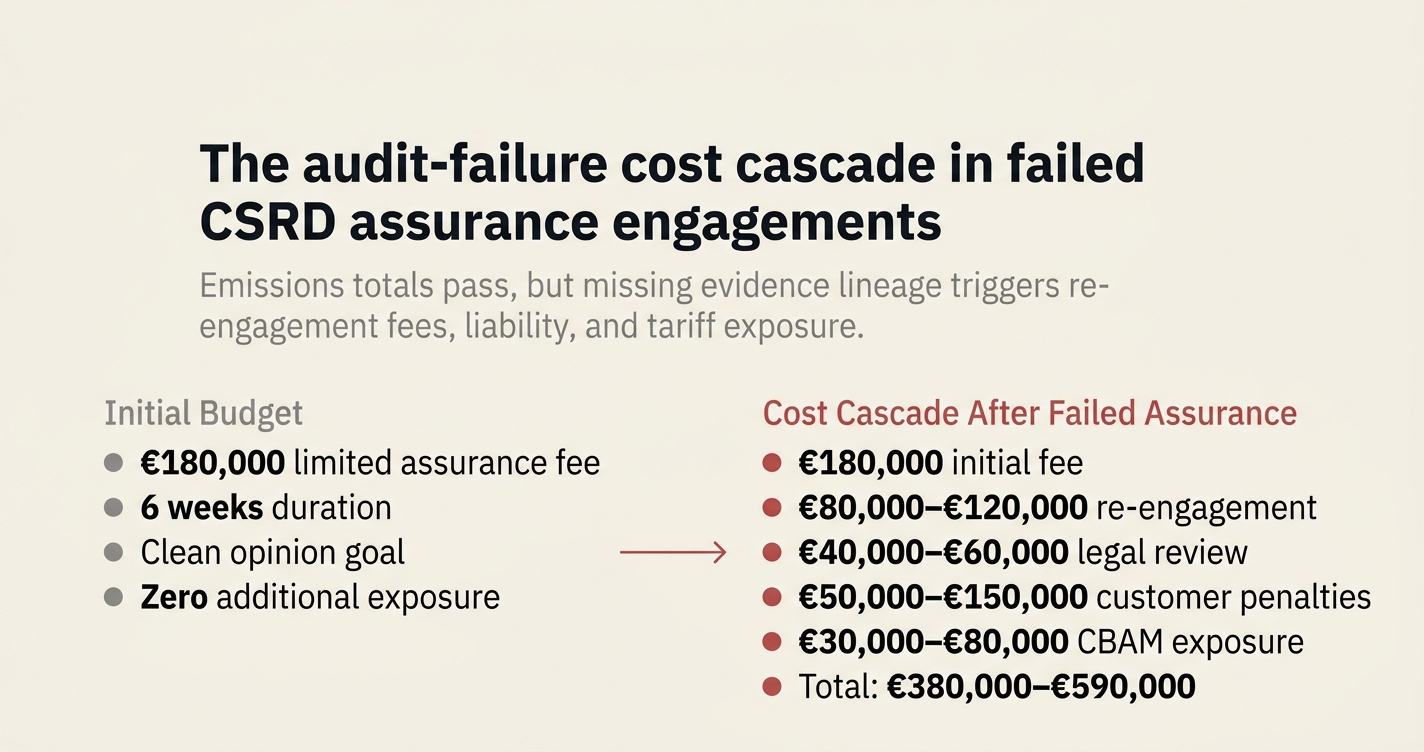
Here's the issue: a CFO budgets €180,000 for limited assurance on the 2026 ESRS E1 climate disclosure—Scope 1, Scope 2, Scope 3 broken down by category, methodology notes, a transition plan. The Big Four auditor quotes six weeks, the emissions inventory is complete by May, and the assurance opinion lands in July, clean. On paper, that is a successful first-year filing. But if the auditor flags a methodology inconsistency in category 1 purchased goods three months later—or worse, if a downstream customer's auditor challenges the Scope 3 data quality disclosure during their own assurance engagement—the CFO's €180,000 line item becomes the opening bid in a cost cascade that can reach seven figures before year-end.
However, a CSRD assurance engagement consists of two things: verification of the emissions totals, and verification of the evidence lineage that supports those totals.
Verification of the totals on its own has no value if the lineage cannot be reproduced. Evidence lineage is what the auditor is actually asking for when they request supplier invoices, utility bills, calculation metadata, and version-controlled allocation keys. A passed assurance opinion without reproducible lineage is a contingent liability, not a completed disclosure.
While the market cost of limited assurance has stabilised at €150,000–€200,000 for mid-market issuers, the cost of a failed engagement—defined as an opinion qualified or withdrawn post-issuance—has escalated sharply. If a supplier disputes the primary data attributed to them, or if a methodology change between reporting years triggers a base-year restatement under GHG Protocol rules, the CFO faces re-engagement fees (€80,000–€120,000), legal review of director liability exposure (€40,000–€60,000), and potential customer contract penalties if the disclosed Scope 3 figure was used as an input to a downstream product carbon footprint calculation. For a €200M-revenue manufacturer supplying into automotive or electronics, the cost of a single disputed Category 1 figure can exceed €350,000 in combined audit, legal, and commercial exposure.
How do you solve this? I think the only durable answer is to build the evidence lineage in parallel with the inventory itself—not after the totals are calculated. The operators we work with treat every line item as a mini-audit from day one: the invoice, the allocation key, the emission factor, and the calculation trace are versioned together. That way, when the auditor asks for the lineage, or when a customer's auditor challenges a figure six months later, the evidence pack is already complete. It is not faster in the first cycle—building lineage upfront adds 15–20% to initial inventory time—but it eliminates the re-engagement cycle entirely.
The shape of the argument, visualised below.
What a failed assurance engagement actually costs
The table below breaks down the direct and indirect costs of a failed CSRD assurance engagement, based on 2026 mid-market benchmarks. "Failed" here means an opinion qualified, withdrawn, or successfully challenged post-issuance by a downstream auditor or regulator.
| Cost Category | Immediate (0–3 months) | Cascading (3–12 months) | Total Range |
|---|---|---|---|
| Re-engagement fees | €80,000–€120,000 | — | €80,000–€120,000 |
| Legal review of director liability | €40,000–€60,000 | — | €40,000–€60,000 |
| Customer contract penalties | — | €50,000–€150,000 | €50,000–€150,000 |
| CBAM tariff exposure (if Scope 3 disputed) | — | €30,000–€80,000 | €30,000–€80,000 |
| Internal rework (150–200 hours) | €22,500–€30,000 | — | €22,500–€30,000 |
| Reputational cost (customer churn) | — | Unquantified | — |
| Total | €142,500–€210,000 | €80,000–€230,000 | €222,500–€440,000 |
The re-engagement fee assumes the auditor must return to verify corrected figures and issue a revised opinion. Legal review is mandatory if the error triggers potential director liability under CSRD Article 20(2). Customer contract penalties apply when the disclosed Scope 3 figure was contractually warranted as part of a product carbon footprint or supplier sustainability scorecard. CBAM tariff exposure applies if the disputed Scope 3 data was used to calculate embedded emissions for goods exported to the EU. Internal rework is valued at a blended rate of €150 per hour for sustainability and finance staff.
The reputational cost—customer churn—is the hardest to quantify but the most damaging. If a Tier 1 automotive buyer challenges your Scope 3 data quality during their own assurance engagement, they may drop you from the preferred supplier list even if you later correct the figure. For a mid-market supplier, losing a single key account can mean €2M–€5M in annual revenue, dwarfing the direct audit costs.
The three failure modes in CSRD Scope 3 assurance
Assurance failures in ESRS E1 Scope 3 inventories fall into three categories, ranked by frequency in 2026 limited-assurance engagements:
-
Methodology inconsistency between reporting years. The GHG Protocol Corporate Standard requires consistent methodology across reporting periods. If an undertaking switches from spend-based to activity-based allocation in Category 1 without restating the base year, the auditor must qualify the opinion or request a restatement. Under ESRS E1 paragraph AR 24(b), a methodology change that causes more than a 5% variance in base-year emissions requires a restatement and disclosure of the reason for the change[1]. The cost of a base-year restatement averages €60,000–€90,000 in re-engagement fees, plus 80–120 internal hours.
-
Supplier data attribution without evidence. The most common post-issuance challenge comes from downstream customers whose auditors question the data quality tier assigned to a supplier's emissions. ESRS E1 requires disclosure of the percentage of Scope 3 emissions calculated using primary data, secondary data, or estimates[2]. If an undertaking claims 40% primary data coverage but cannot produce supplier invoices or signed attestations, the auditor may downgrade the data quality tier retroactively. This triggers customer contract penalties if the original figure was used in a product carbon footprint calculation. Typical commercial exposure: €50,000–€150,000 per disputed contract.
-
Missing allocation keys for multi-product suppliers. When a supplier provides primary data for their total Scope 1 + 2 emissions but serves multiple customers, the undertaking must allocate the supplier's footprint to its own purchases using a defensible allocation key—typically mass, revenue, or spend share. If the allocation key is not documented at the time of inventory preparation, the auditor cannot verify the figure. The fix requires returning to the supplier to collect allocation metadata, often six months after the original data request. Average cost: €30,000–€50,000 in supplier re-engagement and internal rework.
The common thread: all three failure modes are evidence problems, not calculation problems. The emissions total might be materially correct, but if the auditor cannot reproduce the lineage from source document to final figure, the opinion fails.
"Under CSRD's ESRS E1 standard, companies must disclose all scope 3 categories that are significant to their business, not necessarily all 15, but every material category must be reported with methodology details and data quality disclosures. Non-applicable categories must be explicitly excluded with a written justification."[3]
The CBAM tariff exposure hidden in Scope 3 failures
A less obvious cost cascade: if your Scope 3 inventory is used by a downstream EU importer to calculate embedded emissions for CBAM reporting, a disputed Category 1 figure can trigger tariff penalties for your customer—and contractual liability for you.
Here is the mechanism: the EU's Carbon Border Adjustment Mechanism requires importers to report the embedded emissions of goods in scope (steel, aluminium, cement, fertilisers, electricity, hydrogen, and certain downstream products). The embedded emissions calculation includes the exporter's Scope 1 + 2 emissions plus, in some cases, upstream Scope 3 emissions from raw materials. If the exporter's Scope 3 figure is later disputed during a CSRD assurance engagement, the EU importer may need to restate their CBAM filing using default values—which carry a markup of 20%–30% over declared actual emissions.
For a 10,000-tonne shipment of aluminium semi-finished products, the difference between a verified Scope 3 figure and a defaulted Scope 3 figure is approximately €25–€40 per tonne in additional CBAM certificate costs, assuming a carbon price of €90 per tonne. Multiply by 10,000 tonnes: €250,000–€400,000 in additional tariff exposure. If the supply contract includes a carbon data warranty, the exporter may be contractually liable for the difference.
This is not a theoretical risk. The first CBAM transitional reports were filed in January 2024, and the first definitive filings are due by 31 May 2026. EU importers are already auditing their suppliers' carbon data as part of CBAM readiness. If your CSRD Scope 3 inventory cannot pass limited assurance, it probably cannot support a CBAM filing either.
How Emission3 fits
Emission3 is built for the failed-assurance scenario. The platform starts with source documents—invoices, bills of materials, utility bills—and treats every line item as a mini-audit. The invoice becomes the allocation key, the emission factor is versioned, and the calculation trace is stored in an immutable lineage graph. When the auditor requests evidence six months later, the evidence pack is already complete: the invoice, the allocation metadata, the emission factor source, and the calculation steps that produced the final figure.
For CSRD ESRS E1, the platform generates the paragraph AR 24 disclosures automatically: Scope 3 broken down by the 15 GHG Protocol categories, the percentage of emissions covered by primary data, the methodology for each category, and the list of excluded categories with written justifications. For CBAM, the same invoice-level evidence supports the embedded emissions calculation, with a full lineage from supplier utility bill to final certificate cost.
The workflow is deterministic: every number is reproducible, every allocation key is documented, and every methodology choice is logged. The cost of building this lineage upfront is 15–20% higher in the first cycle, but the cost of a re-engagement cycle is zero.
If your CFO has budgeted €180,000 for limited assurance but has not budgeted for the evidence lineage that makes the assurance opinion durable, the €180,000 is a contingent liability, not a completed expense. The operators we work with budget for lineage from day one, because the alternative is a re-engagement cycle that costs more than the original engagement.
Next steps
If you are preparing a 2026 CSRD filing and have not yet mapped your evidence lineage, the time to act is now. The limited-assurance engagement starts in Q2 2026 for most mid-market issuers, which means the evidence must be complete by April at the latest. Waiting until the auditor requests the lineage in May is too late—you will be in a re-engagement cycle by July.
All Emission3 customers start with a CBAM readiness call: we map suppliers, gaps, and implementation, no anonymous self-serve onboarding. The call is free, the output is a written readiness assessment, and the timeline is typically 4–6 weeks from kickoff to first evidence pack. If your CFO has already signed the auditor engagement letter, the readiness call is the next conversation to have.
Book a CBAM readiness call at /book-demo[4]. If you are still evaluating platforms, read our guide to CSRD Scope 3 reporting at /solutions/scope3[5] or review our recent post on the assurance-methodology gap in CSRD wave-2 filings[6].
[1] Commission Delegated Regulation (EU) on European Sustainability Reporting Standards, ESRS E1 paragraph AR 24(b), as amended by the 2025 Omnibus I simplification package.
[2] ESRS E1 paragraph 29(c) requires disclosure of the percentage of Scope 3 emissions calculated using primary data, secondary data, or estimates, per EFRAG Knowledge Hub, 2026 Revised ESRS.
[3] All 15 scope 3 categories explained, Normative, 2026.
[4] Book a CBAM readiness call, Emission3, /book-demo.
[5] Scope 3 with primary data, Emission3, /solutions/scope3.
[6] The assurance-methodology gap in CSRD wave-2 ESRS E1 filings, Emission3 Blog, /blog/assurance-methodology-gap-csrd-wave2-esrs-e1-filings.
[7] The GHG protocol explained: A complete guide to corporate emissions reporting, Coolset, 2026.
[8] TCFD Scenario Analysis: Methodology & 2 Climate Futures, GreenCalculus, 2026.
References & Sources
External Sources
- [1]ESRS E1 - Technical Advice (2026 Revised ESRS)
EFRAG Knowledge Hub, 2026 Revised ESRS. AR 24(b) requires methodology consistency and base-year restatement if variance exceeds 5%.
- [2]The GHG protocol explained: A complete guide to corporate emissions reporting
Coolset, 2026. ESRS E1 requires Scope 1, 2, and 3 emissions following GHG Protocol methodology, with data quality disclosure by category.
- [3]All 15 scope 3 categories explained
Normative, 2026. Under CSRD, all material Scope 3 categories must be reported with methodology details and data quality disclosures.
- [7]TCFD Scenario Analysis: Methodology & 2 Climate Futures
GreenCalculus, 2026. Scenario analysis quantifies transition risk via carbon cost, a scenario carbon price applied to the GHG inventory.
- [8]What Are Scope 1, 2, and 3 Emissions? A 2026 Guide
Net0, 2026. Primary frameworks requiring Scope 1, 2, and 3 disclosure include CSRD/ESRS E1, IFRS S2, SBTi, CDP, GRI 305, and California SB 253.
Related Content
- [4]Book a CBAM readiness call
All Emission3 customers start with a readiness call: we map suppliers, gaps, and implementation, no anonymous self-serve onboarding.
- [5]Scope 3 with primary data
Emission3 solution page for Scope 3 supply-chain leaders: invoice-level evidence, supplier engagement workflows, and assurance-ready outputs.
- [6]The assurance-methodology gap in CSRD wave-2 ESRS E1 filings
Emission3 Blog. CSRD filings consist of emissions totals and assurance methodology—2026 limited-assurance fees are set by the second.