The audit-evidence gap in CSRD wave-2 ESRS E1 filings
The audit-evidence gap in CSRD wave-2 ESRS E1 filings
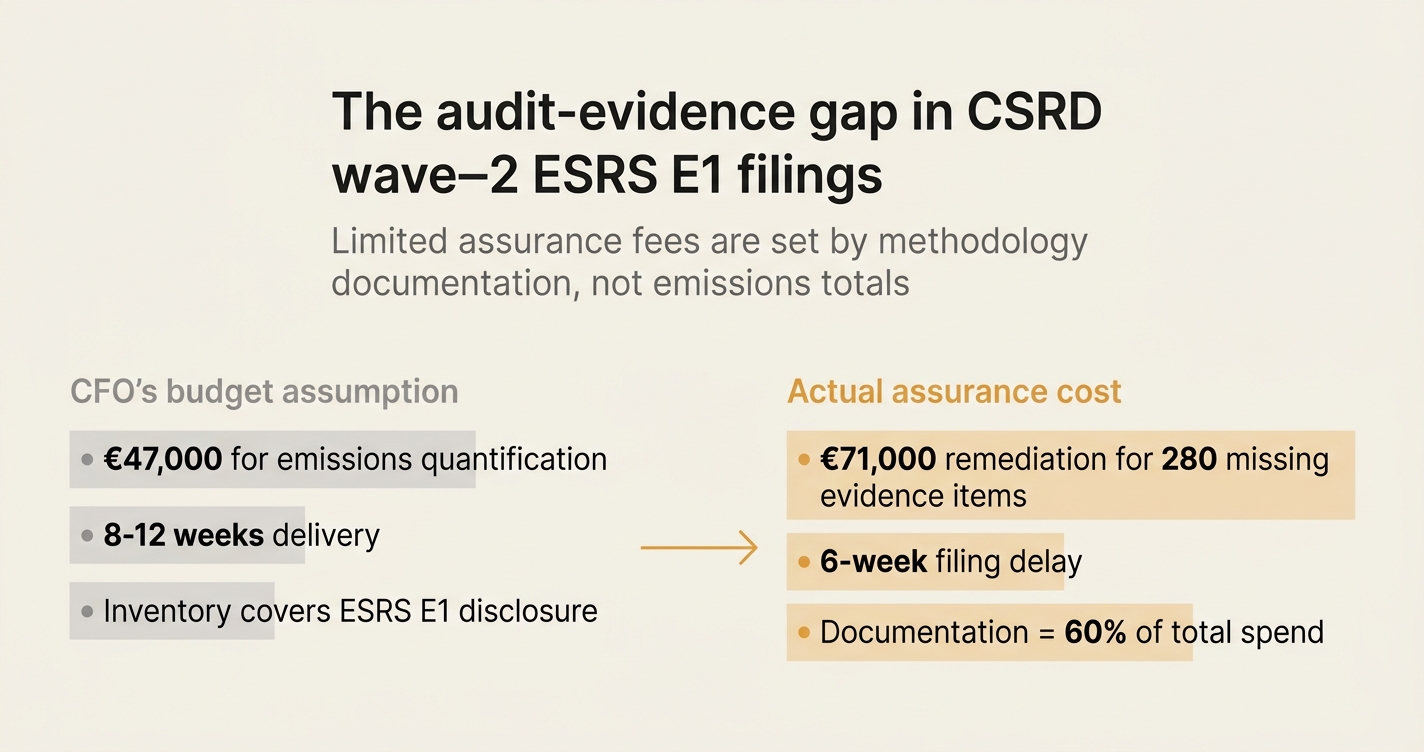
Here's the issue: a mid-sized manufacturing group in Austria spent €47,000 on emissions quantification for its first Corporate Sustainability Reporting Directive filing, covering financial year 2025. The CFO approved the budget expecting that figure to cover the entire ESRS E1 climate disclosure. Four months before the audit engagement, the compliance officer discovered the assurance provider required 280 discrete evidence items—board minutes, policy documents, supplier attestations, internal memos—none of which existed in auditable form. The remediation programme cost €71,000 and delayed filing by six weeks.
However, CSRD filings consist of two things: emissions totals and methodology documentation.
Emissions totals on their own have no value under limited assurance. Methodology documentation is what the assurance provider is actually verifying, and what the European Sustainability Reporting Standards demand in reproducible form. The compliance officer had optimised for the first; the audit engagement priced the second.
While emissions quantification has become cheaper—automated data ingestion, supplier platforms, allocation models—methodology documentation has become more expensive. If a wave-2 filer has 40 material sites, 120 tier-1 suppliers, and three business units, the cost of assembling audit-grade lineage for each datapoint might outpace the cost of calculating the number itself by a factor of two to three.
How do you solve this? I think the operators we work with are beginning to recognise that ESRS E1 is not a reporting problem—it is a documentation problem. For now, the groups that will pass limited assurance in 2026 are the ones building evidence chains in parallel with emissions calculation, not in retrospect.
The shape of the argument, visualised below.
Why CSRD wave-2 filers face a different challenge than wave-1
The Corporate Sustainability Reporting Directive's second wave applies to large undertakings—typically those with more than 250 employees, €50 million turnover, or €25 million in assets—filing for financial year 2025 or 2026, depending on national transposition.[1] Wave-1 filers had sustainability functions in place; wave-2 filers often do not. The European Financial Reporting Advisory Group simplified mandatory datapoints by 61% in December 2025, but ESRS E1 remains uniquely demanding because climate change is almost always double-material, and because the standard requires forward-looking transition plans tied to capital allocation, not just historical emissions totals.[2]
Limited assurance begins immediately. Reasonable assurance—a higher evidentiary bar—is scheduled to replace limited assurance from October 2028 at the earliest, once the Commission adopts the relevant standards under Article 26a of the Audit Directive.[3] This creates a three-year window in which wave-2 filers must build the documentation infrastructure that will survive reasonable assurance later, even though the initial engagement is limited.
The practical consequence: compliance officers are discovering that the emissions inventory they commissioned is not the same artifact the assurance provider will verify. The inventory is a spreadsheet of Scope 1, 2, and 3 totals. The assurance engagement requires:
- Organisational boundary documentation (consolidation approach, equity share, operational control)
- Calculation methodology for each emissions source (emission factors, activity data sources, allocation rules)
- Evidence of data lineage (invoices, meter readings, supplier attestations, haulage logs)
- Policy documentation (climate transition plan, interim targets, governance minutes)
- Value chain mapping (tier-1 supplier list, spend categories, Scope 3 allocation logic)
The first costs €40,000 to €60,000 for a mid-sized group. The second costs €60,000 to €90,000 if built from scratch during the audit engagement. The gap is not technical—it is organisational.
The three documentation gaps that increase limited-assurance costs
| Gap | What is missing | Cost consequence |
|---|---|---|
| Lineage gap | No traceable link from reported emissions figure back to source document (invoice, meter reading, supplier statement) | Auditor must reconstruct lineage manually; increases substantive testing hours by 40-60% |
| Methodology gap | No written record of calculation choices (emission factor source, allocation basis, boundary decisions) | Auditor must interview process owners and document decisions in real time; increases engagement hours by 30-50% |
| Policy gap | No board-approved climate transition plan, or plan exists but lacks quantified milestones and capital allocation linkage | Auditor must request supplementary documentation or qualify opinion; increases remediation cost by €20,000-€40,000 |
The lineage gap is the most common. A compliance officer exports emissions totals from a carbon accounting platform, but the platform does not store the original invoices or meter readings. The auditor asks: "Show me the fuel receipt that supports this 47.3 tonne CO₂e figure for site 12 in Q2." The organisation cannot. The auditor must then perform additional procedures—interviewing the site manager, reviewing purchase orders, reconciling payment records—to gain limited assurance over a single datapoint. Multiply by 280 datapoints and the engagement cost doubles.
The methodology gap is the most expensive to remediate. ESRS E1 requires disclosure of the greenhouse gas accounting methodology, including emission factors, calculation approaches, and boundary decisions.[4] If these choices were made by a consultant or platform vendor and not documented internally, the compliance officer must reverse-engineer the methodology during the audit engagement. This is not a technical exercise—it is a governance exercise. The auditor needs evidence that the methodology was reviewed and approved by someone with authority, that it was applied consistently, and that any changes were documented with rationale.
The policy gap creates the highest reputational risk. ESRS E1 requires a climate transition plan compatible with limiting warming to 1.5 degrees Celsius, with milestones for 2030 and, where relevant, 2050.[5] These narrative sections are where assurance providers concentrate much of their scrutiny, because the underlying evidence—board minutes, internal memos, policy documents—is harder to standardise than a fuel invoice. A weak transition plan does not fail limited assurance on technical grounds, but it signals to the auditor that governance is immature, which increases the scope of testing elsewhere.
"ESRS E1 in particular requires a climate transition plan compatible with limiting warming to 1.5 degrees Celsius, with milestones for 2030 and, where relevant, 2050. These narrative sections are where assurance providers concentrate much of their scrutiny, because the underlying evidence (board minutes, internal memos, policy documents) is harder to standardize than a fuel invoice."[5]
Why documentation cost is rising faster than quantification cost
Emissions quantification has become a commodity service. Spend-based models, supplier platforms, and automated allocation engines reduce the time required to generate Scope 1, 2, and 3 totals. A mid-sized manufacturing group can commission a baseline inventory for €40,000 to €60,000, delivered in 8 to 12 weeks. The outputs are typically adequate for voluntary disclosure or CDP questionnaires.
Documentation, by contrast, has not commoditised. The evidence chain required for limited assurance depends on organisational structure, data availability, and governance maturity. A group with 40 sites might need:
- 40 site-level boundary documents (organisation charts, lease agreements, joint-venture terms)
- 120 supplier attestations (primary data requests, responses, follow-up clarifications)
- 15 emission factor sources (industry databases, government publications, third-party calculators)
- 8 methodology approval records (board minutes, executive sign-offs, change logs)
- 60 activity data sources (utility invoices, fuel receipts, haulage logs, refrigerant purchase orders)
The cost of assembling, organising, and indexing these 243 discrete items typically exceeds the cost of calculating the emissions totals they support. The compliance officer cannot delegate this work to the carbon accounting consultant, because the consultant does not have access to internal governance records, supplier contracts, or board minutes. The work must be done by internal staff, who are often discovering the requirement for the first time during the audit engagement.
This explains the crossover: quantification cost is falling, documentation cost is rising, and the inflection point has already passed for wave-2 filers. The groups that budgeted €50,000 for ESRS E1 assuming the inventory would suffice are now facing €70,000 to €100,000 in combined quantification and documentation costs, with most of the overage occurring in the final three months before filing.
The case of the Austrian manufacturing group
The Austrian manufacturing group mentioned at the opening had 220 employees, €68 million turnover, and operations across three sites. The CFO approved a €47,000 engagement with a carbon accounting consultant to deliver a Scope 1, 2, and 3 inventory for financial year 2025, the first year the group fell in scope for CSRD under Austrian transposition.
The consultant delivered the inventory on schedule in March 2026. The compliance officer reviewed the outputs—an Excel workbook with emissions totals by scope, category, and site—and believed the ESRS E1 quantitative disclosure was complete. In June 2026, the group engaged an assurance provider for limited assurance over the sustainability statement.
The assurance provider's initial information request listed 280 discrete evidence items. The compliance officer had 14 of them. The missing items included:
- Organisational boundary documentation for the two leased sites (the consultant had assumed operational control, but the group had not documented the consolidation approach)
- Emission factor sources for 18 Scope 1 and 2 calculations (the consultant had used a commercial database, but the group did not have a licence or record of which version)
- Supplier attestations for the top 30 Scope 3 spend categories (the consultant had used spend-based estimates, but the assurance provider required evidence of outreach to suppliers)
- Methodology approval record (no board minute or executive sign-off documented the calculation choices)
The remediation programme ran from July to September 2026 and cost €71,000. The group hired two temporary staff to contact suppliers, reconstructed the emission factor sources by purchasing a database licence, and convened an extraordinary board meeting to approve the methodology retrospectively. The assurance provider issued a limited assurance opinion in October 2026, six weeks after the original filing deadline.
The CFO's post-mortem identified the core issue: the group had treated ESRS E1 as a quantification problem, not a documentation problem. The €47,000 consultant engagement delivered the numbers. The €71,000 remediation programme delivered the evidence. The group's 2026 filing will include both, but the cost structure has shifted: documentation now represents 60% of total ESRS E1 spend.
How Emission3 fits
Emission3 is built for this problem. The platform treats CSRD filings as documentation artifacts, not emissions totals. Every reported figure includes a lineage back to source document—invoice, meter reading, supplier attestation—so the assurance provider can verify the number without reconstructing the calculation.
The workflow is document-first. Compliance officers upload invoices, utility bills, and bills of material. The deterministic AI layer extracts activity data, matches emission factors, and generates line-item evidence packs that auditors can replay. The methodology is recorded in-platform: boundary decisions, allocation rules, emission factor sources, and approval records are version-controlled and exportable.
For wave-2 filers, this means documentation cost and quantification cost converge. The same workflow that calculates emissions totals also generates the evidence chain the assurance provider will verify. There is no retrospective remediation programme, no scramble for missing invoices, no extraordinary board meetings to approve methodology after the fact.
The Austrian manufacturing group would have spent €47,000 on Emission3 and received both the inventory and the 280 evidence items the assurance provider requested. The CFO would have budgeted once, not twice.
What to do now
If you are a compliance or legal officer preparing for CSRD wave-2 filing in 2026 or 2027, treat ESRS E1 as a documentation problem first. The emissions totals are necessary but not sufficient. The assurance engagement will price the evidence chain, not the inventory.
Start with a gap analysis. List the evidence items your assurance provider will request—organisational boundary documents, emission factor sources, supplier attestations, methodology approvals, activity data sources—and identify which ones exist in auditable form today. The missing items are your documentation backlog.
Build the evidence chain in parallel with emissions calculation, not in retrospect. If you commission an inventory from a consultant, require them to deliver the source documents, calculation lineage, and methodology record alongside the emissions totals. If the consultant cannot or will not, the inventory is not assurance-ready.
Budget for documentation separately from quantification. A €50,000 inventory that does not include audit-grade evidence will cost €70,000 to €100,000 by the time you file. A €50,000 engagement that delivers both the inventory and the evidence chain costs €50,000.
All Emission3 customers start with a CBAM readiness call—we map suppliers, gaps, and implementation, and the same workflow applies to CSRD ESRS E1 filings. No anonymous self-serve onboarding, because the documentation problem is organisational, not technical. Book a call at the link below, and we will show you what audit-ready evidence looks like before you spend another euro on quantification.
Book a CBAM readiness call and we will map your ESRS E1 documentation backlog in 45 minutes.
References & Sources
External Sources
- [1]CSRD Reporting Requirements: A Practical Climate & ESRS E1 Guide
CSRD reporting requirements apply to large DACH companies with >1,000 employees from FY 2025–2026 onwards, with ESRS E1 climate disclosures almost always material and the most technically demanding standard to implement.
- [2]ESRS E1 Explained: CSRD Climate Disclosure (2026)
ESRS E1 is particularly relevant because climate change affects virtually all businesses and sectors, making it a critical component in sustainability reporting under the double materiality principle.
- [3]CSRD reporting: a complete guide for EU companies in 2026
Reasonable assurance is scheduled to replace limited assurance once the Commission adopts the relevant standards, which Article 26a of the Audit Directive allows from October 2028 at the earliest.
- [4]ESRS, European Sustainability Reporting Standards
The CSRD establishes an EU-wide audit (assurance) requirement for reported sustainability information, initially requiring limited assurance with reasonable assurance from October 1, 2028.
- [5]CSRD reporting: a complete guide for EU companies in 2026
ESRS E1 in particular requires a climate transition plan compatible with limiting warming to 1.5 degrees Celsius, with milestones for 2030 and, where relevant, 2050. These narrative sections are where assurance providers concentrate much of their scrutiny.
Related Content
- [6]The assurance-readiness gap in CSRD wave-2 ESRS E1 inventories
CSRD inventories consist of emissions totals and methodology documentation. CFOs budget for the first, but 2026 limited-assurance fees are set by the second.
- [7]Audit-ready exports in Emission3
For auditors and CFOs, shows the evidence lineage artifact that makes CSRD and CBAM filings verifiable without retrospective reconstruction.
- [8]Book a CBAM readiness call
All customers start with a readiness call: we map suppliers, gaps, and implementation, no anonymous self-serve onboarding.