The assurance-timeline compression in 2026 California SB 253 disclosure for US CFOs transitioning from spreadsheet-based Scope 1 and Scope 2 emissions reporting
The assurance-timeline compression in 2026 California SB 253 disclosure for US CFOs transitioning from spreadsheet-based Scope 1 and Scope 2 emissions reporting
Here's the issue: California Senate Bill 253 (the Climate Corporate Data Accountability Act) requires US companies with over one billion dollars in annual revenue doing business in California to report Scope 1 and Scope 2 greenhouse gas emissions by November 10, 2026. The California Air Resources Board (CARB) has exercised enforcement discretion for this first cycle, accepting submissions with or without assurance. Most CFOs interpret this as a grace period, budget for data collection in 2026, and assume they can address audit readiness in 2027 when limited assurance becomes mandatory.
However, SB 253 disclosure consists of two things: the emissions totals you report in November 2026, and the evidence infrastructure those totals rest on.
The emissions totals on their own have no value to an auditor preparing a 2027 limited assurance engagement. The evidence infrastructure—document lineage, calculation trails, approval workflows, system-generated timestamps—is what the auditor is actually reviewing, and that infrastructure must exist before the 2026 filing, not after.
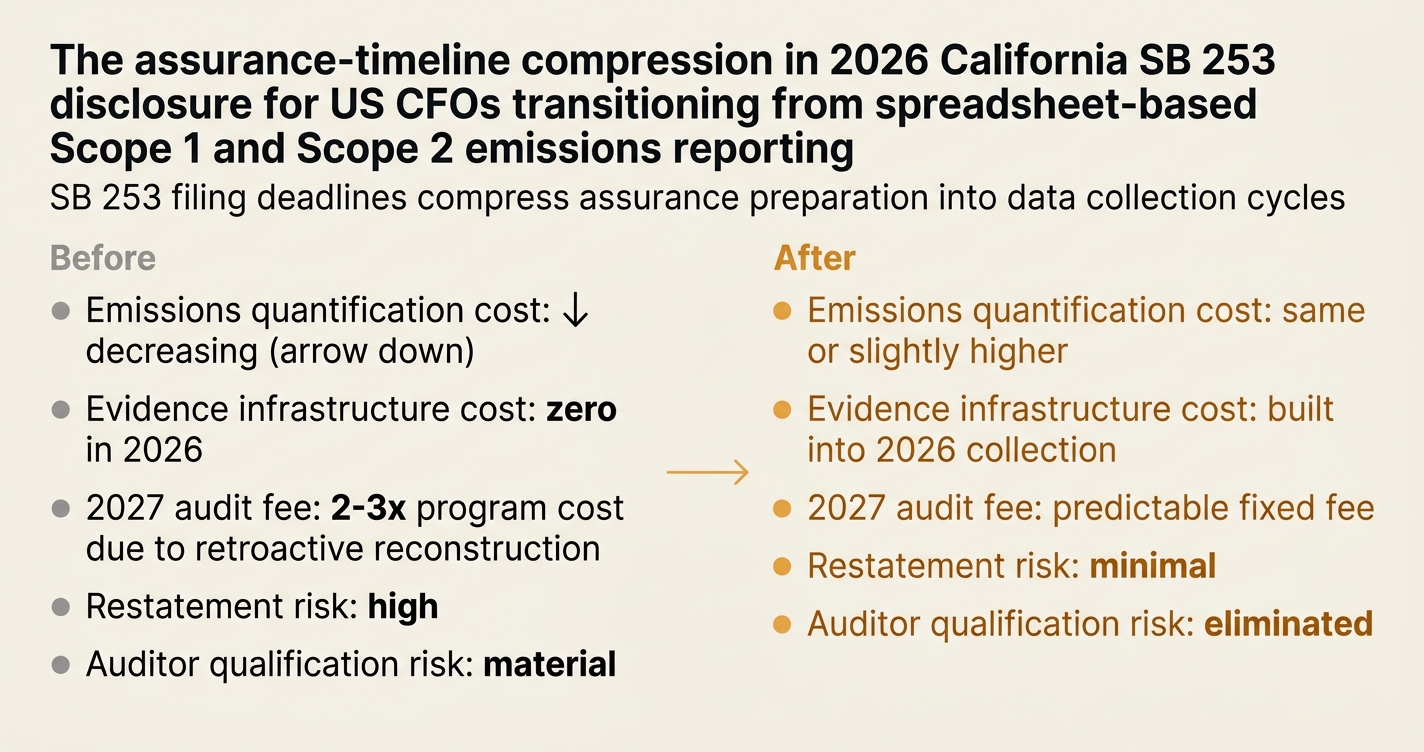
While the cost of emissions quantification has decreased with software tooling and spend-based estimation, the cost of assurance-ready evidence infrastructure has increased sharply. If you file in November 2026 using spreadsheets, activity logs copied from utility bills, and manual roll-ups, the 2027 audit fee might exceed the entire 2026 program cost, because the auditor must reconstruct lineage retroactively or qualify the opinion.
How do you solve this? I think the operators we work with who transitioned from spreadsheet panic to assurance-ready workflows in one cycle did three things: they treated the 2026 filing as the first year of a multi-year audit relationship, not a standalone compliance event; they built document ingestion and calculation lineage as part of 2026 data collection, not as a 2027 remediation project; and they scoped the assurance engagement in parallel with 2026 reporting, locking in the evidence standard before the filing, not negotiating it afterward. For now, this approach treats assurance as a design constraint in 2026, not an add-on service in 2027.
The shape of the argument, visualised below.
The 2026 enforcement discretion creates a compliance trap
CARB's February 26, 2026 rulemaking confirmed that third-party assurance is not required for the initial November 10, 2026 reporting window. Entities whose fiscal year ends between January 1 and February 1, 2026 report fiscal year 2026 data; those with fiscal years ending between February 2 and December 31, 2026 report fiscal year 2025 data [1]. This staggered timeline gives every company comparable lead time regardless of fiscal year close.
The enforcement discretion was intended as practical relief: CARB acknowledged that many companies were not collecting emissions data or planning to collect data when the Enforcement Notice was issued on December 5, 2024 [2]. Companies in that position can submit a statement on company letterhead in lieu of a full report for 2026, then begin compliant reporting in 2027.
But here's the trap: CFOs treating 2026 as a data-collection year and 2027 as an assurance year are building a compliance workflow that cannot be audited without expensive retroactive remediation. The first limited assurance engagement covers the 2027 filing, but the auditor's evidence review looks backward to the systems, controls, and documentation practices that generated the 2026 baseline. If those systems were spreadsheets, email threads, and manual calculations, the auditor must either qualify the opinion or charge for forensic reconstruction.
CARB's fee structure underscores the permanence of the program: annual fees are three thousand one hundred six dollars for SB 253 and one thousand four hundred three dollars for SB 261, invoiced on September 10, 2026, with penalties up to five hundred thousand dollars per year for non-compliance [3]. This is not a one-time disclosure event. It is an ongoing financial filing with escalating assurance requirements and executive liability.
The assurance roadmap compresses preparation time
The assurance escalation timeline is unambiguous:
| Reporting Year | Scope 1 & 2 Requirement | Scope 3 Requirement | Assurance Standard |
|---|---|---|---|
| 2026 | Required (Aug 10, 2026) | Not required | Optional |
| 2027 | Required | Required | Limited assurance (Scope 1 & 2) |
| 2028 | Required | Required | Limited assurance (Scope 1 & 2) |
| 2029 | Required | Required | Limited assurance (Scope 1 & 2) |
| 2030+ | Required | Required | Reasonable assurance (Scope 1 & 2) |
CARB has proposed allowing several recognized assurance standards: AA1000 Assurance Standard version 3, AICPA Attestation Auditing Standards AT-C Section 210, ISAE 3410 with ISAE 3000 for engagements starting before December 15, 2026, and ISSA 5000 for engagements starting on or after December 15, 2026 [4]. The transition from ISAE 3410 to ISSA 5000 mid-cycle introduces an additional complexity: auditors scoping 2027 engagements in late 2026 may default to ISSA 5000 evidence expectations even if the formal standard allows ISAE 3410, because they are preparing for the multi-year reasonable assurance escalation.
ERM Certification and Verification Services noted in June 2026 that "this phased approach gives organizations some practical breathing room, but it should not be mistaken for a simplified compliance exercise" [5]. The breathing room is in the enforcement discretion, not the evidence standard. An auditor preparing a 2027 limited assurance engagement needs to review:
- Source documents for every material emission source (utility bills, fuel receipts, purchased electricity invoices)
- Calculation methodology documentation with version control
- Approval workflows and data validation checkpoints
- System-generated audit logs showing who entered data, when, and what changed
- Boundary definitions and organizational control criteria
- Exclusions, estimates, and uncertainty quantification
If none of that exists because the 2026 filing was a spreadsheet exercise, the auditor must either walk the evidence trail backward (expensive) or issue a qualified opinion (expensive and reputationally damaging). The 2027 audit fee is therefore not independent of the 2026 compliance approach—it is a direct function of the evidence infrastructure built during 2026 data collection.
The CFO readiness checklist for 2026 SB 253 disclosure
This checklist assumes you are a CFO or finance leader at a US company with over one billion dollars in annual revenue doing business in California, with a November 10, 2026 Scope 1 and Scope 2 reporting deadline. It is structured for teams transitioning from spreadsheet-based emissions tracking to assurance-ready workflows.
Phase 1: Scoping and Baseline (Q1 2026)
Step 1: Confirm SB 253 applicability
- Action: Review revenue, operating footprint, and California nexus with legal and tax teams.
- Owner: CFO, General Counsel, Tax Director
- Done when: Written determination of covered entity status, documented in a memo that references CARB's applicability guidance and your company's fiscal year end.
Step 2: Map emission sources by facility and legal entity
- Action: Inventory all facilities, equipment, vehicles, and purchased electricity accounts. Classify each source as Scope 1 direct combustion, Scope 1 fugitive, or Scope 2 purchased electricity.
- Owner: Operations, Facilities, Procurement
- Done when: Emission source register in a structured format (not a spreadsheet unless it has controlled versioning and audit logs), with source ID, location, fuel type, meter ID, and responsible party.
Step 3: Identify data custodians and document sources
- Action: For every emission source, identify who holds the source documents (utility bills, fuel receipts, refrigerant logs) and in what system (email, shared drive, vendor portal, ERP).
- Owner: Facilities, Procurement, IT
- Done when: Data custodian matrix mapping each emission source to document location, access credentials, and ingestion cadence.
Phase 2: Evidence Infrastructure (Q2 2026)
Step 4: Select a document ingestion system
- Action: Evaluate whether your current ERP, ESG platform, or emissions accounting system can ingest source documents with metadata (upload timestamp, uploader identity, document type) and maintain immutable storage.
- Owner: CFO, CTO, Sustainability Lead
- Done when: Platform decision documented, with written confirmation that the system produces system-generated audit logs and can export document lineage for assurance purposes.
Step 5: Build calculation methodology documentation
- Action: For each emission source category, document the calculation formula, emission factor source, unit conversions, and any assumptions or estimates. Use version control.
- Owner: Sustainability Lead, Technical Accounting
- Done when: Calculation methodology document that an auditor could use to reproduce every line item in the disclosure, with version history showing who approved changes and when.
Step 6: Define approval workflows and validation checkpoints
- Action: Establish who reviews data entry, who approves calculations, and who signs off on the final disclosure. Build this into the ingestion system if possible.
- Owner: CFO, Controller, Sustainability Lead
- Done when: Workflow diagram showing approval gates, with role assignments and SOX-equivalent segregation of duties (the person entering data is not the person approving the calculation).
Phase 3: Data Collection and Filing (Q3 2026)
Step 7: Ingest source documents for fiscal year 2025 or 2026
- Action: Upload every utility bill, fuel receipt, and purchased electricity invoice into the ingestion system. Ensure metadata is captured automatically.
- Owner: Facilities, Procurement, Sustainability Analyst
- Done when: All source documents uploaded, with zero manual data entry from emails or PDFs unless the system logs the manual entry as a discrete event.
Step 8: Calculate emissions by source and legal entity
- Action: Run calculations using the documented methodology. Cross-check totals against prior estimates or industry benchmarks.
- Owner: Sustainability Lead, Technical Accounting
- Done when: Emissions totals by Scope 1 category and Scope 2 purchased electricity, with line-item traceability to source documents.
Step 9: Quantify uncertainty and document exclusions
- Action: Identify any emission sources excluded due to materiality thresholds, data gaps, or operational control ambiguity. Estimate uncertainty as a percentage of total emissions.
- Owner: Sustainability Lead, Risk Management
- Done when: Exclusions memo and uncertainty statement, with supporting rationale that references CARB's guidance on materiality and the Greenhouse Gas Protocol.
Step 10: Prepare the SB 253 disclosure report
- Action: Draft the report using CARB's reporting template. Include total Scope 1 emissions in metric tonnes of carbon dioxide equivalent, total Scope 2 emissions (location-based and market-based if applicable), and a brief methodology summary.
- Owner: Sustainability Lead, Corporate Communications, Legal
- Done when: Draft report reviewed by CFO and General Counsel, with sign-off that the report is consistent with source documents and calculation methodology.
Step 11: File the disclosure by November 10, 2026
- Action: Submit the report to CARB via the public docket (exact submission mechanism to be confirmed by CARB). Publish the report on your company website.
- Owner: CFO, Sustainability Lead, Corporate Secretary
- Done when: Confirmation receipt from CARB, public website link live, and internal record of the filing timestamp.
Phase 4: Assurance Preparation (Q4 2026)
Step 12: Engage an assurance provider for 2027
- Action: Issue an RFP for limited assurance services covering the 2027 filing. Share your 2026 evidence infrastructure documentation (calculation methodology, data custodian matrix, approval workflows) as part of the RFP.
- Owner: CFO, Procurement, Internal Audit
- Done when: Signed engagement letter with an assurance provider qualified under AICPA AT-C 210, ISAE 3410, or ISSA 5000, with a fixed-fee structure or fee cap tied to the evidence infrastructure you built in 2026.
Step 13: Conduct a pre-assurance evidence review
- Action: Ask the assurance provider to review your 2026 evidence infrastructure before the 2027 engagement begins. Identify gaps (missing source documents, unclear approval workflows, insufficient calculation documentation) and remediate them.
- Owner: CFO, Sustainability Lead, assurance provider
- Done when: Written gap assessment from the assurance provider, with a remediation plan that specifies what additional documentation or system changes are needed before the 2027 audit.
Step 14: Lock the 2026 evidence baseline
- Action: Freeze your 2026 source documents, calculation outputs, and methodology documentation in read-only storage. Ensure the assurance provider has access to the baseline for comparative purposes in 2027.
- Owner: IT, Sustainability Lead
- Done when: Evidence archive with immutable timestamps, accessible to the assurance provider via secure link or data room.
Phase 5: Scope 3 Readiness (Q1 2027)
Step 15: Begin Scope 3 supplier engagement
- Action: Identify your top suppliers by spend in Category 1 (purchased goods and services). Request primary emissions data or environmental product declarations. CARB has not yet specified the exact Scope 3 reporting deadline for 2027, but early engagement reduces last-minute scrambling.
- Owner: Procurement, Sustainability Lead
- Done when: Supplier outreach campaign launched, with target coverage of seventy percent of Category 1 spend, and a data classification protocol that distinguishes primary supplier-specific data from activity-based secondary data.
How Emission3 fits
Emission3 positions itself as productized CBAM implementation, but the compliance infrastructure we built—document-first ingestion, deterministic calculation lineage, registry-oriented outputs—applies directly to SB 253 disclosure. The technical problem is identical: turn source documents into auditable line items with full traceability, then export evidence packs for assurance.
Our platform ingests utility bills, fuel receipts, and purchased electricity invoices as PDFs or structured data. Every line item in the final disclosure traces back to a specific source document, uploaded by a named user at a recorded timestamp. The calculation layer uses a deterministic large language model to extract activity data, apply emission factors from your chosen registry (EPA, IEA, or custom), and log every transformation. The output is a Scope 1 and Scope 2 emissions total with an attached evidence pack: the source documents, the calculation lineage, and an export formatted for CARB's reporting template.
For US companies subject to SB 253, this means you build the evidence infrastructure in 2026 as part of normal data collection, not as a separate assurance preparation project in 2027. When your auditor begins the limited assurance engagement, they receive a data room with document-to-line-item lineage, not a spreadsheet they must reverse-engineer.
We also support California SB 261 climate-related financial risk disclosure and EU CSRD ESRS E1 limited-to-reasonable assurance transitions, because the underlying compliance architecture—document ingestion, deterministic calculation, evidence export—is the same across regimes. The difference is the reporting template and the assurance standard, not the evidence workflow.
If you are a CFO at a US company with over one billion dollars in revenue doing business in California, the November 10, 2026 deadline is eight months away as of this writing. The question is not whether you will file—the question is whether the filing you submit in November 2026 can survive a limited assurance engagement in 2027 without retroactive remediation.
Emission3 helps you answer that question in the affirmative. We start every engagement with a CBAM readiness call, but the conversation for SB 253 is structurally identical: map your emission sources, identify your data custodians, scope the evidence infrastructure, and implement the workflow before the filing deadline. No anonymous self-serve onboarding. No generic SaaS. Productized compliance implementation backed by the compliance engine we already built.
"While the U.S. Securities and Exchange Commission proposed to rescind its federal climate disclosure rule in May 2026, California's mandates have moved forward. CARB approved the initial implementing regulations for SB 253 in February 2026, effectively establishing California as the primary regulatory standard for climate disclosure in the United States." [6]
The primary regulatory standard for climate disclosure in the United States is now a state-level financial filing with multi-year assurance escalation and executive liability. If you are in scope for SB 253, the compliance program you build in 2026 determines your audit fees, your restatement risk, and your assurance provider's willingness to issue an unqualified opinion in 2027 and beyond.
The operators who made the transition from spreadsheet panic to assurance-ready workflows in one cycle did not treat 2026 as a grace period. They treated it as the first year of a permanent financial disclosure regime, and they built the evidence infrastructure accordingly.
Next steps
If you are a CFO or finance leader at a US company with over one billion dollars in annual revenue doing business in California, we recommend three immediate actions:
- Confirm your SB 253 applicability by reviewing revenue, California nexus, and fiscal year end with legal and tax. Document the determination in writing.
- Map your emission sources by facility and legal entity, identifying data custodians and document locations for every utility bill, fuel receipt, and purchased electricity invoice.
- Book a CBAM readiness call with Emission3 to scope your evidence infrastructure, identify gaps, and implement a document-first workflow before the November 10, 2026 filing deadline [7].
The assurance-timeline compression is not a theoretical risk. It is a quantified consequence of treating 2026 as a compliance event instead of the first year of a multi-year audit relationship. The CFOs who solved this problem built the evidence infrastructure in 2026, locked in the assurance engagement before the filing, and delivered audit-ready exports to their assurance provider without retroactive remediation.
You can do the same. The tooling exists, the workflow is proven, and the compliance engine is already built. The question is whether you implement it before the November deadline or negotiate the remediation cost afterward.
See audit-ready exports in Emission3 [8].
References & Sources
External Sources
- [1]California's climate disclosure regulations: An update on SB 253 and SB 261
Baker Tilly overview of SB 253 and SB 261 implementation, including staggered fiscal year reporting deadlines and CARB fee structures.
- [2]Navigating California's Climate Disclosure Laws: Your Complete Guide to SB 253 and SB 261
Nelson Mullins legal analysis of SB 253 and SB 261, clarifying CARB's enforcement discretion for entities not collecting data as of December 5, 2024.
- [3]The 9th Circuit and California's climate disclosure laws—what companies need to know
Watershed summary of CARB's February 26, 2026 fee structure adoption, with SB 253 annual fees at $3,106 and maximum penalties of $500,000.
- [4]California's SB 253 Climate Disclosure Requirements
Schellman guidance on SB 253 assurance standards, including AA1000AS v3, AICPA AT-C 210, ISAE 3410, and ISSA 5000 for multi-year engagements.
- [5]SB 253 Compliance and Assurance: How California's climate disclosure bill creates business value
ERM CVS analysis of CARB's March 2026 workshop clarifications, emphasizing that phased implementation does not simplify compliance evidence requirements.
- [6]California SB 253 & SB 261: Compliance Guide
Greenly overview of California's climate disclosure mandates in the context of the SEC's proposed rescission of federal climate rules, positioning SB 253 as the US regulatory standard.
Related Content
- [7]Book a CBAM readiness call
All customers start with a readiness call: we map suppliers, gaps, and implementation, no anonymous self-serve onboarding.
- [8]Audit-ready exports in Emission3
For auditors and CFOs, shows the evidence lineage artifact: document-to-line-item traceability, calculation methodology, and registry-oriented outputs.