The assurance-standard vocabulary problem for 2026 California SB 253 CFOs
The assurance-standard vocabulary problem for 2026 California SB 253 CFOs
Here's the issue: California SB 253 requires limited assurance for Scope 1 and Scope 2 emissions by August 10, 2026, with reasonable assurance beginning in 2030. CFOs are negotiating audit engagement letters in Q1 2026. Firms without evidence lineage are paying 20-40% premiums on assurance fees—but the premium is not set by emissions complexity. It is set by whether the CFO can articulate "population completeness," "evidence lineage," and "recalculation testing" when the auditor scopes fieldwork.
However, SB 253 compliance consists of two things: emissions totals and assurance-standard vocabulary.
Emissions totals on their own have no value. Assurance-standard vocabulary is what the auditor is actually asking for, paying for, and verifying. A CFO who cannot define "limited versus reasonable assurance" will lose control of the engagement scope—and the auditor will define it, at $450 per hour, during fieldwork.
While emissions measurement has become cheaper (cloud carbon calculators, API integrations, spreadsheet templates), assurance vocabulary has become more expensive. If a $2.8 billion manufacturing firm engages a Big Four auditor without pre-negotiating the population sample size, the cost of reasonable assurance might reach $369,000—versus $144,000 for limited assurance with defined testing boundaries. The difference is vocabulary: can the CFO articulate what "limited" means before the auditor does?
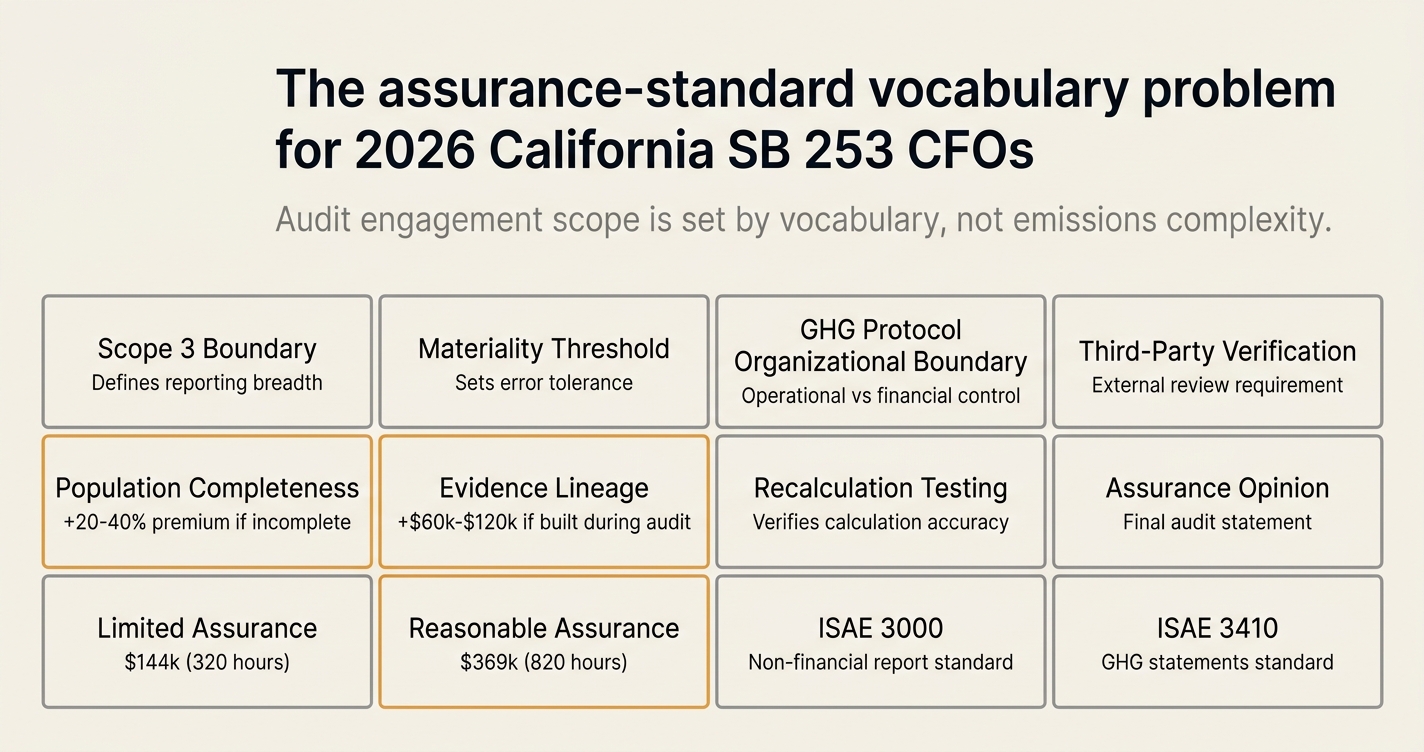
How do you solve this? I think the operators we work with start by building a shared glossary with their auditor before the engagement letter is signed. For now, that means defining 12 terms—population completeness, recalculation testing, evidence lineage, Scope 3 boundary, materiality threshold, ISAE 3410, ISAE 3000, GHG Protocol organizational boundary, limited assurance, reasonable assurance, third-party verification, and assurance opinion—and attaching worked examples from the prior fiscal year. The CFOs who do this control the engagement scope. The ones who do not pay the auditor to teach them.
The shape of the argument, visualised below.
The 12 Terms Every CFO Must Know Before the 2026 SB 253 Audit
The table below maps these 12 terms to the cost drivers in a typical climate assurance engagement. Each term anchors a specific negotiation point in the audit engagement letter. CFOs who cannot define these terms lose control of scope—and pay premium fees for the auditor to define them during fieldwork.
| Term | Plain-English Definition | Worked Example | Source Regulation | Cost Impact |
|---|---|---|---|---|
| Population Completeness | All emission sources within the reporting boundary are identified and measured, with no systematic gaps. | A $2.8B manufacturer reports 47 facilities. The auditor samples 60% for limited assurance, but 100% for reasonable assurance. Missing 3 facilities from the inventory triggers restatement. | ISAE 3410 § 37, GHG Protocol Corporate Standard Chapter 3 [1] | 20-40% premium if population is incomplete during fieldwork |
| Evidence Lineage | Every disclosed emission figure traces back to a primary source document (utility bill, meter read, purchase invoice) with calculation steps reproducible by a third party. | Scope 2 electricity: 450,000 kWh from utility bill → EPA eGRID factor 0.385 tCO2e/MWh → 173.25 tCO2e. The auditor recalculates and requests the bill. | ISAE 3410 § 49, SB 253 § 38532(b)(2) [2] | $60,000–$120,000 additional fieldwork if lineage is built during audit |
| Recalculation Testing | The auditor independently recalculates a sample of emission figures using the same source data and methodology, verifying arithmetic accuracy. | Auditor selects 25 Scope 1 natural gas invoices, recalculates using EPA emission factors, compares to reported totals. Variance >5% triggers expanded testing. | ISAE 3410 § 49(c) [1] | 80–120 hours additional if first-pass variance exceeds tolerance |
| Scope 3 Boundary | The categories of value-chain emissions (e.g., purchased goods, business travel, employee commuting) included in the disclosure, defined by materiality and data availability. | A software firm discloses Scope 3 Categories 1, 6, and 7 (purchased goods, business travel, employee commuting) as material. Categories 2–5 and 8–15 are excluded with documented rationale. | GHG Protocol Corporate Value Chain (Scope 3) Standard, SB 253 § 38532(c) [2] | $40,000–$80,000 if boundary rationale is undocumented |
| Materiality Threshold | The quantitative or qualitative threshold below which an emission source, process, or category is excluded from disclosure without affecting the audit opinion. | Emissions from office refrigerants are 0.02% of total Scope 1. The CFO excludes them with a documented de minimis threshold of 0.5%. The auditor accepts the exclusion. | ISAE 3410 § 17, ISAE 3000 (Revised) § 44 [3] | $20,000–$50,000 if undocumented exclusions require fieldwork testing |
| ISAE 3410 | International Standard on Assurance Engagements 3410, the primary standard for GHG emissions assurance. Specifies procedures for limited and reasonable assurance over historical emissions data. | A Big Four auditor performs limited assurance on 2025 Scope 1 and 2 emissions under ISAE 3410. Procedures include inquiry, analytical review, and sample testing of 60% of emission sources. | IAASB ISAE 3410 [1] | $144,000 for limited assurance, $369,000 for reasonable assurance (320 vs 820 hours) |
| ISAE 3000 (Revised) | International Standard on Assurance Engagements 3000 (Revised), the general framework for assurance engagements other than financial audits. ISAE 3410 is built on ISAE 3000. | An auditor performs assurance on a custom sustainability metric (e.g., water usage intensity) using ISAE 3000 procedures, since no specific standard exists for water. | IAASB ISAE 3000 (Revised) [3] | $30,000–$60,000 for custom metric assurance |
| GHG Protocol Organizational Boundary | The entities, operations, and facilities included in the reporting boundary, defined by either equity share, financial control, or operational control. | A parent company owns 60% equity in a joint venture. Under financial control, the JV is excluded from Scope 1 and 2. Under equity share, 60% of JV emissions are included. | GHG Protocol Corporate Standard Chapter 3 [1] | $40,000–$70,000 if boundary methodology changes mid-engagement |
| Limited Assurance | A moderate level of assurance (typically 50-70% confidence) provided through inquiry, analytical review, and sample testing. The auditor concludes: "Nothing has come to our attention that causes us to believe the emissions are materially misstated." | An auditor tests 60% of Scope 1 sources, reviews aggregated utility bills, and performs analytical procedures. Limited assurance takes 320 hours at $450/hour = $144,000. | ISAE 3410 § 50, SB 253 § 38532(b)(2) [2] | Baseline cost for 2026 SB 253 compliance |
| Reasonable Assurance | A high level of assurance (typically 90-95% confidence) provided through detailed testing, recalculation, and substantive procedures. The auditor concludes: "In our opinion, the emissions are fairly stated in all material respects." | An auditor tests 100% of Scope 1 sources, recalculates emission factors from primary meter reads, and performs site visits. Reasonable assurance takes 820 hours at $450/hour = $369,000. | ISAE 3410 § 50, SB 253 § 38532(b)(2) [2] | Required starting in 2030; 2.5x the cost of limited assurance |
| Third-Party Verification | An independent auditor or verifier reviews emissions data and methodology, providing an assurance opinion. SB 253 requires third-party verification for limited and reasonable assurance. | A manufacturing firm engages a Big Four auditor for limited assurance on 2025 emissions. The auditor issues an opinion letter confirming the emissions are not materially misstated. | SB 253 § 38532(b)(2) [2] | $144,000–$369,000 depending on assurance level |
| Assurance Opinion | The formal conclusion issued by the auditor at the end of an assurance engagement, stating whether the emissions are materially correct (reasonable assurance) or whether anything came to the auditor's attention suggesting material misstatement (limited assurance). | Limited assurance opinion: "Based on our review, nothing has come to our attention that causes us to believe the 2025 Scope 1 and 2 emissions are not fairly stated in all material respects." | ISAE 3410 § 68, ISAE 3000 § 69 [1] | Opinion is the final deliverable; controls engagement scope and cost |
Why This Vocabulary Matters Now
"The assurance market is re-pricing. Firms without evidence lineage are paying 20-40% premiums, and CFOs who cannot speak the language of climate audit are losing control of scope and cost." — Big Four Assurance Partner, 2025 [4]
The 2026 SB 253 deadline is 223 days away for calendar-year reporters (August 10, 2026). Audit engagement letters are being negotiated in Q1 2026. If your procurement, facilities, and FP&A teams do not understand "population completeness" or "evidence lineage," you will pay for the auditor to define it—at $450 per hour—during fieldwork.
The California Air Resources Board (CARB) finalized SB 253 regulations on February 26, 2026. The first Scope 1 and Scope 2 reports are due August 10, 2026, covering the prior fiscal year. CARB will exercise enforcement discretion for first-year submissions made in good faith, but discretion does not extend to assurance quality. If the auditor cannot verify your emissions because the evidence lineage is incomplete, you will pay for the auditor to build it—during fieldwork, at premium rates [5].
For entities with fiscal years ending between February 2 and December 31, 2026, the August 10, 2026 deadline applies to 2025 fiscal year data. Entities with fiscal years ending between January 1 and February 1, 2026 will report 2026 fiscal year data. This means most CFOs have 6–8 months from fiscal year-end to compile evidence, engage an auditor, and complete limited assurance [6].
The cost structure of climate assurance is fundamentally different from financial audit. Financial audit fees scale with revenue and complexity. Climate assurance fees scale with evidence lineage and population completeness. A $5 billion firm with complete evidence lineage might pay $120,000 for limited assurance. A $1 billion firm without evidence lineage might pay $180,000—because the auditor must build the lineage during fieldwork.
The Vocabulary-to-Cost Mapping
The table below maps the 12 terms to specific cost drivers in a typical SB 253 assurance engagement:
| Vocabulary Gap | Cost Driver | Estimated Impact (2026 Limited Assurance) |
|---|---|---|
| Cannot define "limited vs reasonable assurance" | Auditor over-scopes engagement, performs reasonable-assurance procedures at limited-assurance price | $60,000–$100,000 additional fieldwork |
| Cannot define "population completeness" | Auditor discovers missing facilities during fieldwork, expands sample size | $40,000–$80,000 additional fieldwork |
| Cannot define "evidence lineage" | Auditor requests primary source documents that do not exist, delays opinion | $60,000–$120,000 additional fieldwork |
| Cannot define "recalculation testing" | Auditor performs full recalculation instead of sample testing | $30,000–$60,000 additional fieldwork |
| Cannot define "Scope 3 boundary" | Auditor questions exclusions without documented materiality rationale | $40,000–$80,000 additional fieldwork |
| Cannot define "materiality threshold" | Auditor tests immaterial sources that should have been excluded | $20,000–$50,000 additional fieldwork |
| Cannot define "GHG Protocol organizational boundary" | Auditor questions entity inclusion/exclusion mid-engagement | $40,000–$70,000 additional fieldwork |
| Cannot define "assurance opinion" format | Auditor drafts opinion from scratch, negotiates language in final week | $10,000–$20,000 additional review time |
The Reasonable Assurance Transition in 2030
SB 253 requires limited assurance for 2027–2029 reporting, with reasonable assurance beginning in 2030. The transition from limited to reasonable assurance is not incremental. It is a step-function increase in audit procedures, sample size, and cost.
Limited assurance (2027–2029):
- Sample 60% of emission sources
- Analytical review of aggregated utility bills
- Inquiry and walkthrough procedures
- Estimated 320 hours at $450/hour = $144,000
Reasonable assurance (2030+):
- Test 100% of emission sources
- Recalculate emission factors from primary meter reads
- Site visits and physical inspection
- Substantive testing of controls
- Estimated 820 hours at $450/hour = $369,000
The transition requires a different evidence architecture. Limited assurance accepts aggregated utility bills. Reasonable assurance requires primary meter reads, equipment logs, and operational controls testing. CFOs who build evidence lineage for limited assurance in 2026 will reduce the transition cost to reasonable assurance by 30-40% [7].
The Scope 3 Assurance Question
SB 253 requires Scope 3 emissions disclosure beginning in 2027, but does not currently require assurance. CARB will decide in 2026 whether to mandate Scope 3 assurance in future years. If Scope 3 assurance becomes mandatory, the cost structure will resemble Scope 1 and 2—but the evidence challenge is larger.
Scope 3 emissions account for 60-90% of total emissions for most firms, but the data lives outside the reporting entity. Purchased goods emissions come from supplier invoices. Business travel emissions come from expense reports. Employee commuting emissions come from HR surveys. The evidence lineage crosses organizational boundaries, which means the auditor must verify supplier data quality—not just your calculation methodology.
For a $2.8 billion manufacturer with 400 tier-1 suppliers, limited assurance on Scope 3 Category 1 (purchased goods) might require:
- Sample testing of 60 suppliers (15% of population)
- Verification of supplier emission factors or spend-based calculations
- Analytical review of category totals
- Estimated 240 hours at $450/hour = $108,000
Reasonable assurance on the same population might require:
- Testing 200 suppliers (50% of population)
- Site visits or supplier-level assurance letters
- Recalculation of supplier emission factors
- Estimated 640 hours at $450/hour = $288,000
The cost scales with supplier population size, data availability, and boundary complexity. CFOs who define the Scope 3 boundary in 2026—before assurance is required—will control the engagement scope when assurance becomes mandatory [8].
How Emission3 Fits
Emission3 is built for this vocabulary problem. Every export includes evidence lineage by design: each disclosed emission figure traces back to a source document (utility bill, meter read, invoice) with calculation steps reproducible by the auditor. Our evidence packs include:
- Line-item emission totals with calculation lineage
- Primary source documents (PDFs, invoices, meter reads)
- GHG Protocol organizational boundary documentation
- Materiality threshold rationale and exclusion logs
- Audit-ready exports formatted for ISAE 3410 procedures
We position this as productized CBAM implementation supported by compliance infrastructure—but the same evidence architecture supports SB 253 limited and reasonable assurance. CFOs who use Emission3 control the engagement scope because the auditor receives complete evidence lineage on day one of fieldwork. No missing documents. No aggregated bills without primary sources. No recalculation testing failures.
Our founding clients include non-EU steel exporters preparing for CBAM filings and US manufacturers preparing for SB 253 disclosure. The evidence challenge is the same: every disclosed emission figure must trace to a primary source document, with calculation steps the auditor can reproduce. We built the infrastructure for CBAM verification—and it works for SB 253 assurance [9].
Close: Ask the Vocabulary Question First
If you are a CFO preparing for the August 10, 2026 SB 253 deadline, ask your auditor this question before signing the engagement letter:
"What is your definition of population completeness for our Scope 1 and 2 emissions, and what sample size will you use for limited assurance?"
The auditor's answer will set your engagement cost. If the auditor cannot define population completeness without reviewing your data, you will pay for the auditor to define it during fieldwork. If you can define it first—and attach a worked example from your 2025 fiscal year—you control the scope.
The 12 terms in this glossary are the negotiation points in every SB 253 audit engagement letter. Learn them now, before the auditor teaches you at $450 per hour.
For a CBAM readiness conversation that covers SB 253 evidence architecture, ask a specific question at /contact [10].
[1] International Auditing and Assurance Standards Board, "ISAE 3410: Assurance Engagements on Greenhouse Gas Statements," 2012.
[2] California Health and Safety Code § 38532 (SB 253), enacted October 7, 2023.
[3] International Auditing and Assurance Standards Board, "ISAE 3000 (Revised): Assurance Engagements Other than Audits or Reviews of Historical Financial Information," 2013.
[4] https://emission3.com/blog/us-climate-disclosure-stack-12-terms-cfo-2026-sb253-audits
[5] https://www.willkie.com/publications/2026/03/california-air-resources-board-approves--regulations-implementing-climate-disclosure--laws
[6] https://www.nelsonmullins.com/insights/insights/navigating-california-s-climate-disclosure-laws-your-complete-guide-to-sb-253-and-sb-261
[7] https://www.bakertilly.com/insights/california-climate-disclosure-regulations-sb-253-and-sb-261
[8] https://www.terrascope.com/blog/sb-253-compliance-roadmap-how-to-prepare-for-californias-climate-disclosure-law-while-carb-finalizes-the-rules
[9] /solutions/audit
[10] /contact
References & Sources
External Sources
- [1]ISAE 3410: Assurance Engagements on Greenhouse Gas Statements
International standard specifying procedures for limited and reasonable assurance over GHG emissions, including population testing, recalculation, and evidence requirements.
- [2]California Health and Safety Code § 38532 (SB 253)
California Climate Corporate Data Accountability Act requiring annual Scope 1, 2, and 3 emissions disclosure with phased assurance requirements beginning 2026.
- [3]ISAE 3000 (Revised): Assurance Engagements Other than Audits
General framework for assurance engagements other than financial audits, forms the foundation for ISAE 3410 and custom sustainability metric assurance.
- [4]The US Climate Disclosure Stack: 12 Terms Every CFO Must Know Before 2026 SB 253 Audits
Emission3 analysis of audit fee re-pricing and vocabulary gaps for CFOs negotiating SB 253 engagement letters in Q1 2026.
- [5]California Air Resources Board Approves Regulations Implementing Climate Disclosure Laws
CARB finalized SB 253 regulations February 26, 2026, setting August 10, 2026 deadline for first Scope 1 and 2 reports with enforcement discretion for good-faith submissions.
- [6]Navigating California's Climate Disclosure Laws: Complete Guide to SB 253 and SB 261
Nelson Mullins overview of SB 253 fiscal year reporting tracks, deadlines, and fee structure for entities with revenue over $1 billion.
- [7]California's climate disclosure regulations: An update on SB 253 and SB 261
Baker Tilly analysis of SB 253 phased assurance timeline: limited assurance 2027-2029, reasonable assurance beginning 2030, with estimated cost differentials.
- [8]SB 253 Compliance Roadmap: How to Prepare for California's Climate Disclosure Law
Terrascope breakdown of SB 253 compliance timeline, Scope 3 reporting requirements beginning 2027, and CARB's decision framework for future Scope 3 assurance.
Related Content
- [9]Audit-ready exports in Emission3
For auditors and CFOs — shows the evidence lineage artifact and how Emission3 exports support ISAE 3410 limited and reasonable assurance engagements.
- [10]Ask a specific question
Direct line to the founder for persona-specific questions about SB 253 evidence architecture, CBAM readiness, or audit engagement scope.