The assurance-standard terminology shift in 2026 CSRD reporting after the Omnibus directive
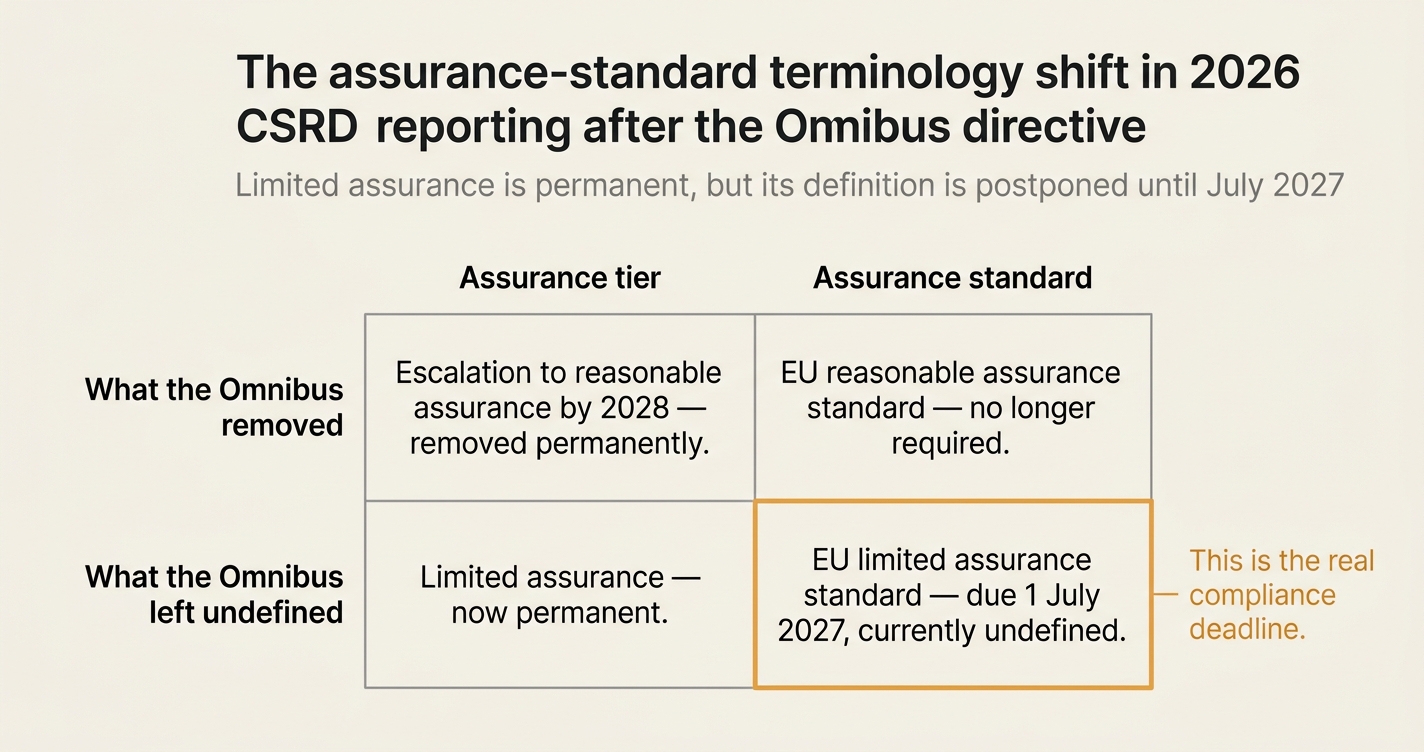
The assurance-standard terminology shift in 2026 CSRD reporting after the Omnibus directive
Here's the issue: the December 2025 Omnibus agreement removed the Corporate Sustainability Reporting Directive's planned escalation from limited assurance to reasonable assurance by 2028, capping the statutory requirement at limited assurance permanently[1]. For compliance and legal officers building 2026 reporting processes, this sounds like welcome simplification—one assurance tier, no moving target, lower audit fees. However, the Omnibus created a terminology gap that most teams have not yet noticed.
CSRD assurance consists of two things: the assurance tier (limited vs reasonable) and the assurance standard (the specification of what "limited" means). The Omnibus removed the escalation to reasonable assurance. It did not define what limited assurance requires.
The assurance tier on its own has no value. The assurance standard is what the auditor is actually checking—what evidence they review, what testing procedures they run, what traceability they require from each disclosed figure back to source documents. Until the European Commission adopts EU-specific limited assurance standards by 1 July 2027, the term "limited assurance" is a compliance placeholder, not an implementation specification[2].
While the Omnibus removed the cost escalation of moving to reasonable assurance, it postponed the definition of what limited assurance means by twelve months. If your CSRD reporting process for FY 2026 is built on assumptions about what "limited" requires—what documentation auditors will accept, which estimates need lineage, how Scope 3 activity-based data must be classified—those assumptions may not match the standard the Commission publishes in mid-2027. The cost of rework after the standard lands might outpace the savings from avoiding reasonable assurance.
How do you solve this? I think compliance officers should treat the Commission's 2027 limited assurance standard as the real compliance deadline, not the FY 2026 reporting deadline. The operators we work with are building 2026 processes around the draft ISSA 5000 international standard the Commission plans to adapt, not around generic "limited" assumptions. For now, that means document-first ingestion—invoices, bills of materials, utility bills turned into line-item evidence—and deterministic calculation lineage, because those are the controls ISSA 5000 requires auditors to test.
The shape of the argument, visualised below.
What "limited assurance" meant before the Omnibus
Under the original CSRD text, limited assurance was the starting tier for sustainability disclosures, with the European Commission authorised to escalate the requirement to reasonable assurance by 1 October 2028, contingent on an assessment of feasibility for both companies and assurance practitioners[3]. Limited assurance, under international auditing standards, means the auditor performs fewer tests than in a reasonable assurance engagement—typically analytical procedures and inquiry, rather than the extensive substantive testing and internal-control evaluation required for reasonable assurance. The conclusion is expressed in negative form: the auditor states that nothing has come to their attention indicating material misstatement, rather than providing a positive opinion that the information is fairly stated[4].
For CSRD filers, this tier structure created a two-phase compliance roadmap: build processes sufficient for limited assurance by 2025-2026, then upgrade those processes for reasonable assurance by 2028-2029. The cost difference was significant—reasonable assurance engagements typically require 30-50% more audit hours than limited assurance, because the auditor must test a larger sample of transactions, verify internal controls, and obtain more substantive evidence[5]. The Omnibus removed that escalation entirely, which held compliance costs down but left the specification of "limited" undefined.
What the Omnibus changed, and what it left open
The Omnibus provisional agreement, reached 22 December 2025, removed the clause authorising the Commission to mandate reasonable assurance by 2028, making limited assurance the permanent statutory standard for CSRD[6]. It also postponed the Commission's deadline to adopt EU-specific limited assurance standards from 1 October 2026 to 1 July 2027, giving the Commission an additional nine months to develop those standards[7]. The Commission plans to base the EU standards on ISSA 5000, the International Standard on Sustainability Assurance issued by the International Auditing and Assurance Standards Board, with EU-specific additions addressing the particularities of ESRS disclosure[2].
What the Omnibus did not do: it did not specify what evidence, testing procedures, or documentation requirements constitute "limited assurance" for CSRD purposes. The term appears in the directive, but the operational definition—what auditors will check, what traceability they will require, what estimates they will accept—depends on the Commission's July 2027 delegated act. Until that act is adopted, CSRD filers building 2026 reporting processes are working from assumptions, not specifications.
| Assurance tier | Testing scope | Conclusion form | CSRD status post-Omnibus |
|---|---|---|---|
| Limited assurance | Analytical procedures, inquiry, limited sampling | Negative ("nothing has come to our attention") | Permanent statutory requirement; EU standard due 1 July 2027[7] |
| Reasonable assurance | Extensive substantive testing, internal control evaluation, large sample sizes | Positive ("the information is fairly stated") | No longer required; Omnibus removed the 2028 escalation clause[1] |
The terminology gap: what "limited" does not yet specify
For a compliance or legal officer building 2026 CSRD reporting processes, the undefined "limited assurance" standard creates four material gaps:
-
Evidence lineage for Scope 3 estimates. ESRS E1 requires Scope 3 Category 1 (purchased goods) disclosure, and most companies use a mix of supplier-specific data and spend-based estimates. Under financial audit standards, estimates require documentation of the estimation method, the data sources, and the controls over estimation accuracy. Does "limited assurance" for CSRD require the same lineage for Scope 3 estimates, or does it allow undocumented modelling? The July 2027 standard will answer this; FY 2026 processes built on the assumption that estimates need no lineage may fail limited assurance in 2027[8].
-
Classification of supplier data as primary vs activity-based. California SB 253 and the GHG Protocol distinguish between primary data (supplier-measured emissions for a specific transaction) and activity-based data (emissions calculated from activity factors like kWh per unit). ISSA 5000 requires auditors to test the classification, not just the coverage. If your FY 2026 process classifies supplier invoices as "primary" without verifying that the supplier measured the emissions for your transaction specifically, that misclassification becomes a limited assurance failure under ISSA 5000 procedures, even though the data is real[8].
-
Traceability from disclosed figure to source document. Limited assurance under ISSA 5000 does not mean "check the totals." It means the auditor must be able to trace a disclosed emissions figure—for example, 450 tCO2e for a specific Scope 1 combustion source—back through the calculation to the source document (a utility bill, a fuel invoice). If your FY 2026 process aggregates inputs before the audit trail begins, the auditor cannot perform limited assurance procedures, because there is no traceable path from the disclosure to the evidence[2].
-
Safe harbor for immature data. Some teams assume "limited" assurance creates a safe harbor for incomplete Scope 3 data or rough Scope 1 estimates. It does not. Limited assurance means the auditor checks whether the disclosed information is plausible and consistent with the underlying evidence, not whether it is perfect. If the evidence is immature but traceable, and the methodology is documented, the auditor can express limited assurance. If the evidence is missing or the methodology is undocumented, the auditor cannot, regardless of the assurance tier[4].
"The gradual approach from limited assurance engagements to reasonable assurance engagements would also allow for the progressive development of the assurance market for sustainability information, and of undertakings' reporting practices." — CSRD Recital 62, before the Omnibus removed the escalation[5]
The Omnibus removed the escalation, but it did not remove the need for assurance-market development. The July 2027 EU limited assurance standard will define what "progressive development" means.
The ISSA 5000 baseline: what the Commission is likely to require
The Commission has stated it will base the EU limited assurance standards on ISSA 5000, with EU-specific additions[2]. ISSA 5000, issued in March 2025, is the first international standard specifically designed for sustainability assurance, replacing the generic ISAE 3000 and ISAE 3410 standards that audit firms previously adapted for environmental, social, and governance (ESG) engagements. For CSRD filers, ISSA 5000 establishes four baseline requirements that are likely to carry over into the July 2027 EU standard:
1. Evidence chain from disclosure to source. ISSA 5000 paragraph 84 requires the assurance practitioner to "obtain evidence by performing procedures to evaluate whether the sustainability information is free from material misstatement." For a CSRD climate disclosure, that means the auditor must trace each disclosed emissions figure—Scope 1 combustion, Scope 2 purchased electricity, Scope 3 Category 1 purchased goods—back through the calculation to the source document. If the calculation is reproducible but the source document is missing, the auditor cannot express assurance[2].
2. Testing of estimation methodology, not just totals. ISSA 5000 paragraph 92 requires the auditor to evaluate the "appropriateness of the methods and assumptions used" in estimates. For Scope 3, that means the auditor checks whether the estimation method is documented, whether the emission factors are from a credible source, and whether the activity data (spend, units purchased, kWh consumed) is verifiable. A Scope 3 estimate that produces a plausible total but has no documented methodology fails limited assurance under ISSA 5000, because the auditor cannot test the method[8].
3. Classification testing, not just coverage. ISSA 5000 paragraph 88 requires the auditor to test whether the sustainability information is "classified appropriately." For supplier data in CSRD Scope 3, that means the auditor checks whether data labelled "primary" is actually primary (supplier-measured for your transaction), not activity-based (calculated from your invoice using the supplier's average emission factor). Misclassification creates an assurance failure even if the number is directionally correct[8].
4. Professional scepticism over management representations. ISSA 5000 paragraph 50 requires the auditor to "plan and perform the engagement with professional scepticism," meaning the auditor does not accept management's assertions without corroboration. For a CSRD filing, that means oral statements like "this Scope 3 estimate is conservative" or "we verified this with the supplier" must be backed by written evidence—a methodology document, an email from the supplier, a third-party verification certificate. Assurance is evidence-based, not trust-based[2].
How Emission3 fits: document-first ingestion, deterministic lineage, registry-ready outputs
Emission3 is built on the assumption that the Commission's July 2027 EU limited assurance standard will operationalise the four ISSA 5000 requirements above. Our platform ingests source documents—invoices, bills of materials, utility bills, supplier certificates—and converts them into line-item evidence with full calculation lineage from each disclosed figure back to the originating document. The system is deterministic: every emissions figure is reproducible, with a full audit trail of transformations, and the same input document always produces the same output figure. For a compliance officer building 2026 CSRD processes, this means:
- Evidence packs that match ISSA 5000 testing requirements: each disclosed Scope 1, Scope 2, or Scope 3 figure is backed by a folder of source documents, calculation steps, and emission-factor citations, structured for auditor review[2].
- Classification enforcement that prevents misclassification: supplier data is tagged as primary (supplier-measured for your transaction), activity-based (calculated from invoice line items using factors), or spend-based (modelled from spend totals), and the classification is locked at ingestion, not editable post-calculation[8].
- Reproducibility that supports professional scepticism: auditors can replay the calculation from source document to final figure, with no black-box steps or undocumented adjustments, which satisfies the ISSA 5000 requirement for corroborable evidence[2].
The platform also exports in the submission formats CSRD auditors and national registries expect: XBRL for digital filing, PDF evidence packs for auditor review, and CSV lineage tables for internal quality assurance. For more on how the deterministic layer works, see the Emission3 AI layer explainer[9]. For audit-specific workflows, see the audit-ready exports page[10].
Building 2026 processes for the 2027 standard
For compliance and legal officers, the Omnibus created a one-year planning window: FY 2026 CSRD reports are due in 2027, and the EU limited assurance standard is due by July 2027. That means the first assurance engagements on 2026 data will occur under a standard that does not yet exist, which creates a sequencing problem. You cannot build an assurance-ready process without knowing what the assurance standard requires, but you cannot wait until July 2027 to start building, because your 2026 data collection must begin in January 2026 for a calendar-year filer.
The safest approach: treat ISSA 5000 as the baseline, and build 2026 processes that satisfy its evidence, methodology-documentation, classification, and reproducibility requirements. When the Commission publishes the EU standard in July 2027, the delta between ISSA 5000 and the EU standard will be smaller than the delta between your current process and ISSA 5000. In practice, that means:
- Start with source documents, not aggregated data. Ingest invoices, utility bills, and supplier certificates at line-item level, so the audit trail exists from the beginning. Aggregation happens after evidence is captured, not before.
- Document every estimation method before you use it. If you estimate Scope 3 Category 1 using spend and emission factors, write down the method, cite the factor source, and store the documentation in the same folder as the calculation. The auditor will ask for it.
- Classify supplier data correctly, and lock the classification. If a supplier sends you their total emissions and you divide by your invoice total to get your share, that is activity-based data, not primary. Label it correctly at ingestion, because the auditor will test the classification.
- Build reproducibility into the calculation layer. Every disclosed figure should be reproducible from its source document with no manual adjustments, no formulas in spreadsheets that reference other spreadsheets. The auditor needs to replay the calculation, and "it is in the spreadsheet" is not a reproducible path.
If you would like to map your FY 2026 CSRD process against the ISSA 5000 baseline, book a CBAM readiness call[11]. We walk through supplier coverage, evidence gaps, and methodology documentation in the first call—no anonymous self-serve onboarding, because every team's supplier base and data maturity is different.
Conclusion: the assurance standard is the real deadline
The Omnibus removed the escalation from limited to reasonable assurance, which simplified the compliance roadmap and held audit costs down. It did not remove the need to define what "limited" means. For CSRD filers building 2026 reporting processes, the July 2027 EU limited assurance standard is the real compliance deadline, not the FY 2026 reporting deadline. Processes built on undefined assumptions about what "limited" requires—what evidence auditors accept, which estimates need methodology documentation, how supplier data must be classified—will fail assurance when the standard lands, and the cost of rework after the fact is higher than the cost of building ISSA 5000 compliance from the beginning.
The Omnibus bought you time on reasonable assurance. It did not buy you time on limited assurance readiness. If your 2026 process is not built for deterministic lineage, document-first evidence, and classification enforcement today, the July 2027 standard will force a rebuild. Book a CBAM readiness call to map your process against ISSA 5000 requirements now, before the Commission publishes the EU standard[11].
References & Sources
External Sources
- [1]CSRD Assurance Requirements: Limited vs Reasonable (2026)
Analysis of the December 2025 Omnibus amendment removing the escalation to reasonable assurance by 2028, making limited assurance the permanent statutory standard.
- [2]CSRD Reporting Requirements (Post-Omnibus)
Explanation of the July 2027 deadline for EU limited assurance standards and the Commission's plan to base them on ISSA 5000 with EU-specific additions.
- [3]Corporate Sustainability Reporting Directive (CSRD)
Original CSRD text describing the planned escalation from limited to reasonable assurance by 1 October 2028, contingent on feasibility assessment.
- [4]CSRD Assurance: Limited and Reasonable Assurance Engagement
Technical comparison of limited vs reasonable assurance procedures, including negative vs positive conclusion forms and testing scope differences.
- [5]Corporate Sustainability Reporting Directive (CSRD) — Recital 62
CSRD recital explaining the gradual approach from limited to reasonable assurance and the rationale for phasing in cost increases before the Omnibus removed the escalation.
- [6]CSRD Reporting Requirements (Post-Omnibus)
Summary of the December 2025 provisional agreement removing the option to amend limited assurance to reasonable assurance under CSRD.
- [7]Heads Up — European Sustainability Reporting — Omnibus Legislative Developments
Deloitte analysis of the Omnibus provisional agreement postponing the EC's adoption of limited assurance standards from October 2026 to July 2027.
- [8]CSRD Reporting Requirements: A Practical Climate & ESRS E1 Guide
Practical guidance on CSRD ESRS E1 climate disclosure, including Scope 3 estimation methodology, supplier data classification, and ISSA 5000 testing requirements.
Related Content
- [9]The Emission3 AI layer
How the deterministic LLM layer converts source documents into line-item evidence with full calculation lineage that auditors can replay.
- [10]Audit-ready exports in Emission3
Evidence packs, XBRL exports, and calculation lineage tables structured for CSRD auditor review and national registry submission.
- [11]Book a CBAM readiness call
Map your FY 2026 CSRD process against ISSA 5000 evidence, methodology-documentation, and classification requirements in a 45-minute workflow review.