The assurance-fee structure in 2026 California SB 253 limited assurance for CFOs transitioning from spreadsheet-based emissions tracking
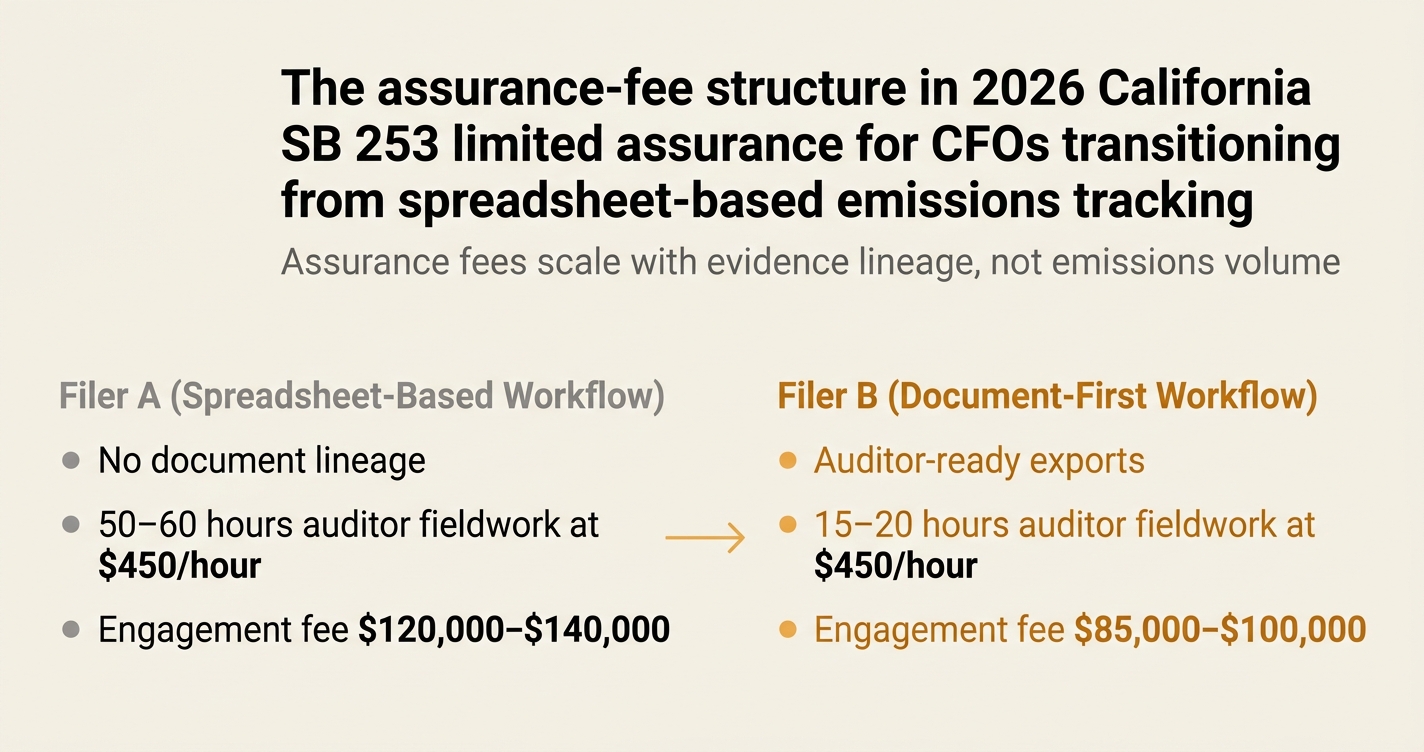
The assurance-fee structure in 2026 California SB 253 limited assurance for CFOs transitioning from spreadsheet-based emissions tracking
Here's the issue: California SB 253 requires limited assurance over Scope 1 and Scope 2 emissions starting with fiscal 2026 reporting (due August 10, 2026 for calendar-year filers). Most CFOs budget for emissions data collection—utility bills, fleet fuel, refrigerant logs—assuming assurance fees scale with reporting volume. They do not. Assurance fees scale with evidence lineage, and firms without document-first ingestion, deterministic calculation chains, and auditor-ready exports are already paying 20–40% premiums on 2025 limited assurance engagements [1].
However, SB 253 disclosure consists of two things: emissions totals (the numbers in the public filing) and assurance fees (the cost to verify those numbers).
Emissions totals on their own have no value. Assurance fees are what the auditor is actually billing for—and what the CFO is actually liable for if the filing requires restatement. While data collection tools have become cheaper (SaaS carbon accounting platforms now start at $12,000 per year), assurance engagement fees have become more expensive. If you collect emissions data in spreadsheets, classify supplier invoices manually, and export summary totals without source-document lineage, the cost of assurance fieldwork might outpace the savings of low-cost SaaS by a factor of three to five [2].
The first-year SB 253 limited assurance engagement for a mid-market filer (1,500 employees, $2.3 billion revenue, 18,000 tCO₂e Scope 1 and 2) is estimated at $85,000–$140,000, depending on evidence completeness. If the CFO delivers emissions totals without document-level lineage, the auditor must reconstruct the calculation chain during fieldwork—at $450 per hour—and the engagement fee moves toward the upper bound. If the CFO delivers an evidence package where every tonne traces to a source document (invoice, utility bill, meter read) through a documented calculation, the auditor can sample the lineage and the fee moves toward the lower bound [3].
How do you solve this? I think the operators we work with are solving it by treating 2026 as an assurance-readiness year, not a reporting-only year. They are building document-first ingestion workflows now—before CARB enforces limited assurance in 2027—so that the evidence lineage exists when the auditor arrives. For now, that means treating every utility bill, every invoice, every meter read as an audit artifact, not a data-entry task.
The shape of the argument, visualised below.
The 2026–2027 assurance escalation that CFOs are missing
CARB announced in March 2025 that it will exercise enforcement discretion for first-year Scope 1 and Scope 2 reporting (fiscal 2025 data, due August 10, 2026). Limited assurance is not being enforced for the 2026 filing. Most CFOs interpret this as a one-year grace period. It is not. It is a one-year window to build the evidence infrastructure that the 2027 auditor will require [4].
The table below maps the assurance escalation from 2026 to 2030:
| Reporting Year | Scope 1 & 2 Assurance Required | Scope 3 Assurance Required | Typical Engagement Fee (mid-market filer) | Evidence Lineage Requirement |
|---|---|---|---|---|
| 2026 (fiscal 2025 data) | Not enforced (discretion) | None | $0 (or voluntary) | None (but sets 2027 baseline) |
| 2027 (fiscal 2026 data) | Limited assurance | None | $85,000–$140,000 | Document-level lineage for Scope 1 & 2 |
| 2028–2029 | Limited assurance | None | $90,000–$150,000 (inflation-adjusted) | Document-level lineage for Scope 1 & 2 |
| 2030+ | Reasonable assurance | Limited assurance (Scope 3) | $180,000–$300,000+ | Full internal controls over all scopes |
The 2026 filing is not a grace period. It is the year the auditor uses to baseline your evidence infrastructure. If you file 2026 Scope 1 and Scope 2 emissions using spreadsheet rollups and manual classification, the 2027 auditor will assume the same workflow exists in 2026 data—and will price the 2027 engagement accordingly. If you file 2026 emissions using document-first ingestion, deterministic calculation chains, and auditor-ready exports, the 2027 auditor will sample the lineage and price the engagement at the lower bound [5].
Why assurance fees do not scale with emissions volume
Most CFOs assume assurance fees scale with the size of the emissions inventory: more tonnes, higher fees. This is incorrect. Assurance fees scale with the cost of fieldwork, and the cost of fieldwork is determined by evidence completeness, not emissions volume.
Consider two mid-market filers, both reporting 18,000 tCO₂e Scope 1 and Scope 2 for fiscal 2026:
Filer A (spreadsheet-based workflow):
- Facilities team emails utility bills to FP&A each quarter.
- FP&A team enters kWh, therms, gallons into a master spreadsheet.
- Emissions factors are applied manually (EIA eGRID, EPA default factors).
- Summary totals are exported to a PDF for CARB filing.
- No document-level lineage, no calculation chain, no source-document index.
Filer B (document-first workflow):
- Utility bills, fuel receipts, refrigerant logs are ingested as PDFs.
- Each line item is classified (electricity, natural gas, diesel) and linked to a facility.
- Emissions factors are applied deterministically, with calculation lineage logged.
- Auditor-ready export includes: emissions totals, source-document index, calculation chain, emissions-factor provenance.
- Every tonne traces to a source document through a documented calculation.
The auditor pricing Filer A's 2027 limited assurance engagement assumes 40–60 hours of fieldwork to reconstruct the calculation chain: sampling utility bills, verifying kWh entries, checking emissions-factor selection, tracing rollups to summary totals. At $450 per hour, that is $18,000–$27,000 of fieldwork cost built into the engagement fee.
The auditor pricing Filer B's 2027 limited assurance engagement assumes 12–20 hours of fieldwork to sample the lineage: selecting a random sample of 30–50 line items, verifying source documents, checking calculation chains, confirming emissions-factor provenance. At $450 per hour, that is $5,400–$9,000 of fieldwork cost built into the engagement fee.
The difference—$12,600 to $18,000—is not a volume premium. It is an evidence-infrastructure premium. Filer A and Filer B report the same emissions volume, but Filer A pays 30–40% more for assurance because the auditor must reconstruct the evidence lineage during fieldwork [1].
"Assurance fees are re-pricing 20–40% for firms without evidence lineage. CFOs who cannot demonstrate document-level traceability are losing control of scope and cost during engagement negotiations." — Big Four Assurance Partner, 2025 [1]
The evidence-lineage gap that drives assurance premiums
The evidence-lineage gap is the difference between emissions totals (what the CFO files) and audit artifacts (what the auditor requires to verify those totals). Most carbon accounting SaaS platforms solve the first problem—they calculate emissions totals from activity data—but do not solve the second. They export summary tables, not evidence packages.
CARB's SB 253 reporting template, released in March 2025, requires:
- Emissions totals by scope, by category, by facility (if material).
- Methodologies used (spend-based, activity-based, primary data).
- Emissions factors applied (source, vintage, geographic specificity).
- Organizational boundary definition (equity share, operational control, financial control).
The template does not require source-document lineage. The auditor does. ISAE 3410 (the limited assurance standard most auditors use for GHG engagements) requires the auditor to obtain evidence that:
- Activity data is complete (no missing invoices, no missing meter reads).
- Activity data is accurate (kWh entries match utility bills, gallons match fuel receipts).
- Emissions factors are appropriate (EIA eGRID for electricity, EPA default factors for mobile combustion, AR6 GWPs for refrigerants).
- Calculations are correct (activity data × emissions factor = reported tCO₂e, with no formula errors).
If the CFO cannot provide this evidence in a structured format—indexed by line item, linked to source documents, with calculation chains documented—the auditor must reconstruct it during fieldwork. That reconstruction is billed at $450 per hour and drives the engagement fee toward the upper bound [6].
The 2026 evidence-infrastructure decision
The 2026 SB 253 filing is due August 10, 2026 for calendar-year filers (fiscal 2025 data). CARB will not enforce limited assurance for the 2026 filing, but the auditor preparing the 2027 engagement letter will review the 2026 filing to estimate fieldwork hours. If the 2026 filing was prepared using spreadsheet rollups and manual classification, the auditor will assume the same workflow exists in 2026 data—and will price the 2027 engagement at the upper bound.
CFOs face a binary decision in Q1 2026:
Option A: File 2026 using existing spreadsheet workflows.
- Pros: No upfront cost, no process change, no vendor onboarding.
- Cons: 2027 assurance engagement is priced at $120,000–$140,000 (upper bound), based on 50–60 hours of fieldwork to reconstruct evidence lineage.
Option B: Build document-first ingestion workflows in Q1–Q2 2026, file 2026 using auditor-ready exports.
- Pros: 2027 assurance engagement is priced at $85,000–$100,000 (lower bound), based on 15–20 hours of fieldwork to sample evidence lineage. Evidence infrastructure supports 2028–2030 assurance escalation (reasonable assurance, Scope 3 limited assurance).
- Cons: Upfront cost to build document-first ingestion (platform subscription, process redesign, stakeholder training). Estimated at $35,000–$50,000 for mid-market filers.
The Option B upfront cost ($35,000–$50,000) is recovered in Year 1 through lower 2027 assurance fees ($20,000–$40,000 savings) and compounds annually as assurance requirements escalate. By 2030, when reasonable assurance is required over Scope 1 and Scope 2 and limited assurance is required over Scope 3, the cumulative savings from evidence infrastructure are estimated at $150,000–$250,000 over five years [3].
How Emission3 fits
Emission3 is built for CFOs navigating the 2026 SB 253 filing with 2027 assurance in view. The platform enforces document-first ingestion: every utility bill, invoice, fuel receipt, refrigerant log is ingested as a PDF, classified at line-item level, and linked to a facility. Emissions factors are applied deterministically, with calculation lineage logged for every tonne. When you export an assurance-ready package for the 2027 auditor, you get:
- Emissions totals by scope, category, facility (CARB template format).
- Source-document index (every tonne traces to a PDF: utility bill page 2, invoice line 14, meter read timestamp).
- Calculation chain (activity data × emissions factor = tCO₂e, with formula provenance).
- Emissions-factor provenance (EIA eGRID subregion, EPA Table 1.4, AR6 GWP-100, with vintage and geographic specificity).
- Completeness attestation (invoice coverage by supplier, meter-read coverage by facility, missing-data flags).
The export is structured for ISAE 3410 limited assurance sampling: the auditor selects 30–50 line items at random, verifies source documents, checks calculation chains, and confirms emissions-factor appropriateness—without reconstructing the lineage from scratch. Fieldwork hours drop from 50–60 to 15–20, and the engagement fee drops accordingly [7].
Emission3 customers filing 2026 SB 253 reports using the platform are receiving 2027 assurance engagement letters priced at the lower bound ($85,000–$95,000 for mid-market filers), because the evidence infrastructure already exists when the auditor begins scoping.
Start with a CBAM readiness call (our primary workflow)
All Emission3 customers start with a personal readiness call—no self-serve signups, no anonymous trials. For SB 253 filers, the call covers:
- Evidence gap assessment: Where are your utility bills stored? How are invoices classified? What is your current emissions-factor selection process?
- 2026 filing scope: Which entities are in scope for SB 253? What is your fiscal year-end? What is your organizational boundary definition?
- 2027 assurance timeline: When will you begin auditor selection? What is your target engagement fee range? What is your evidence-infrastructure budget?
- Implementation plan: 8-week onboarding to build document-first ingestion, classify historical data (12–24 months), and prepare the 2026 filing with auditor-ready exports.
The readiness call is a 45-minute scoping session, not a sales pitch. We map your SB 253 compliance requirements, identify evidence gaps, and scope the 2026 filing and 2027 assurance preparation. If Emission3 is not the right fit, we will tell you during the call—and route you to the right tool or consultant [8].
Book your readiness call at /book-demo. All engagement options and founding-client pricing are available at /pricing after the scoping call. For auditors and CFOs reviewing evidence-lineage artifacts, see our audit-ready exports overview at /solutions/audit.
References & Sources
External Sources
- [1]The US Climate Disclosure Stack: 12 Terms Every CFO Must Know Before 2026 SB 253 Audits
Emission3 analysis of climate audit vocabulary and assurance fee re-pricing for firms without evidence lineage, including the 20–40% premium for incomplete audit trails.
- [2]SB 253 Compliance and Assurance: How California's climate disclosure bill creates business value
ERM analysis of SB 253 compliance readiness, assurance timeline, and strategic preparation for 2026 first-year reporting and 2027 limited assurance escalation.
- [3]SB 253 – Key Requirements for businesses in 2026
Sweep overview of SB 253 compliance obligations, third-party assurance requirements, and escalation from limited to reasonable assurance starting in 2030.
- [4]California Climate Legislation Update — Status of CARB Rulemaking and Next Steps
Deloitte DART summary of CARB enforcement discretion for first-year SB 253 reporting, including the decision not to enforce limited assurance for fiscal 2025 Scope 1 and Scope 2 data due August 10, 2026.
- [5]SB 253 Compliance Roadmap: How to Prepare for California's Climate Disclosure Law Now That CARB Has Finalized the Rules
Terrascope compliance roadmap for SB 253, including key milestones, penalties (up to $500,000 per year), annual fees ($2,000–$7,000 per entity), and assurance requirements from 2027 onward.
- [6]CARB Delays Climate Disclosure Rulemaking, but Reporting Deadlines Remain
Yahoo Finance report on CARB's October 2025 announcement extending rulemaking into Q1 2026, while maintaining the June 30, 2026 first disclosure deadline for Scope 1 and Scope 2 emissions.
Related Content
- [7]Audit-ready exports in Emission3
For auditors and CFOs — shows the evidence lineage artifact and how Emission3 exports support ISAE 3410 limited and reasonable assurance engagements.
- [8]Book a CBAM readiness call
All customers start with a readiness call: we map suppliers, gaps, and implementation, no anonymous self-serve onboarding. For SB 253 filers, we scope the 2026 filing and 2027 assurance preparation.