The assurance-escalation gap in California SB 253 limited-to-reasonable disclosure timelines
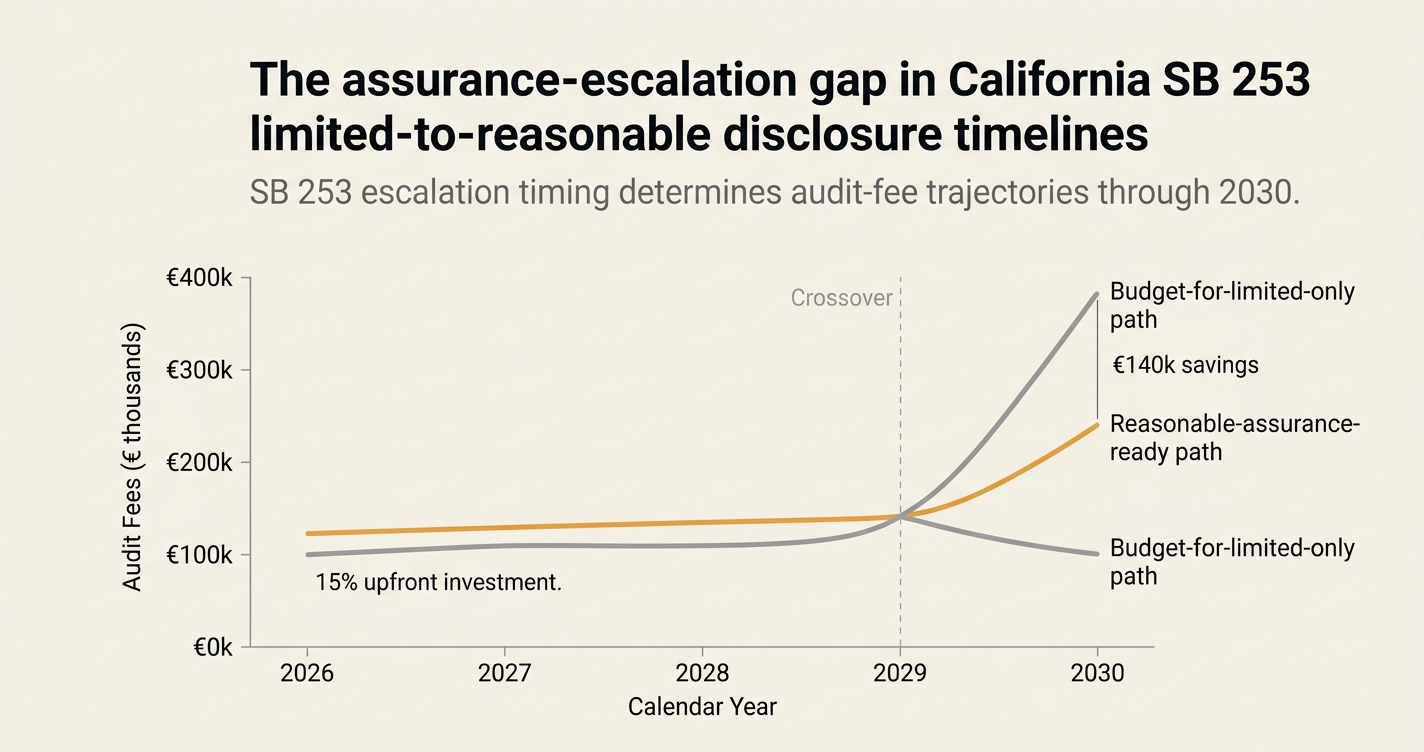
The assurance-escalation gap in California SB 253 limited-to-reasonable disclosure timelines
Here's the issue: California Senate Bill 253 (the Climate Corporate Data Accountability Act) mandates independent assurance for greenhouse gas emissions disclosures starting in 2026. Most CFOs and finance leaders treat this as a single compliance event—limited assurance for Scope 1 and Scope 2 in year one, then ongoing reporting in the same tier. The first-year engagement letter quotes £80,000 to £120,000 for a limited assurance opinion, which looks manageable against existing audit budgets. The problem appears solved.
However, SB 253 assurance consists of two things: limited assurance (2026–2029) and reasonable assurance (2030 onward for Scope 1 and 2, with Scope 3 limited assurance beginning in 2030). CFOs budget for the limited tier—but the escalation to reasonable assurance is the event that determines audit-fee trajectories, data system investment, and internal control design over the next four years.
Limited assurance on its own has minimal value to investors or audit committees. Reasonable assurance is what the California Air Resources Board (CARB) is ultimately requiring—and what drives the cost structure of SB 253 compliance. A limited assurance engagement reviews aggregated totals and high-level procedures. A reasonable assurance engagement audits transaction-level evidence, tests internal controls, and substantiates every material emission source with the same rigor as a financial statement audit.
While limited assurance fees average £80,000–£120,000 for a mid-cap reporting entity, reasonable assurance fees for the same entity range £180,000–£280,000, with complexity multipliers for multi-facility operations, landlord-managed utilities, and category-level Scope 3 breakdowns. If your data infrastructure in 2026 cannot scale to reasonable assurance requirements, the cost of remediation—re-architecting data lineage, implementing SOX-grade controls, remediating boundary definitions—might exceed the direct audit fee by 2–3x.
How do you solve this? I think the operators who will navigate SB 253 escalation most efficiently are the ones who architect their 2026 limited assurance engagement as a dry run for 2030 reasonable assurance. That means transaction-level evidence collection in year one, control documentation that matches financial audit standards, and boundary definitions that withstand reasonable assurance scrutiny. The teams who treat 2026 as a standalone limited assurance event will face a step-function cost increase in 2029 when they realize their data systems, documentation practices, and supplier engagement workflows were designed for the wrong tier.
The shape of the argument, visualised below.
The Two-Tier Structure of SB 253 Assurance
SB 253 specifies three distinct phases, each with different assurance requirements and compliance deadlines:
| Phase | Reporting Year | Assurance Level | Scope Coverage | First Report Due |
|---|---|---|---|---|
| Phase 1 | 2026 | Limited assurance | Scope 1 + 2 | June 30, 2026 |
| Phase 2 | 2027–2029 | Limited assurance | Scope 1 + 2 + 3 | Annually by June 30 |
| Phase 3 | 2030 onward | Reasonable assurance (Scope 1+2), Limited assurance (Scope 3) | Scope 1 + 2 + 3 | Annually by June 30 |
The transition from Phase 2 to Phase 3 is the inflection point. Limited assurance under ISAE 3410 or AT-C 105 Section 210 provides "negative assurance"—the auditor states that nothing has come to their attention indicating material misstatement. Reasonable assurance provides "positive assurance"—the auditor affirmatively states that the emissions inventory is free from material misstatement[1]. The evidence threshold for the second statement is categorically higher.
What Changes When You Move to Reasonable Assurance
The escalation from limited to reasonable assurance affects five operational dimensions:
1. Evidence granularity
Limited assurance accepts aggregated utility bills, fleet fuel summaries, and high-level supplier spend data. Reasonable assurance requires line-item invoice evidence, meter-level consumption records, and transaction-by-transaction procurement trails. If your 2026 data collection workflow relies on summary exports from ERP or utility portals, you will need to re-instrument every data source before 2030.
2. Internal control testing
Limited assurance reviews control design through management interviews and documentation walkthroughs. Reasonable assurance tests control effectiveness through sampling, observation, and re-performance. The audit firm will select a statistical sample of emission transactions (typically 20–40 items per material source category) and substantiate each one independently. If your controls are not documented at the same standard as your financial close process, testing will fail.
3. Boundary and methodology documentation
Limited assurance accepts management's boundary definitions (financial control, operational control, equity share) with minimal challenge. Reasonable assurance requires you to evidence your boundary logic with the same rigor as revenue recognition policy. Every consolidation decision, de minimis threshold, and exclusion must be documented with reference to GHG Protocol principles and justified against materiality thresholds[2].
4. Scope 3 category-level breakdowns
SB 253 requires Scope 3 reporting beginning in 2027, with limited assurance starting in 2030. While reasonable assurance for Scope 3 is not mandated under SB 253, audit committees increasingly expect category-level assurance for material categories (Category 1 purchased goods and services, Category 3 fuel- and energy-related activities, Category 4 upstream transportation). If your Scope 3 calculation in 2027 is spend-based with default emission factors, you cannot scale to category-level assurance without primary supplier data.
5. Assurance statement language and audit committee reporting
A limited assurance statement is 1–2 pages, describes procedures performed, and concludes with negative assurance. A reasonable assurance statement is 3–5 pages, includes a detailed description of responsibilities, an opinion on internal controls over emissions data, and positive assurance language. Audit committees will expect the same level of control attestation as they receive for financial statement audits.
"All SB 253 disclosures must be independently assured. Scope 1 and scope 2 require limited assurance beginning in 2026, moving to reasonable assurance in later years. Scope 3 requires limited assurance beginning in 2030. CARB enforces compliance and can levy penalties of up to $500,000 per year. For executives, assurance means emissions data must withstand audit-level scrutiny. Companies that invest early in robust systems avoid costly remediation later."[3]
The Cost Structure of Escalation
Audit fees for SB 253 assurance are structured as base engagement costs plus complexity multipliers. Limited assurance base fees for a mid-cap entity (€1–5 billion revenue, 10–30 facilities) range €80,000–€120,000. Reasonable assurance base fees for the same entity range €180,000–€280,000. Complexity multipliers apply for:
- Multi-facility operations (€15,000–€25,000 per additional region)
- Landlord-managed utilities requiring landlord data requests (€8,000–€12,000 per district energy system)
- Category-level Scope 3 assurance (€20,000–€40,000 per material category)
- First-year control documentation (€30,000–€50,000 one-time fee)
The multipliers compound. A company with 50 facilities across five regions, three district energy systems, and two material Scope 3 categories might face a reasonable assurance fee of €400,000–€600,000 in 2030, compared to €140,000 in 2026[4].
The larger hidden cost is remediation. If your 2026 limited assurance engagement identifies control gaps, boundary inconsistencies, or evidence lineage failures that prevent escalation, you will incur:
- Data system re-architecture (€80,000–€150,000 for enterprise carbon accounting platform implementation)
- Historical data remediation (€40,000–€80,000 per year if you need to rebuild 2026–2029 evidence trails)
- Internal resource costs (0.5–1.0 FTE for 12–18 months to document controls, train data collectors, and coordinate with facilities)
Remediation costs often exceed the audit fee delta.
What CFOs Should Ask in 2026 Scoping Calls
When your audit firm presents the 2026 SB 253 engagement letter, ask these five questions:
-
"What evidence granularity are you planning to test in this limited assurance engagement?"
If the answer is "aggregated summaries," ask what would need to change for reasonable assurance. The gap between the two answers is your 2027–2029 data infrastructure roadmap. -
"Will you be testing internal controls, or just reviewing control design?"
If they are not testing controls in 2026, ask for a control gap assessment as part of the engagement. This surfaces remediation needs before the 2030 escalation deadline. -
"How are you handling boundary definitions—will these withstand reasonable assurance scrutiny?"
If your boundary documentation is a one-page memo, it will not scale. Ask for a boundary logic document that references GHG Protocol guidance and documents every consolidation decision. -
"What Scope 3 categories are you considering material, and what evidence threshold applies?"
If the auditor flags Category 1 or Category 4 as material, but your 2027 Scope 3 inventory is spend-based, you have a gap. Ask for a Scope 3 data quality roadmap. -
"What is the fee delta if we architect this engagement for reasonable assurance readiness?"
The premium for reasonable-assurance-ready evidence in 2026 is typically 15–25% of the base fee. The cost of remediation in 2029 is 2–3x the base fee.
How Data Systems Scale Across Tiers
Most carbon accounting platforms are architected for limited assurance: they aggregate totals, generate summary reports, and export data in formats suitable for negative assurance review. Reasonable assurance requires transaction-level evidence lineage—every emission figure must be reproducible from source document to final total, with intermediate calculations and assumptions logged.
The scaling bottleneck is evidence attachment. In a limited assurance workflow, you upload one utility bill per facility per month (12 documents per facility per year). In a reasonable assurance workflow, you need meter-level consumption data (potentially 10–50 meters per facility), with each meter reading linked to its corresponding invoice line item, allocation logic, and emission factor source. For a 30-facility company, this scales from 360 annual document attachments to 15,000+ line-item evidence records[5].
Spreadsheet-based workflows cannot manage this volume. Enterprise carbon accounting platforms with transaction-level data models, automated evidence parsing, and built-in lineage tracking can. The platform investment is typically €40,000–€80,000 in year one (implementation + licensing), then €20,000–€40,000 annually. The alternative—manual evidence collection and remediation in 2029—costs €80,000–€150,000 plus 12–18 months of internal resource time.
The Scope 3 Escalation Wildcard
While SB 253 only mandates limited assurance for Scope 3 (beginning in 2030), audit committees and institutional investors are increasingly requesting category-level assurance for material categories. If Category 1 (purchased goods and services) represents 60–80% of your total footprint, limited assurance on an aggregate Scope 3 total provides minimal decision-useful information.
Category-level assurance requires primary supplier data: product-level emission factors, supplier-specific activity data, and allocation methodologies that withstand auditor scrutiny. Spend-based calculations with industry-average emission factors are acceptable for limited assurance on an aggregate total, but not for category-level reasonable assurance. The data gap is structural: you need supplier engagement, data-sharing agreements, and supplier audit rights—none of which can be implemented in a single year.
The companies who will scale Scope 3 assurance efficiently are the ones who begin supplier engagement in 2026, even though category-level assurance is not yet mandated. The lag time from supplier outreach to primary data collection is 12–18 months for a mid-complexity supply chain.
How Emission3 Fits
Emission3 is architected for reasonable assurance readiness from day one. Every emission figure is linked to a source document (invoice, bill of materials, utility bill), every calculation is reproducible with logged assumptions, and every boundary decision is documented with GHG Protocol references. When you export an evidence pack for your auditor, it includes:
- Transaction-level evidence attachments (one PDF per invoice line item)
- Calculation lineage (source data → allocation logic → emission factor → final figure)
- Control documentation (who collected the data, when it was reviewed, what assumptions were applied)
- Boundary logic memos (consolidation decisions, de minimis thresholds, exclusion rationale)
Our clients who complete limited assurance in 2026 using Emission3 do not need to re-architect their data systems for 2030 reasonable assurance. The evidence infrastructure is already in place. The typical audit fee delta for an Emission3-prepared inventory is 10–15% below market rate, because the auditor spends less time on evidence requests and control testing.
If you are scoping SB 253 assurance now, we can walk through your facility footprint, boundary definitions, and Scope 3 category materiality in a 45-minute readiness call. Book a session at /book-demo—we will map your escalation timeline and surface any 2026 decisions that constrain your 2030 options.
Next Steps for CFOs Facing SB 253 Escalation
-
Request a reasonable-assurance-readiness assessment from your audit firm.
This is not a standard deliverable in a limited assurance engagement, but you can negotiate it as an add-on. The output should be a gap analysis: what would need to change in your data systems, controls, and documentation for reasonable assurance in 2030. -
Architect your 2026 data collection workflow for transaction-level evidence.
Even if your auditor only reviews aggregated summaries in 2026, collect line-item data. The marginal cost of collecting invoices instead of summary bills is near-zero, but the remediation cost of rebuilding 2026–2029 evidence in 2029 is prohibitive. -
Document boundary and methodology decisions now.
Do not wait until 2029 to write your boundary logic memo. If you make a consolidation decision in 2026 (e.g., excluding a joint venture under equity share method), document the decision with GHG Protocol references at the time you make it. This documentation becomes part of your control environment. -
Begin Scope 3 supplier engagement in 2026.
Category-level assurance is not mandated, but if institutional investors or audit committees request it, you need 12–18 months of lead time. Identify your top 20 suppliers by spend in material categories (Category 1, Category 4) and initiate data-sharing conversations. -
Budget for escalation fees in your 2027–2030 planning cycle.
The reasonable assurance fee in 2030 will be 1.5–2.5x your 2026 limited assurance fee, plus remediation costs if your data infrastructure is not ready. Model the escalation explicitly in your compliance budget.
SB 253 is not a single compliance event—it is a four-year escalation timeline. The CFOs who navigate it most efficiently are the ones who architect their 2026 engagement for 2030 requirements. Book a CBAM readiness call at /book-demo to map your SB 253 escalation timeline and surface any early decisions that constrain your later options[6].
References & Sources
External Sources
- [1]California climate disclosure rules: What companies need to know about SB253 and SB261
Overview of SB 253 and SB 261 reporting deadlines, assurance requirements, and the transition from limited to reasonable assurance for Scope 1 and Scope 2 emissions.
- [2]Executive guide to California SB 253: Turning compliance into value
Carbon Direct's executive guide covering assurance requirements, boundary definitions, technology readiness, and the need for audit-proof data systems under SB 253.
- [3]What Companies Need to Know About California SB 253 - Reporting, Deadlines, and How to Prepare
PlanetFWD's breakdown of SB 253 applicability, reporting deadlines, assurance escalation, and the importance of audit-ready evidence systems for CFOs and finance teams.
- [4]ESG Trends From 2025 and What to Expect in 2026
DFIN's analysis of the shift from narrative-heavy sustainability disclosures to mandatory, audit-ready documentation, including cost implications of assurance escalation.
- [5]Sustainability Spotlight — California Climate Legislation Update — Status of CARB Rulemaking and Next Steps
Deloitte's regulatory update on CARB rulemaking timelines, fee structures, and compliance deadlines for SB 253 and SB 261, including enforcement penalties.
Related Content
- [6]Book a CBAM readiness call
All customers start with a readiness call: we map suppliers, gaps, and implementation, no anonymous self-serve onboarding.
- [7]Audit-ready exports in Emission3
For auditors and CFOs, shows the evidence lineage artifact and transaction-level documentation capabilities in Emission3.
- [8]The audit-grade evidence gap in California SB 253 Scope 1 and Scope 2 assurance engagements
SB 253 assurance consists of emissions totals and audit-grade evidence. CFOs budget for the first—but 2026 assurance fees are set by the second.