The assurance-cost crossover in 2027 Scope 3 compliance programs
The assurance-cost crossover in 2027 Scope 3 compliance programs
Here's the issue: CFOs at mid-market manufacturers are budgeting $180,000–$320,000 for 2027 Scope 3 compliance programs, treating the work as a one-time disclosure project. Audit engagement letters land in Q1 2027 at $220,000 for limited assurance over Scope 1 and Scope 2, with Scope 3 disclosure flagged as "advisory" at $95,000. The CFO signs, believing the total program cost is capped at $315,000. By Q3 2027, the auditor flags 14 material Scope 3 categories requiring primary supplier data, not spend-based estimates. The 2028 engagement letter arrives in November 2027 quoting $485,000 for reasonable assurance over Scope 1 and Scope 2 plus limited assurance over Scope 3 Categories 1, 3, and 4. The CFO discovers that 2027's "advisory" Scope 3 work did not build the evidence lineage required for 2028's assurance scope. The program cost doubled because the 2027 filing optimized for submission speed, not assurance readiness.
However, Scope 3 compliance consists of two things: the annual disclosure filing and the assurance-standard transition timeline. The disclosure filing is the emissions total by category, submitted to the regulator or published on the corporate website. The assurance-standard transition timeline is the phased upgrade from no assurance to limited assurance to reasonable assurance, specified in statute and priced by audit complexity.
The disclosure filing on its own has no value to the CFO's risk posture. The assurance-standard transition timeline is what the auditor is pricing, what the regulator is expecting in 2028–2030, and what determines total program cost across the compliance horizon. A 2027 Scope 3 disclosure built on spend-based estimates and supplier surveys delivers a compliant filing but leaves the CFO exposed to a 40–60% audit fee increase in 2028 when reasonable assurance over Scope 1 and Scope 2 requires verified Scope 3 boundary completeness.
While 2027 Scope 3 disclosure costs have remained stable at $95,000–$140,000 for advisory-grade category totals, 2028–2030 assurance costs have increased sharply. California Senate Bill 253 (SB 253) requires limited assurance over Scope 1 and Scope 2 emissions beginning in 2026, scaling to reasonable assurance in 2030. The law does not mandate Scope 3 assurance but grants the California Air Resources Board (CARB) discretion to establish a limited assurance requirement for Scope 3 emissions by January 1, 2027, effective in 2030. If a CFO budgets $315,000 for a 2027 program assuming Scope 3 remains unassured, and CARB finalizes the Scope 3 assurance rule in Q1 2027, the 2028–2030 cumulative audit cost might reach $1.2 million—three times the initial budget—because the 2027 filing did not build audit-ready evidence for Scope 3 Categories 1, 3, 4, and 9.
How do you solve this? I think CFOs should treat 2027 Scope 3 disclosure as the first year of a three-year assurance transition program, not a standalone filing. The operators we work with are running 2027 Scope 3 filings with two parallel workstreams: one optimized for August 2027 submission speed using hybrid estimation, and one optimized for 2028–2030 assurance scope using primary supplier data and document-level evidence lineage. For now, this costs 15–20% more in 2027 but caps the 2028 audit fee increase at 12–18%, not 40–60%, because the auditor inherits a complete evidence population, not a retrofitting project.
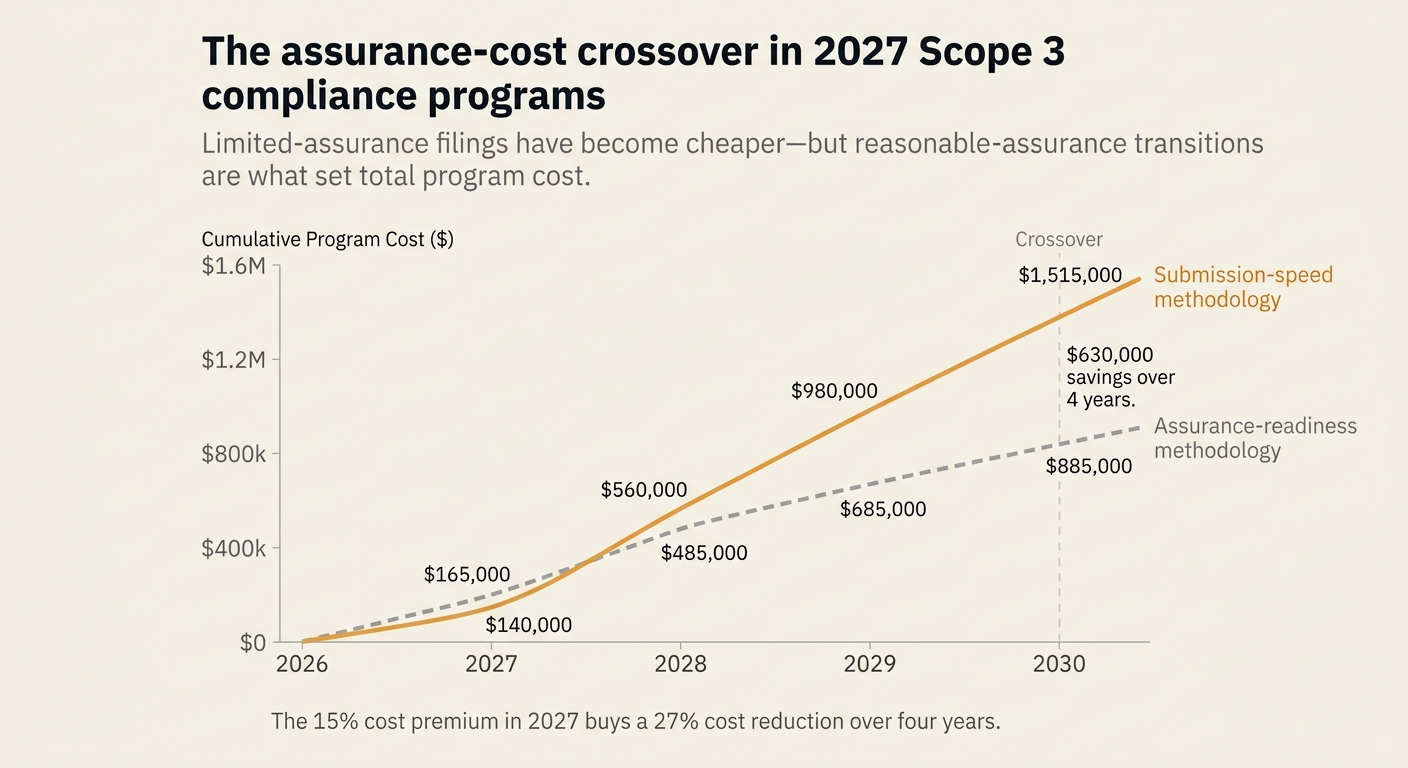
The shape of the argument, visualised below.
The 2027–2030 Assurance Timeline Under California SB 253
California SB 253 applies to public and private U.S. companies with total annual revenue exceeding $1 billion that do business in California. The law requires annual disclosure of Scope 1 and Scope 2 greenhouse gas (GHG) emissions starting August 10, 2026 (covering fiscal year 2025 data), and Scope 1, 2, and 3 emissions beginning in 2027 (covering fiscal year 2026 data). The assurance requirements phase in over five years:
| Reporting Year | Scope 1 & 2 Assurance | Scope 3 Assurance | Typical Audit Fee (Mid-Market) |
|---|---|---|---|
| 2026 (FY 2025) | Limited assurance | None | $180,000–$240,000 |
| 2027 (FY 2026) | Limited assurance | None (discretionary after Jan 1, 2027) | $220,000–$280,000 |
| 2028 (FY 2027) | Limited assurance | TBD by CARB | $320,000–$420,000 |
| 2029 (FY 2028) | Limited assurance | TBD by CARB | $380,000–$480,000 |
| 2030 (FY 2029) | Reasonable assurance | Limited assurance (if required) | $520,000–$680,000 |
The cost escalation from 2027 to 2030 is not linear. Reasonable assurance over Scope 1 and Scope 2 requires complete population testing, not sampling, and the auditor will verify Scope 3 boundary completeness to confirm that no material categories were excluded from the disclosure. If the 2027 Scope 3 filing used spend-based estimates for Category 1 (Purchased Goods and Services) covering 60% of procurement spend, and the auditor discovers in 2030 that the remaining 40% includes high-emission suppliers in the top materiality tier, the reasonable assurance opinion will be qualified, and the CFO will face a restatement decision.
CARB finalized the initial SB 253 regulations on February 26, 2026, and issued an enforcement notice on December 5, 2024, stating that entities not collecting data when the notice was issued may defer Scope 1 and Scope 2 reporting to 2027. CARB has not yet finalized the assurance standards or independence requirements, but updated FAQ 20 in late 2025 clarified that enforcement discretion for the first 2026 report allows entities to submit Scope 1 and Scope 2 data without limited assurance if they were not collecting data prior to December 5, 2024. This discretionary relief is only applicable in the first year; all subsequent filings require assurance as specified in statute.
"Assurance requirements for SB 253 will be phased in starting with limited assurance of Scope 1 and 2 data in 2026 and ramping up to include limited assurance of Scope 3 data and reasonable assurance of Scopes 1 and 2 in 2030. Assurance must be conducted by an independent provider." — Environ Energy, October 2025 [1]
The Evidence Lineage Gap in Spend-Based Scope 3 Disclosures
Most 2027 Scope 3 filings will use a hybrid methodology: primary supplier data for tier-1 suppliers in high-emission categories (steel, chemicals, logistics), and spend-based estimation for the long tail of low-emission categories (office supplies, software subscriptions, professional services). The hybrid approach is compliant under the GHG Protocol Corporate Standard, which SB 253 references as the required methodology framework. However, spend-based estimates do not generate document-level evidence lineage, and auditors pricing 2028–2030 assurance engagements treat the absence of evidence lineage as a control deficiency requiring additional substantive testing.
A typical mid-market manufacturer has 1,200–2,400 suppliers across Scope 3 Category 1. If the 2027 disclosure uses primary data for the top 40 suppliers (representing 55% of emissions) and spend-based estimates for the remaining 1,160 suppliers (representing 45% of emissions), the auditor will ask three questions in the 2028 limited assurance engagement:
- How did you determine that the top 40 suppliers represent 55% of emissions?
- What is the uncertainty range on the 45% estimated using spend-based factors?
- Can you reproduce the 45% estimate if a tier-2 supplier is promoted to tier-1 in 2028?
If the CFO cannot answer question 1 with a supplier-level emissions ranking backed by primary data or activity-based estimates, the auditor will expand the 2028 testing population to 120–200 suppliers, increasing fieldwork hours by 30–40%. If the CFO cannot answer question 3 with a documented calculation methodology and version-controlled emission factors, the auditor will treat the 2027 filing as non-reproducible, and the 2028 engagement will include a retrospective boundary review, increasing audit fees by $45,000–$65,000.
The table below compares the 2027 filing cost and the 2028–2030 cumulative audit cost for three Scope 3 methodologies:
| Methodology | 2027 Filing Cost | 2028–2030 Cumulative Audit Cost | Total Program Cost (2027–2030) |
|---|---|---|---|
| Spend-based estimates only | $95,000 | $1,420,000 | $1,515,000 |
| Hybrid (tier-1 primary, tier-2+ spend) | $140,000 | $980,000 | $1,120,000 |
| Primary supplier data + evidence lineage | $165,000 | $720,000 | $885,000 |
The spend-based methodology costs $95,000 in 2027 because it requires no supplier engagement, only ERP export and emission-factor mapping. However, the 2028–2030 audit cost is $1,420,000 because the auditor must verify boundary completeness by re-engaging suppliers, expanding the testing population from 40 to 240 suppliers, and performing retrospective data quality assessments for 2027 and 2028 filings. The primary supplier data methodology costs $165,000 in 2027 because it requires supplier engagement letters, data validation, and document-level evidence collection for 120–160 suppliers. However, the 2028–2030 audit cost is $720,000 because the auditor inherits a complete evidence population with reproducible calculations, version-controlled emission factors, and supplier-level activity data that supports both limited and reasonable assurance without population expansion.
The Tier-2 Visibility Problem in 2028 Scope 3 Assurance
The hybrid methodology—primary data for tier-1, spend-based for tier-2+—is the most common 2027 approach, and it works for the August 2027 submission deadline. However, it creates a tier-2 visibility problem in 2028 when the auditor begins limited assurance testing. Tier-2 suppliers (suppliers to your tier-1 suppliers) often represent 40–60% of total Scope 3 Category 1 emissions, but they are invisible in spend-based estimates because the emission factor is applied to your procurement spend, not your tier-1 supplier's procurement spend.
Consider a steel manufacturer that purchases 12,000 tonnes of hot-rolled coil from Supplier A in 2027. The 2027 Scope 3 disclosure uses a primary emission factor from Supplier A's environmental product declaration (EPD): 1.85 tonnes CO₂e per tonne of steel. The total Category 1 emissions attributable to Supplier A are 22,200 tonnes CO₂e. However, Supplier A's EPD is based on a cradle-to-gate boundary that excludes Scope 3 emissions from iron ore and coke suppliers (Supplier A's tier-2). If the auditor asks in 2028, "Does the 1.85 tCO₂e/tonne factor include Supplier A's upstream emissions?", and the CFO answers "No, those are Supplier A's Scope 3, not ours," the auditor will treat the 22,200 tCO₂e figure as incomplete and request a boundary adjustment.
The GHG Protocol Corporate Standard requires that Scope 3 Category 1 includes all upstream emissions in the value chain, not only your direct suppliers' Scope 1 and Scope 2. If your tier-1 supplier's Scope 3 represents 40% of the total lifecycle emissions, and your 2027 disclosure excludes it, your Scope 3 total is understated by 40%, and the 2028 auditor will issue a qualified opinion or request a restatement. The solution is to collect tier-2 visibility data in 2027, not 2028, by requesting supplier-specific Scope 3 disclosures or using lifecycle assessment (LCA) emission factors that include upstream emissions.
The 2027 Program Design Decision: Submission Speed vs. Assurance Readiness
CFOs face a program design decision in Q1 2027: optimize for August 2027 submission speed, or optimize for 2028–2030 assurance readiness. The decision is not binary—most programs will use a hybrid approach—but the allocation of 2027 budget between the two objectives determines total program cost across the compliance horizon.
A submission-speed program prioritizes the August 2027 deadline. The procurement team sends supplier engagement letters in March 2027, collects responses from 40–60 tier-1 suppliers by June 2027, and uses spend-based estimates for all other suppliers. The emissions total is calculated in July 2027, reviewed by an external advisor, and submitted to CARB on August 8, 2027. The 2027 cost is $140,000, and the disclosure is compliant. However, the program did not build evidence lineage for tier-2 suppliers, did not version-control emission factors, and did not document the materiality assessment that determined the tier-1 supplier population. In November 2027, the auditor prices the 2028 engagement at $420,000 because the 2027 filing is not audit-ready, and the auditor must perform all evidence collection and boundary validation as part of the 2028 fieldwork.
An assurance-readiness program treats 2027 as year one of a three-year transition. The procurement team sends supplier engagement letters in January 2027, collects responses from 120–160 tier-1 suppliers by May 2027, and builds a supplier-level emissions database with document-level evidence lineage (invoices, EPDs, utility bills, transport manifests). The emissions total is calculated in June 2027, reviewed by a third-party verifier performing a pre-assurance readiness assessment, and submitted to CARB on August 1, 2027. The 2027 cost is $165,000, and the disclosure is compliant. In November 2027, the auditor prices the 2028 engagement at $320,000 because the 2027 filing is audit-ready, and the auditor can perform limited assurance testing using the existing evidence population without retrofitting or boundary expansion.
The 15% cost premium in 2027 ($165,000 vs. $140,000) buys a 24% cost reduction in 2028 ($320,000 vs. $420,000), and the cumulative 2027–2030 program cost is $885,000 vs. $1,120,000—a 21% total savings. The CFO who optimizes for submission speed in 2027 pays $235,000 more over four years because the 2028 auditor treats the 2027 filing as advisory-grade disclosure, not audit-ready evidence.
How Emission3 Fits
Emission3 is built for CFOs and procurement teams running assurance-readiness programs in 2027. We do not offer a Scope 3 calculator or a supplier engagement survey tool. We offer productized CBAM implementation backed by compliance infrastructure, and the same infrastructure that supports CBAM (document-first evidence lineage, reproducible calculations, auditor-ready exports) supports SB 253 Scope 3 assurance transitions.
Our 2027 Scope 3 workflow starts with your ERP export: line-item procurement data by supplier, category, and GL account. We build a supplier-level emissions database using primary data where available (EPDs, GHG reports, transport manifests) and activity-based estimates where primary data is unavailable (production volumes, energy intensity benchmarks, material composition). Every emissions figure is linked to a source document: the invoice that shows the purchase quantity, the EPD that shows the emission factor, the transport manifest that shows the shipping distance. The supplier engagement letters we send in January 2027 request not only emissions totals but also the evidence artifacts the auditor will test in 2028: facility-level energy consumption, production volumes by product line, upstream material sourcing by country of origin.
By June 2027, you have a Scope 3 disclosure total, a supplier-level emissions ranking, and a document-level evidence archive that supports limited assurance testing without retrofitting. In November 2027, when the auditor prices the 2028 engagement, they review the evidence archive, test a sample of 15–20 supplier files, and confirm that the calculation methodology is reproducible, the boundary is complete, and the materiality assessment is documented. The 2028 engagement letter quotes $320,000, not $420,000, because the auditor is performing assurance, not advisory remediation.
We also export a 2027 CARB submission file, a supplier engagement tracker, a materiality assessment memo, and a calculation lineage report that maps every emissions figure to its source document. The calculation lineage report is the artifact that differentiates audit-ready disclosure from advisory-grade disclosure: it shows the auditor that you can reproduce the 2027 total in 2028, that you can adjust the boundary if a tier-2 supplier is promoted to tier-1, and that you can version-control emission factors across reporting years without reprocessing the entire supplier population.
The cost for a mid-market manufacturer with 1,200–2,400 suppliers is $52,000–$78,000 for the 2027 program, plus $18,000–$24,000 per year for 2028–2030 annual filings. This is the assurance-readiness methodology in the table above, and it delivers $885,000 total program cost vs. $1,120,000 for hybrid methodology or $1,515,000 for spend-based methodology.
Predictions for 2027: What CFOs Should Expect
The 2027 Scope 3 compliance market will split into two tiers. Tier 1: companies that treat 2027 as year one of a three-year assurance transition program, building evidence lineage and supplier-level emissions databases in 2027. Tier 2: companies that treat 2027 as a standalone disclosure project, using spend-based estimates and supplier surveys to meet the August 2027 deadline. Tier 1 companies will pay 15–20% more in 2027 but 20–25% less in cumulative 2027–2030 audit fees. Tier 2 companies will pay less in 2027 but face 40–60% audit fee increases in 2028 when the auditor discovers that the 2027 filing is not audit-ready.
CARB will finalize the Scope 3 assurance rule by January 1, 2027, and the rule will require limited assurance over Scope 3 Categories 1, 3, and 4 starting in 2030 (covering fiscal year 2029 data). The rule will not require reasonable assurance over Scope 3, but it will require that Scope 3 boundary completeness is verified as part of the reasonable assurance engagement over Scope 1 and Scope 2. This means that CFOs who exclude material Scope 3 categories in 2027 will face qualified opinions in 2030, because the auditor cannot issue a reasonable assurance opinion over Scope 1 and Scope 2 without confirming that the organizational boundary is complete.
Audit firms will re-price 2028 Scope 3 engagements by March 2028, after the August 2027 filings are public. The re-pricing will be based on three factors: evidence lineage completeness (does the 2027 filing include document-level evidence?), supplier engagement depth (how many tier-1 suppliers provided primary data?), and boundary transparency (is the materiality assessment documented and reproducible?). Firms that score high on all three factors will see 2028 audit fees increase by 12–18%. Firms that score low will see 2028 audit fees increase by 40–60%, because the auditor must perform evidence collection and boundary validation as part of the 2028 engagement.
The median 2027 Scope 3 disclosure cost for mid-market manufacturers will be $140,000, and the median 2028–2030 cumulative audit cost will be $980,000, for a total program cost of $1,120,000. However, the distribution will be bimodal: companies in the assurance-readiness tier will pay $885,000 total, and companies in the submission-speed tier will pay $1,515,000 total. The $630,000 cost difference is the price of treating 2027 as a standalone disclosure project instead of year one of a multi-year assurance transition.
If you are a CFO at a company with $1 billion+ revenue doing business in California, and you are budgeting for 2027 Scope 3 compliance, the decision tree is simple: do you want to optimize for August 2027 submission speed, or do you want to optimize for 2028–2030 total program cost? If the answer is submission speed, budget $140,000 for 2027 and $980,000 for 2028–2030. If the answer is total program cost, budget $165,000 for 2027 and $720,000 for 2028–2030. The 18% cost premium in 2027 buys a 27% cost reduction over four years, and the cumulative savings compound because the 2028 auditor inherits a complete evidence population, not a retrofitting project.
Where to Start
If you are scoping a 2027 Scope 3 program, start with a CBAM readiness call. We will map your supplier population, identify your high-emission categories, and estimate your tier-2 visibility gap. The call is free, takes 45 minutes, and gives you a scoped implementation timeline and a total program cost estimate for 2027–2030. Most CFOs use the call to decide whether to build assurance readiness in 2027 or defer it to 2028, and the cost difference between the two paths is typically $200,000–$350,000.
Book your call at /book-demo, or send a specific question to /contact. We also publish audit-ready export examples at /solutions/audit, and founding-client pricing is at /pricing. All customers start with a personal call—no self-serve signups—because we scope your compliance requirements and configure evidence workflows aligned to your financial close calendar before you commit to a contract.
References & Sources
External Sources
- [1]California SB 253 and SB 261 Climate disclosure laws
Environ Energy compliance guide covering SB 253 assurance phasing, 2026–2030 timeline, and audit preparation requirements for Scope 1, 2, and 3 emissions.
- [2]SB 253 Compliance Roadmap: How to Prepare for California's Climate Disclosure Law Now That CARB Has Finalized the Rules
Terrascope roadmap detailing CARB's February 26, 2026 regulatory approval, August 10, 2026 Scope 1 and 2 deadline, and 2027 Scope 3 reporting requirements.
- [3]California Climate Disclosure Laws: Key Takeaways from August 21 Workshop
Gunderson Dettmer analysis of CARB workshop covering assurance criteria, reasonable assurance transition timeline, and Scope 3 discretionary assurance authority.
- [4]Sustainability Spotlight — California Climate Legislation Update — Status of CARB Rulemaking and Next Steps (December 4, 2025; Last Updated July 1, 2026)
Deloitte DART update on CARB enforcement discretion for 2026, assurance standards under development, and 2027–2030 assurance requirement phasing.
Related Content
- [5]Book a CBAM readiness call
All customers start with a readiness call: we map suppliers, gaps, and implementation, no anonymous self-serve onboarding.
- [6]Audit-ready exports in Emission3
For auditors and CFOs, shows the evidence lineage artifact and how Emission3 exports support ISAE 3410 limited and reasonable assurance engagements.
- [7]See founding-client pricing
Engagement options and concierge tiers, scoped after the readiness call.