The 2026 CBAM Cliff
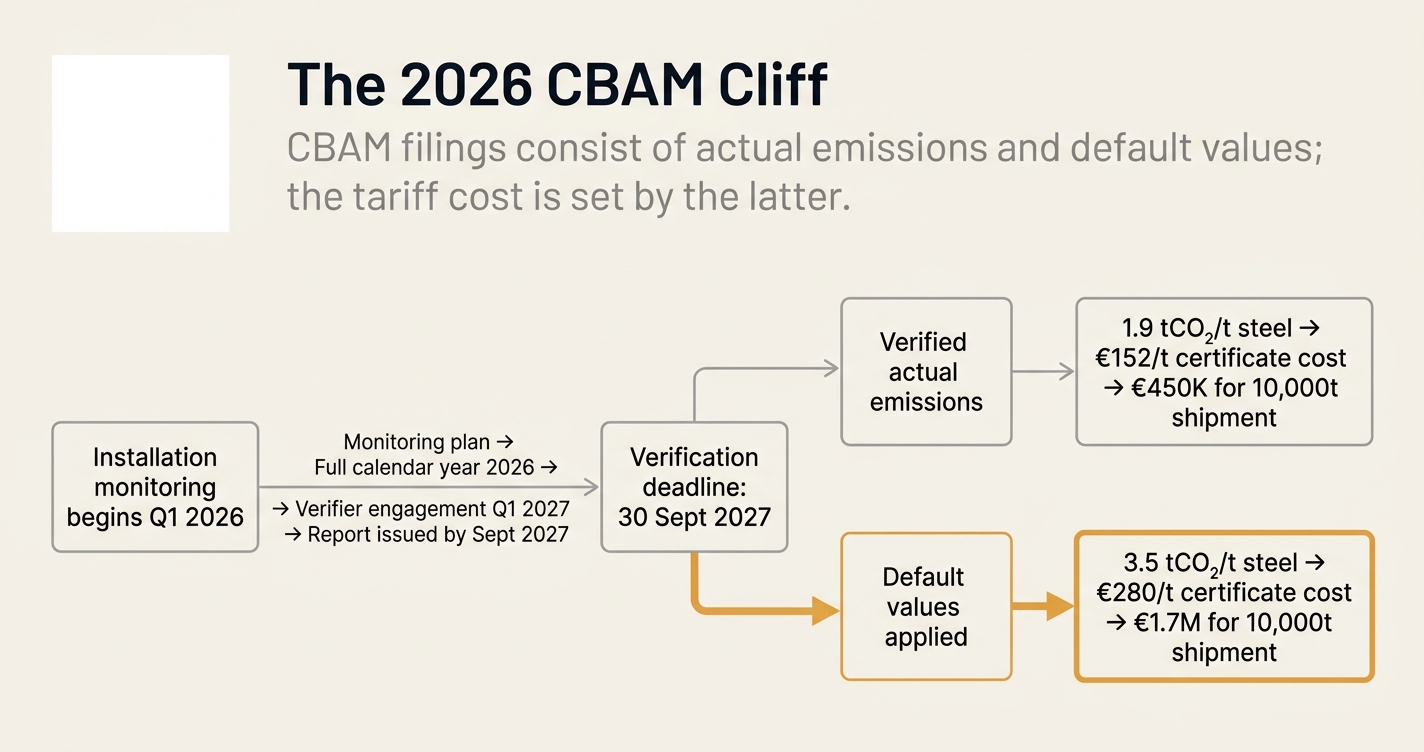
The 2026 CBAM Cliff
Here's the issue: on 1 January 2026, the Carbon Border Adjustment Mechanism transitional period ended. Non-EU exporters of steel, aluminium, cement, fertilizers, hydrogen, and electricity now face a choice: provide installation-level actual emissions data verified by an accredited third party, or accept country-specific default values that inflate declared emissions by 200-500% above real installation performance. A 10,000-tonne shipment of blast furnace steel from a high-emitting country using default values at 3.5 tonnes of carbon dioxide per tonne of product and €80 per European Union Allowance could face €1.7 million in CBAM certificate costs in 2026. The same tonnage with verified actual data at 1.9 tonnes of carbon dioxide per tonne from the mill might reduce this to under €450,000.[1]
However, CBAM filings consist of two things: declared embedded emissions totals and the methodology used to calculate them—actual values or default values.
Actual values on their own have no value. Default values are what the European Commission will apply if installation-level data is missing, and default values are what set the tariff cost per tonne shipped. While most non-EU exporters have focused on calculating their emissions, the Commission revised default benchmarks downward in late 2025, which actually raises CBAM exposure for most products because the gap between default and actual has widened.[2]
While installation operators have invested in emissions monitoring systems, verification cycles have become more expensive. If an exporter ships 50,000 tonnes of aluminium ingots across six production runs in 2026 and cannot provide verified actual emissions for all six batches, the CBAM declarant—the EU importer—will apply the United States country-specific default value plus markup to the entire shipment. The cost delta might outpace the savings from optimising furnace efficiency.
How do you solve this? I think the operators we work with treat 2026 as a verification-readiness year, not a reporting year. The first annual CBAM declaration is due by 30 September 2027, covering the full 2026 calendar year. Installations that complete pre-verification in 2026 and establish a monitoring plan aligned with Commission Implementing Regulation 2025/2547 can submit verified actual emissions for the entire reporting period. For now, the bottleneck is not the emissions total—it is the verification evidence and the audit trail that connects raw utility bills and invoices to line-item emissions at the installation level.
The shape of the argument, visualised below.
The statutory trigger
Article 7(6) of Regulation (EU) 2023/956 establishes the mechanism:
"Where the actual embedded emissions cannot be adequately determined, the default values referred to in paragraph 7 shall apply. Those default values shall be based on the average emission intensity of each exporting country for each type of goods, increased by a mark-up reflecting the difference in the average carbon price between the exporting country and the EU."
Commission Implementing Regulation 2025/2621 published the legally binding default values for 2026.[3] The Excel file circulated in December 2025 is for information purposes only. The regulation itself binds all CBAM declarants and sets the penalty structure for missing actual data.
What this means for you
| Scenario | Data requirement | Cost exposure | Verification cycle | Declarant obligation |
|---|---|---|---|---|
| Actual emissions data, verified | Installation-level monitoring plan, quarterly data, accredited verifier report | Tariff based on real emissions intensity (1.9–2.5 tCO₂/t for efficient steel mills) | Mandatory physical site visit in 2026, risk-based virtual visits from 2027[4] | Surrender certificates equal to verified embedded emissions |
| Default values applied | No installation data required | Tariff based on country average plus markup (3.5–4.2 tCO₂/t for US steel, for example) | None | Surrender certificates equal to default value times tonnage |
| Partial actual data | Verified data for some batches, defaults applied to remainder | Blended tariff, weighted by tonnage | Partial verification scope | Surrender certificates for verified batches at actual, remainder at default |
| Late verification | Actual data collected but verification report issued after 30 September 2027 deadline | Default values applied to entire shipment | Delayed cycle, no retroactive adjustment | Declarant cannot use late-verified data for 2026 filing |
| No monitoring plan | Emissions estimates exist but not aligned with Implementing Regulation 2025/2547 | Default values applied | No accredited verifier will issue report | Declarant has no pathway to actual values |
The verification-timing penalty
The first official verification covers the 2026 calendar year and includes an on-site audit of the installation. Verifiers assess the data itself and the methodology used to collect it, including system boundaries, precursor emissions, and production route allocations.[5] A physical site visit of the non-EU installation is mandatory starting in 2026. In subsequent years, the regulation allows for limited flexibility, permitting virtual site visits or, in certain cases, waivers, provided strict conditions are met—including completion of a prior physical site visit and a verifier risk assessment demonstrating that the reliability of the verification process would not be compromised.[6]
The verification report can be transmitted to the operator via the CBAM Registry if the operator is registered, or by other means if not registered. Verification reports for 2026 can be issued in an electronic EU template from January 2027 via the CBAM Registry.[7] Exporters who begin monitoring in January 2026 and engage a verifier in the first quarter can complete verification by mid-2027 and deliver the report to the EU importer before the 30 September 2027 deadline. Exporters who delay monitoring until the second half of 2026 will not have a full reporting period to verify, and the verifier will need to assess partial-year data or default to country benchmarks.
The default-value penalty structure
The European Commission published provisional default values for all major countries that export to the EU. These default values have been deliberately kept very high to use them as punitive measures and encourage importers and exporters to use actual emission values. There are different benchmarks given for different sectors and products for all the CBAM-listed Harmonised System Nomenclature and Combined Nomenclature codes.[8]
For US iron and steel exporters, default values range from 1.87 tonnes of carbon dioxide per tonne for steel billet in some countries to 2.3–3.5 tonnes of carbon dioxide per tonne for product from China, South Africa, or Mozambique. Aluminium defaults vary widely: low-emission jurisdictions like Saudi Arabia, Qatar, or Malaysia cluster around 1.9 tonnes of carbon dioxide per tonne of primary aluminium, while high-emission baselines exceed 4 tonnes of carbon dioxide per tonne. The markup applied to default values reflects the carbon price differential between the exporting country and the EU Emissions Trading System price, currently trading above €80 per allowance.[1]
An exporter operating a blast furnace at 1.9 tonnes of carbon dioxide per tonne faces a CBAM certificate cost of approximately €152 per tonne of steel at current EUA prices. The same exporter using the default value of 3.5 tonnes of carbon dioxide per tonne faces a certificate cost of €280 per tonne. For a 10,000-tonne shipment, the delta is €1.28 million. EU importers will push this tariff cost back on the supplier through pricing negotiations or contract renegotiation.
The installation-data gap
Producers seeking to avoid the use of default values must monitor emissions at each installation, allocate emissions to specific production processes, and attribute emissions to individual goods. Actual emissions data must be verified by accredited third parties to ensure compliance with EU standards.[2] The calculation of specific embedded emissions follows a top-down approach as defined in Implementing Regulation 2025/2547: emissions are monitored at installation level, then attributed to production processes, and then converted to specific embedded emissions for the goods produced.
Starting point is the monitoring of data at the installation level. CBAM allows two methodologies: calculation-based methods using activity data and emission factors, or measurement-based methods using continuous emissions monitoring systems. The monitoring plan must specify the system boundaries, the production processes covered, the allocation methodology for multi-product installations, and the precursor emissions attributable to inputs like scrap metal, coke, or electricity.
Installations that have not established a monitoring plan aligned with Implementing Regulation 2025/2547 by the end of the first quarter of 2026 will struggle to complete verification before the 30 September 2027 deadline. The verifier must assess a full calendar year of data, which means the earliest a 2026 monitoring plan can be verified is January 2027. Adding three to six months for verifier engagement, site visit scheduling, and report issuance, the practical deadline for starting monitoring is March 2026.
The audit-trail requirement
Verifiers will review both your emissions intensity figures and your benchmarks. An accredited verifier must apply a risk-based approach when assessing emissions data. The Verification Regulation establishes materiality thresholds at the level of individual goods, generally set at 5% of total specific embedded emissions per tonne.[6] If a batch of cement clinker reports 0.85 tonnes of carbon dioxide per tonne of product, and the verifier's risk assessment identifies a potential 8% variance due to incomplete fuel metering, the entire batch may be rejected and the default value applied.
The audit trail must connect source documents—utility bills, fuel invoices, electricity meter readings, Bills of Materials—to line-item emissions at the batch level. A verification report that states "We reviewed the operator's emissions calculations and found them to be materially correct" without line-item traceability will not satisfy the CBAM declarant's obligation under Article 7(6). The verifier must document the data flow from raw input to declared emissions intensity, including allocation assumptions for multi-product installations and precursor emissions for purchased inputs.
Installations that use spreadsheet-based emissions accounting or manual invoice reconciliation will face verifier queries on reproducibility. If the operator cannot reproduce the emissions intensity figure for a specific batch using the source documents alone, the verifier will apply a higher materiality threshold or request additional evidence. The cost of verification rework—additional site visits, document requests, extended engagement periods—can exceed €50,000 per installation for complex multi-product facilities.
How Emission3 fits
We treat CBAM filings as an evidence problem, not a reporting problem. Our compliance infrastructure ingests raw source documents—utility bills, fuel invoices, electricity statements, Bills of Materials—and constructs a line-item audit trail from document to declared emissions intensity. Every number in a CBAM declaration is reproducible from the source document, and every allocation assumption is explicit and traceable.
For non-EU exporters, this means verification cycles run faster and cheaper. Verifiers receive an evidence pack that includes the monitoring plan, the source documents, the allocation methodology, and the line-item emissions intensity for each batch. No verifier queries on reproducibility. No rework cycles. No delayed verification reports.
For EU importers—CBAM declarants—this means the actual emissions data you receive from your supplier is already auditor-ready. You can surrender certificates equal to verified embedded emissions on the 30 September 2027 deadline without late-filing risk or default-value fallback. The tariff cost per tonne shipped reflects real installation performance, not country averages inflated by 200-500%.
We support both installation operators and EU importers in the same workflow. Operators book a CBAM readiness call[9], we map their monitoring plan requirements, their supplier data gaps, and their verification timeline. Importers book the same call, we map their supplier roster, their default-value exposure, and their declarant obligations under the CBAM Regulation. Both workflows converge on the same compliance infrastructure: document-first ingestion, deterministic calculation lineage, and verification-ready evidence packs.
Start with a CBAM readiness call
All Emission3 customers start with a readiness call—not anonymous self-serve onboarding. We map your supplier roster, your default-value exposure, and your verification timeline. The call routes to implementation if the gaps are clear: monitoring plan setup, document ingestion scope, verifier engagement timeline. The call routes to a follow-up conversation if the regulatory picture is still forming: partial supplier data, delayed Commission guidance, uncertain declarant obligations.
Book a CBAM readiness call now[9] to map your 2026 verification timeline and your default-value exposure. The first annual declaration is due 30 September 2027. Verification cycles start in January 2027. Monitoring must begin by the end of the first quarter 2026 to deliver a full reporting period. The compliance infrastructure you choose now determines whether your CBAM certificate cost per tonne shipped reflects actual emissions or default values inflated by 200-500%.
References & Sources
External Sources
- [1]CBAM | Your Guide to the EU Carbon Border Adjustment Mechanism
Detailed CBAM cost scenario showing the cost differential between default values and verified actual emissions for steel shipments, including specific numeric examples and benchmark ranges.
- [2]How the EU's New Default Emissions Values Under CBAM Impact US Exporters
Analysis of the December 2025 default values regulation and the monitoring requirements for producers seeking to avoid default values through verified actual emissions data.
- [3]CBAM legislation and guidance - Taxation and Customs Union
Official European Commission page listing all CBAM implementing regulations, including Commission Implementing Regulation 2025/2621 on default values and 2025/2620 on benchmarks.
- [4]EU CBAM Emissions Data: Monitoring, Reporting & Verification
Overview of the monitoring methodologies allowed under CBAM, including calculation-based and measurement-based approaches, and the verification report transmission process via the CBAM Registry.
- [5]CBAM | Your Guide to the EU Carbon Border Adjustment Mechanism
Explanation of the verification process, including what verifiers assess: emissions data, methodology, system boundaries, precursor emissions, and production route allocations.
- [6]A Guide to the EU CBAM
Detailed analysis of the Verification Regulation (Commission Implementing Regulation 2025/2546), including site visit requirements, materiality thresholds at 5% of embedded emissions, and risk-based assessment methodology.
- [7]EU CBAM Emissions Data: Monitoring, Reporting & Verification
Technical details on verification report transmission and the electronic EU template available from January 2027 via the CBAM Registry.
- [8]CBAM reporting requirements & Compliance Guide for 2026
Analysis of the Commission's default values strategy, including the deliberate use of high benchmarks as punitive measures to encourage actual emissions reporting.
Related Content
- [9]Book a CBAM readiness call
All Emission3 customers start with a readiness call: we map suppliers, gaps, and implementation timeline—no anonymous self-serve onboarding.
- [10]How Emission3 handles CBAM
Specific to CBAM exporters, shows the installation-data flow from raw source documents to verification-ready evidence packs.